













About
Your subscription greatly helps Basketball Resources develop his athletic career, and you have full access to his exclusive content.
Your one-stop hub for everything basketball. Whether you’re an aspiring player, a coach, or a dedicated fan, Basketball Resources provides the tools, tips, and insights you need to excel in the game. From training drills and playbooks to the latest gear reviews and recruiting advice, we've got you covered.
Stay ahead of the competition with expert guidance, in-depth articles, and exclusive content designed to help you elevate your game.
Join our community to access a wealth of knowledge and connect with others who share your passion for basketball.
0

Basketball Resources
3.1K

Basketball Resources
2.8K
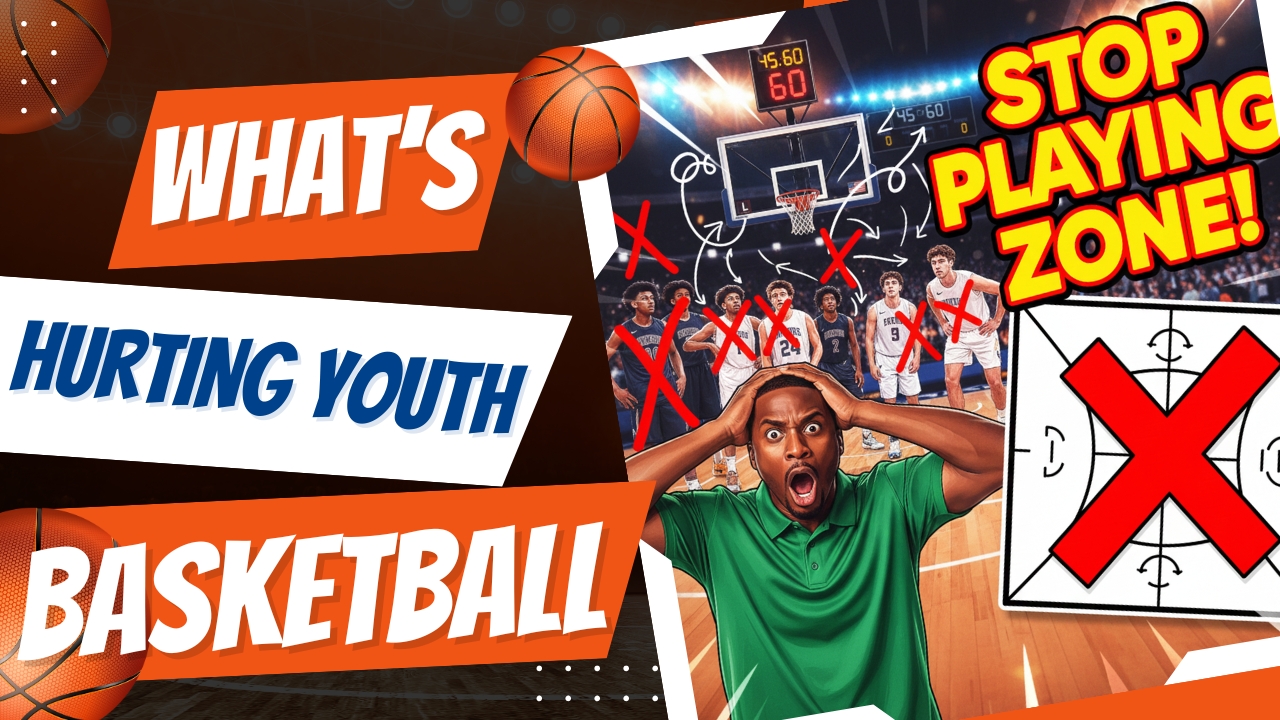
Why You Shouldn't Play Zone Defense in Youth Basketball: The Long-Term Cost of Short-Term Wins
It's Tuesday night, and your youth basketball team just lost by 15 points. Again. The other team ran a packed 2-3 zone that your kids couldn't figure out. They stood around the perimeter, passed the ball sideways a few times, then launched wild three-pointers that had no chance. Meanwhile, your team played honest man-to-man defense, teaching proper fundamentals, and got torched.
As you drive home, you think: "Maybe I should just run a zone too. At least we'd be competitive."
Stop right there.
What you're about to do—what thousands of well-intentioned youth coaches do every season—is prioritize winning 4th grade basketball games over developing players who can actually succeed at the next level. And while zone defense might help you win more games this season, it's setting your players up to fail in the future.
Here's why zone defense is terrible for youth basketball, even though it works in the short term.
Let's be honest: Zone defense works and will win games because young players from first to fifth grade are not strong enough, skilled enough, or experienced enough to exploit a zone.
The reasons zone defense dominates youth basketball are clear:
Players can't shoot from distance: Most youth players lack the strength and coordination to consistently make shots from beyond 15 feet. A zone defense dares them to shoot, knowing they'll miss.
Players can't pass effectively: Most youth and high school players are average passers and have difficulty making good inside passes and accurate skip passes needed to break down a zone.
Players lack basketball IQ: Young players haven't developed the cognitive skills to recognize how zones work, find gaps, or execute proper ball movement.
Players aren't physically developed: They can't throw crisp, hard passes across the court or through tight windows that punish zones.
So yes, if your goal is to win 3rd, 4th, or 5th-grade basketball games, zone defense is extremely effective. Opponents tend to become impatient against the zone and often rush shots, leading to easy wins for the zone defense team.
But here's the problem: Your job as a youth coach isn't to win 9-year-old basketball games. It's to develop players for the future.
And zone defense actively works against that goal on both sides of the ball.
DON’T PLAY ZONE IN YOUTH BASKETBALL 🗣️ 🗣️ 🗣️
— Hoop Herald (@TheHoopHerald) December 9, 2025
(Via @FauxCoachWoodar 🎥)
pic.twitter.com/EcEL5R1K5K
Most youth players have yet to develop strong man-to-man defensive skills, and many youth basketball coaches tend to default to a zone to get cheap wins instead of developing long-term, winning basketball habits.
When you teach zone defense to young players, you're teaching them to develop terrible defensive habits that will haunt them for years.
Here are the poor defensive habits that zone defense promotes in youth players:
1. Standing and Watching: In a zone, defenders often stand in their assigned spot and watch the action rather than actively defending. They learn to be spectators, not defenders.
2. No Closeout Discipline: Zone defenders often start in a set spot, requiring quick reactions to contest shots. Youth players learn to sprint at shooters out of control rather than using proper closeout technique with short, choppy steps.
3. Ball-Watching: Zone defenders fixate on the ball and lose track of cutters, screeners, and off-ball movement because they're not responsible for guarding a specific person.
4. Reduced Accountability: In a zone, players guard areas, not individuals, which can allow players to avoid direct responsibility. When someone scores, whose fault is it? In man-to-man, it's clear. In zone, everyone can blame someone else.
5. Poor Communication: A 2-3 zone at foundational age will deter athletes from learning solid defensive communication habits. Players aren't learning to call out screens, switches, and help situations because they're not tracking individual players.
6. No On-Ball Pressure Skills: Zone defense doesn't teach proper defensive stance, footwork, or how to pressure the ball handler. Players learn to retreat into their zone rather than engage their opponent.
7. Help Defense Misconceptions: Players learn that "help" means standing in the paint waiting for drivers, rather than understanding proper help-side positioning based on ball location and man location.
It can take years to break these bad defensive habits. After players have spent most of their youth basketball career using poor defensive fundamentals, it's very difficult to break the bad habits.
Ask any high school coach who has received a 9th grader who played zone their entire youth career. They'll tell you how frustrating it is trying to teach that player to stay in front of their man, close out under control, or communicate on screens. These aren't things you can teach in a few practices—they're habits that should have been built over years of youth development.
Here's a fact that should matter to every youth coach: As youth players continue to play basketball at higher levels, they will encounter less and less zone. While zone defense is still used frequently at the high school level, it is used much less in college and is even more rare at the professional level.
The NBA has a defensive three-second rule that effectively eliminates traditional zone defenses. College basketball is overwhelmingly man-to-man. Even high school basketball uses zones situationally rather than exclusively.
A player taught man-to-man defense when they're young will have a much easier transition to playing zone defense than a player who plays zone defense exclusively at a young age will have transitioning to man-to-man.
Think about that: Learning man-to-man first allows players to easily adapt to zone later. But learning zone first creates players who struggle with man-to-man for years, if they ever figure it out at all.
No one should be playing zone defense in youth basketball. pic.twitter.com/virBqvHlhw
— Coach Mac 🏀 (@BballCoachMac) February 27, 2024
Here's something most coaches don't consider: Choosing to play zone at the youth level is incredibly selfish and shortsighted.
When you run a zone against another youth team, you're not just hurting your own players' defensive development—you're robbing the other team's players of critical offensive development opportunities.
Ball Movement Under Pressure: They won't get to practice moving the basketball while being pressured. Against a zone, players just swing the ball around the perimeter with no defensive pressure, learning nothing about passing against live defense.
Cutting and Off-Ball Movement: Their cuts are useless because the paint is flooded with five defenders. Players can't learn proper cutting, backdoor plays, or off-ball movement because zones eliminate those opportunities.
Screening: Setting screens to get open is pointless because the defense is leaving them open and waiting for them to shoot anyway. Players never learn proper screen-setting technique or how to use screens effectively.
Driving and Finishing: Young players need repetitions attacking the basket, learning to finish through contact, and developing their driving game. Zone defense forces them to shoot from outside instead.
Decision-Making: Against man-to-man, players learn to read their defender, recognize advantages, and make smart decisions. Against zone, they learn to stand around and chuck threes.
The result? Zone leads to the offensive team standing around and watching the one or two good offensive players over-dribble and attempt tough shots against multiple defenders. This creates bad habits for offensive players and means weaker players touch the ball less, get fewer opportunities to make an impact on the game, and lose the joy of playing.
Something rarely discussed in the man-to-man versus zone defense debate is athleticism. Who is going to develop into a better athlete? Somebody who has to move all over the floor using many different movement patterns, or a defender in a zone who only has to guard in a 7x7 feet box?
Man-to-man defense requires:
Zone defense requires:
Even aggressive zone defenses do NOT develop athleticism the way man-to-man defense does.
Additionally, in a zone defense, defenders are typically stuck in the post area or perimeter area, so they don't learn post and perimeter defense. Your big players never learn to guard on the perimeter. Your guards never learn to defend in the post. This creates one-dimensional defenders who struggle when asked to switch or guard multiple positions.
The biggest argument for zone defense is simple: "We need to be competitive. I can't let my team get blown out by 40 points."
This argument has some merit. No youth basketball team should ever lose by any number close to 50 points. Using a zone defense can turn a would-be blowout game that's embarrassing for the players into a closer and more respectable game.
But here's what that argument reveals: Your team is playing against the wrong competition.
If you need to run a zone just to avoid getting destroyed, you shouldn't be playing those teams in the first place. Find competition at your team's level. Organize games with teams that have similar skill development. Create a league with other developmental-focused coaches.
The real issue isn't whether you should run zone defense—it's why your youth basketball system is putting you in situations where 8-year-olds are getting blown out by 50 points.
With the instant gratification of winning now and the need to please parents, coaches end up coaching for the outcome rather than the process. And this does hurt youth players' development in the long run.
We get it. Parents want to see their kids win. Winning feels good. Nobody enjoys losing.
But youth basketball isn't about winning championships. It's about developing players who can compete at higher levels. And the harsh truth is that winning games by running zone defense in 4th grade doesn't correlate with success in 8th grade, high school, or beyond.
In fact, teams that focus on man-to-man fundamentals often lose more games early but dominate later. You may not win as many games at first, but you'll start winning more games by 7th and 8th grade as long as man-to-man defense principles are taught consistently.
Under the current system, most coaches get the burden of having to teach skills, zone offense, man offense, press breakers, and defense with limited practice time. Some coaches only get one hour per week.
Here's the math problem: You have extremely limited practice time with youth players. You need to teach:
Now add teaching zone offense AND zone defense to that list. What gets sacrificed?
Fundamental skill development—the very thing youth players need most.
If you play zone defense exclusively (no man-to-man), you can save practice time as zone defense is easier to teach. That sounds great until you realize you're saving time by NOT teaching the defensive skills players actually need to develop.
Zone defense takes 10 minutes to teach: "Stand here, match up to your area, don't leave your spot." Man-to-man defense takes weeks or months to teach properly: stance, footwork, positioning, angles, help-side principles, closeouts, fighting through screens.
But which one creates better basketball players?
Some coaches argue: "Well, I teach zone defense with proper fundamentals. My players still learn closeouts, communication, and help defense."
If a coach had enough time and knowledge to teach and instill proper man-to-man principles, the use of a zone from time to time would not necessarily be setting players back in their defensive fundamentals.
But here's the reality: Most youth coaches are volunteers with limited time and basketball knowledge. They barely have any time to educate themselves on how to teach basketball to youth players. Nobody educates them on age-appropriate skills and how kids learn.
The typical scenario goes like this: A coach sees another team playing zone and sees how much trouble it's giving the opposing team. Next, the coach implements the zone defense and realizes it only takes a few minutes a day to practice. Games are closer and you might be winning a few games you shouldn't. So the coach decides to stick with zone defense.
The result? Players who dominate youth basketball by standing in zones, then struggle mightily when they face real competition that can shoot and pass.
Zone defense forces young players to attempt shots well outside their effective range before they're physically ready.
Think about the 3rd or 4th grader facing a zone. They can't drive through it. They can't make the passes to break it down. So what do they do?
They heave three-pointers from 20 feet, using every ounce of strength just to reach the basket.
These become the shooters that seem to shoot from their hip and may have range but are not able to get their shot off against solid defense. Then high school coaches have to spend time altering their shooting form to make it more consistent with a quicker release.
Zone defense at the youth level creates players with terrible shooting mechanics because they learned to shoot before they were physically developed enough to do it with proper form.
The answer is straightforward, even if it's not easy:
I can promise you that in the long run, you will develop better basketball players by playing man-to-man defense.
Focus your defensive teaching on:
These are the fundamentals that translate to every level of basketball.
If your team can't compete without running zone, you're playing the wrong opponents. Seek out teams at similar developmental levels where games will be competitive even with man-to-man defense.
Spend time in practice teaching inexperienced athletes defensive communication basics. Teach them how to turn around at half court, point at their player, and say who they're supposed to be guarding. Teach them how to say "I got ball" and stand between their player and the basket.
These fundamental communications skills are far more valuable than learning zone rotations.
Help parents understand that development takes priority over winning at the youth level. Show them that teams focused on fundamentals might lose more games initially but produce better players long-term.
Players should play 3v3 games, not 5v5, until they are 10 years old or older. Small-sided games give players more touches, more decision-making opportunities, and more space to develop skills.
In 3v3, zone defense is nearly impossible to run effectively, forcing coaches to teach proper defensive principles.
I love the game, and I want every person who chooses to pursue basketball to enjoy the richness of the game. I want to protect the players, protect the coaches, and protect the game.
Zone defense in youth basketball prioritizes short-term wins over long-term player development. It creates bad defensive habits, robs players of offensive development opportunities, stunts athletic growth, and fails to prepare players for higher levels of competition.
Yes, it works. Yes, it wins games. Yes, it's easier to teach.
But that doesn't make it right.
Your job as a youth coach is to develop basketball players, not to win 4th-grade championships. And that means having the courage to teach man-to-man defense even when other teams are running zones and beating you.
Teaching a zone at youth levels does not lay the defensive foundation required to be successful at the higher levels. High school coaches are frustrated when they receive players who spent their youth careers standing in zones with their hands up, never learning proper closeouts, help-side defense, or communication.
Don't be that coach who prioritizes winning now over developing players for the future.
Teach man-to-man. Focus on fundamentals. Find appropriate competition. And give your players the defensive foundation they need to succeed at the next level.
The wins will come eventually. And when they do, they'll be built on proper habits that translate to long-term success rather than short-term gimmicks that create players who struggle once the competition gets real.
1015
Why You Shouldn't Play Zone Defense in Youth Basketball: The Long-Term Cost of Short-Term Wins
It's Tuesday night, and your youth basketball team just lost by 15 points. Again. The other team ran a packed 2-3 zone that your kids couldn't figure out. They stood around the perimeter, passed the ball sideways a few times, then launched wild three-pointers that had no chance. Meanwhile, your team played honest man-to-man defense, teaching proper fundamentals, and got torched.
As you drive home, you think: "Maybe I should just run a zone too. At least we'd be competitive."
Stop right there.
What you're about to do—what thousands of well-intentioned youth coaches do every season—is prioritize winning 4th grade basketball games over developing players who can actually succeed at the next level. And while zone defense might help you win more games this season, it's setting your players up to fail in the future.
Here's why zone defense is terrible for youth basketball, even though it works in the short term.
Let's be honest: Zone defense works and will win games because young players from first to fifth grade are not strong enough, skilled enough, or experienced enough to exploit a zone.
The reasons zone defense dominates youth basketball are clear:
Players can't shoot from distance: Most youth players lack the strength and coordination to consistently make shots from beyond 15 feet. A zone defense dares them to shoot, knowing they'll miss.
Players can't pass effectively: Most youth and high school players are average passers and have difficulty making good inside passes and accurate skip passes needed to break down a zone.
Players lack basketball IQ: Young players haven't developed the cognitive skills to recognize how zones work, find gaps, or execute proper ball movement.
Players aren't physically developed: They can't throw crisp, hard passes across the court or through tight windows that punish zones.
So yes, if your goal is to win 3rd, 4th, or 5th-grade basketball games, zone defense is extremely effective. Opponents tend to become impatient against the zone and often rush shots, leading to easy wins for the zone defense team.
But here's the problem: Your job as a youth coach isn't to win 9-year-old basketball games. It's to develop players for the future.
And zone defense actively works against that goal on both sides of the ball.
DON’T PLAY ZONE IN YOUTH BASKETBALL 🗣️ 🗣️ 🗣️
— Hoop Herald (@TheHoopHerald) December 9, 2025
(Via @FauxCoachWoodar 🎥)
pic.twitter.com/EcEL5R1K5K
Most youth players have yet to develop strong man-to-man defensive skills, and many youth basketball coaches tend to default to a zone to get cheap wins instead of developing long-term, winning basketball habits.
When you teach zone defense to young players, you're teaching them to develop terrible defensive habits that will haunt them for years.
Here are the poor defensive habits that zone defense promotes in youth players:
1. Standing and Watching: In a zone, defenders often stand in their assigned spot and watch the action rather than actively defending. They learn to be spectators, not defenders.
2. No Closeout Discipline: Zone defenders often start in a set spot, requiring quick reactions to contest shots. Youth players learn to sprint at shooters out of control rather than using proper closeout technique with short, choppy steps.
3. Ball-Watching: Zone defenders fixate on the ball and lose track of cutters, screeners, and off-ball movement because they're not responsible for guarding a specific person.
4. Reduced Accountability: In a zone, players guard areas, not individuals, which can allow players to avoid direct responsibility. When someone scores, whose fault is it? In man-to-man, it's clear. In zone, everyone can blame someone else.
5. Poor Communication: A 2-3 zone at foundational age will deter athletes from learning solid defensive communication habits. Players aren't learning to call out screens, switches, and help situations because they're not tracking individual players.
6. No On-Ball Pressure Skills: Zone defense doesn't teach proper defensive stance, footwork, or how to pressure the ball handler. Players learn to retreat into their zone rather than engage their opponent.
7. Help Defense Misconceptions: Players learn that "help" means standing in the paint waiting for drivers, rather than understanding proper help-side positioning based on ball location and man location.
It can take years to break these bad defensive habits. After players have spent most of their youth basketball career using poor defensive fundamentals, it's very difficult to break the bad habits.
Ask any high school coach who has received a 9th grader who played zone their entire youth career. They'll tell you how frustrating it is trying to teach that player to stay in front of their man, close out under control, or communicate on screens. These aren't things you can teach in a few practices—they're habits that should have been built over years of youth development.
Here's a fact that should matter to every youth coach: As youth players continue to play basketball at higher levels, they will encounter less and less zone. While zone defense is still used frequently at the high school level, it is used much less in college and is even more rare at the professional level.
The NBA has a defensive three-second rule that effectively eliminates traditional zone defenses. College basketball is overwhelmingly man-to-man. Even high school basketball uses zones situationally rather than exclusively.
A player taught man-to-man defense when they're young will have a much easier transition to playing zone defense than a player who plays zone defense exclusively at a young age will have transitioning to man-to-man.
Think about that: Learning man-to-man first allows players to easily adapt to zone later. But learning zone first creates players who struggle with man-to-man for years, if they ever figure it out at all.
No one should be playing zone defense in youth basketball. pic.twitter.com/virBqvHlhw
— Coach Mac 🏀 (@BballCoachMac) February 27, 2024
Here's something most coaches don't consider: Choosing to play zone at the youth level is incredibly selfish and shortsighted.
When you run a zone against another youth team, you're not just hurting your own players' defensive development—you're robbing the other team's players of critical offensive development opportunities.
Ball Movement Under Pressure: They won't get to practice moving the basketball while being pressured. Against a zone, players just swing the ball around the perimeter with no defensive pressure, learning nothing about passing against live defense.
Cutting and Off-Ball Movement: Their cuts are useless because the paint is flooded with five defenders. Players can't learn proper cutting, backdoor plays, or off-ball movement because zones eliminate those opportunities.
Screening: Setting screens to get open is pointless because the defense is leaving them open and waiting for them to shoot anyway. Players never learn proper screen-setting technique or how to use screens effectively.
Driving and Finishing: Young players need repetitions attacking the basket, learning to finish through contact, and developing their driving game. Zone defense forces them to shoot from outside instead.
Decision-Making: Against man-to-man, players learn to read their defender, recognize advantages, and make smart decisions. Against zone, they learn to stand around and chuck threes.
The result? Zone leads to the offensive team standing around and watching the one or two good offensive players over-dribble and attempt tough shots against multiple defenders. This creates bad habits for offensive players and means weaker players touch the ball less, get fewer opportunities to make an impact on the game, and lose the joy of playing.
Something rarely discussed in the man-to-man versus zone defense debate is athleticism. Who is going to develop into a better athlete? Somebody who has to move all over the floor using many different movement patterns, or a defender in a zone who only has to guard in a 7x7 feet box?
Man-to-man defense requires:
Zone defense requires:
Even aggressive zone defenses do NOT develop athleticism the way man-to-man defense does.
Additionally, in a zone defense, defenders are typically stuck in the post area or perimeter area, so they don't learn post and perimeter defense. Your big players never learn to guard on the perimeter. Your guards never learn to defend in the post. This creates one-dimensional defenders who struggle when asked to switch or guard multiple positions.
The biggest argument for zone defense is simple: "We need to be competitive. I can't let my team get blown out by 40 points."
This argument has some merit. No youth basketball team should ever lose by any number close to 50 points. Using a zone defense can turn a would-be blowout game that's embarrassing for the players into a closer and more respectable game.
But here's what that argument reveals: Your team is playing against the wrong competition.
If you need to run a zone just to avoid getting destroyed, you shouldn't be playing those teams in the first place. Find competition at your team's level. Organize games with teams that have similar skill development. Create a league with other developmental-focused coaches.
The real issue isn't whether you should run zone defense—it's why your youth basketball system is putting you in situations where 8-year-olds are getting blown out by 50 points.
With the instant gratification of winning now and the need to please parents, coaches end up coaching for the outcome rather than the process. And this does hurt youth players' development in the long run.
We get it. Parents want to see their kids win. Winning feels good. Nobody enjoys losing.
But youth basketball isn't about winning championships. It's about developing players who can compete at higher levels. And the harsh truth is that winning games by running zone defense in 4th grade doesn't correlate with success in 8th grade, high school, or beyond.
In fact, teams that focus on man-to-man fundamentals often lose more games early but dominate later. You may not win as many games at first, but you'll start winning more games by 7th and 8th grade as long as man-to-man defense principles are taught consistently.
Under the current system, most coaches get the burden of having to teach skills, zone offense, man offense, press breakers, and defense with limited practice time. Some coaches only get one hour per week.
Here's the math problem: You have extremely limited practice time with youth players. You need to teach:
Now add teaching zone offense AND zone defense to that list. What gets sacrificed?
Fundamental skill development—the very thing youth players need most.
If you play zone defense exclusively (no man-to-man), you can save practice time as zone defense is easier to teach. That sounds great until you realize you're saving time by NOT teaching the defensive skills players actually need to develop.
Zone defense takes 10 minutes to teach: "Stand here, match up to your area, don't leave your spot." Man-to-man defense takes weeks or months to teach properly: stance, footwork, positioning, angles, help-side principles, closeouts, fighting through screens.
But which one creates better basketball players?
Some coaches argue: "Well, I teach zone defense with proper fundamentals. My players still learn closeouts, communication, and help defense."
If a coach had enough time and knowledge to teach and instill proper man-to-man principles, the use of a zone from time to time would not necessarily be setting players back in their defensive fundamentals.
But here's the reality: Most youth coaches are volunteers with limited time and basketball knowledge. They barely have any time to educate themselves on how to teach basketball to youth players. Nobody educates them on age-appropriate skills and how kids learn.
The typical scenario goes like this: A coach sees another team playing zone and sees how much trouble it's giving the opposing team. Next, the coach implements the zone defense and realizes it only takes a few minutes a day to practice. Games are closer and you might be winning a few games you shouldn't. So the coach decides to stick with zone defense.
The result? Players who dominate youth basketball by standing in zones, then struggle mightily when they face real competition that can shoot and pass.
Zone defense forces young players to attempt shots well outside their effective range before they're physically ready.
Think about the 3rd or 4th grader facing a zone. They can't drive through it. They can't make the passes to break it down. So what do they do?
They heave three-pointers from 20 feet, using every ounce of strength just to reach the basket.
These become the shooters that seem to shoot from their hip and may have range but are not able to get their shot off against solid defense. Then high school coaches have to spend time altering their shooting form to make it more consistent with a quicker release.
Zone defense at the youth level creates players with terrible shooting mechanics because they learned to shoot before they were physically developed enough to do it with proper form.
The answer is straightforward, even if it's not easy:
I can promise you that in the long run, you will develop better basketball players by playing man-to-man defense.
Focus your defensive teaching on:
These are the fundamentals that translate to every level of basketball.
If your team can't compete without running zone, you're playing the wrong opponents. Seek out teams at similar developmental levels where games will be competitive even with man-to-man defense.
Spend time in practice teaching inexperienced athletes defensive communication basics. Teach them how to turn around at half court, point at their player, and say who they're supposed to be guarding. Teach them how to say "I got ball" and stand between their player and the basket.
These fundamental communications skills are far more valuable than learning zone rotations.
Help parents understand that development takes priority over winning at the youth level. Show them that teams focused on fundamentals might lose more games initially but produce better players long-term.
Players should play 3v3 games, not 5v5, until they are 10 years old or older. Small-sided games give players more touches, more decision-making opportunities, and more space to develop skills.
In 3v3, zone defense is nearly impossible to run effectively, forcing coaches to teach proper defensive principles.
I love the game, and I want every person who chooses to pursue basketball to enjoy the richness of the game. I want to protect the players, protect the coaches, and protect the game.
Zone defense in youth basketball prioritizes short-term wins over long-term player development. It creates bad defensive habits, robs players of offensive development opportunities, stunts athletic growth, and fails to prepare players for higher levels of competition.
Yes, it works. Yes, it wins games. Yes, it's easier to teach.
But that doesn't make it right.
Your job as a youth coach is to develop basketball players, not to win 4th-grade championships. And that means having the courage to teach man-to-man defense even when other teams are running zones and beating you.
Teaching a zone at youth levels does not lay the defensive foundation required to be successful at the higher levels. High school coaches are frustrated when they receive players who spent their youth careers standing in zones with their hands up, never learning proper closeouts, help-side defense, or communication.
Don't be that coach who prioritizes winning now over developing players for the future.
Teach man-to-man. Focus on fundamentals. Find appropriate competition. And give your players the defensive foundation they need to succeed at the next level.
The wins will come eventually. And when they do, they'll be built on proper habits that translate to long-term success rather than short-term gimmicks that create players who struggle once the competition gets real.
1015
Basketball Resources
3.1K
Basketball Resources
2.8K