St. Frances Academy Claims First-Ever Overtime Nationals Championship: Baltimore's Defensive Dynasty and the Fight for a Real High School Playoff
The Coronation in Baltimore
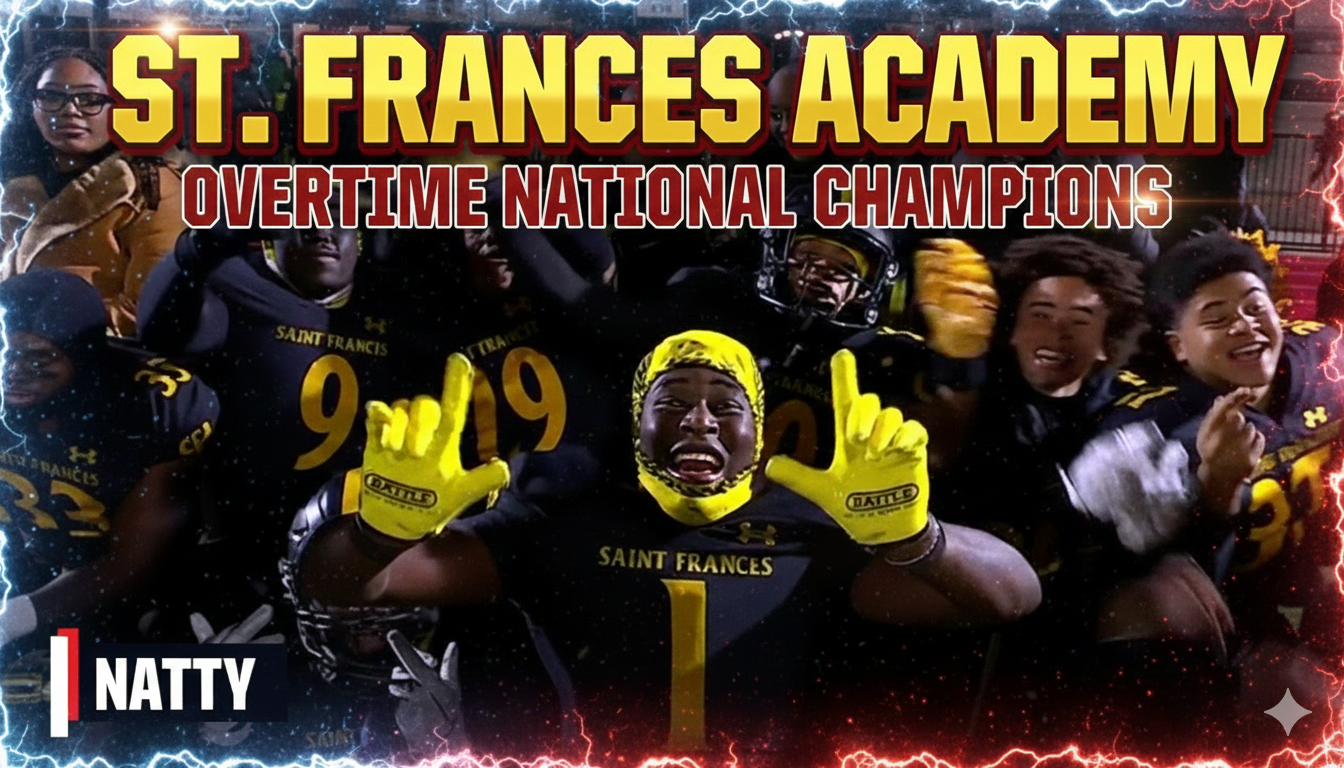
St. Frances Academy defeated Corner Canyon 37-20 Wednesday night at Under Armour Stadium, capturing the inaugural Overtime Nationals High School Football Championship and securing a $250,000 donation for their athletic program. For Baltimore, it was historic—the city's first-ever nationally recognized football title and the first time Maryland has produced a national champion.
But the celebration comes with an asterisk, a controversy, and a growing chorus asking: Is this really a national championship, or just another mythical crown in a sport desperately crying out for a real playoff system?
The Defensive Masterclass
If you watched Wednesday night's game, one thing became abundantly clear: St. Frances Academy possesses one of the greatest high school defenses ever assembled. The Panthers allowed just 67 points through their first nine games, and they made Corner Canyon—a team averaging 48.2 points per game—look completely overmatched.
St. Frances led 21-0 after the first 24 minutes, then extended it to 28-0 midway through the third quarter. While the final score suggests a closer game, anyone watching knew it was never in doubt. The Panthers' defense suffocated every Corner Canyon drive with precision and ferocity.
The Elite Talent: Where Are They Going?
St. Frances isn't just winning—they're sending an extraordinary pipeline of talent to college football's biggest programs. Eleven Panthers have signed with or committed to Power Four programs, headlined by two five-star prospects in the 2026 recruiting class.
Zion Elee - The crown jewel of St. Frances' roster and the ninth-highest ranked player in the country for the 2026 class. The five-star edge rusher is the No. 1 overall prospect in the Rivals Industry Rankings and has officially signed with Maryland. After keeping his recruitment open into early 2025, Elee told ESPN he chose to stay home because "Maryland is already home".
Jireh Edwards - The No. 35 ranked player from the 2026 recruiting class, a safety who signed with Maryland alongside Elee.
DQ Forkpa - The four-star linebacker transferred to St. Frances from Mill Creek over the offseason and officially signed with North Carolina. His addition gave the Panthers arguably the best front seven in the country.
Raylaun Henry - The No. 49 overall prospect nationally and a five-star cornerback in the 2027 class, committed to Texas A&M.
Jayden Travers - In a dramatic announcement during the Overtime Nationals broadcast, the class of 2027 defensive lineman committed to Nebraska on Wednesday night.
Maryland is receiving four St. Frances players from the class of 2026, the most in program history from a single school. St. Frances coach Messay Hailemariam emphasized his goal to "have this whole community stay and build from inside out", keeping elite Baltimore talent home rather than watching it scatter to national powers.
The IMG Academy Controversy: Did They Duck the Real Championship?
The Overtime Nationals exists largely because of what many perceive as IMG Academy backing out of what should have been the definitive national championship game. Originally scheduled for November 7, IMG announced days before kickoff that the game "would not be played as scheduled".
When the game was rescheduled to December 10 to accommodate national television coverage, IMG cited "concerns around player health and safety and the college transition for our seniors" due to the nearly six-week layoff. The official statement emphasized that seniors departing for early enrollment at their college programs made the extended break problematic.
But many in the high school football community aren't buying it. Critics believe Florida powerhouse IMG Academy "ducked" the December matchup with St. Frances, opening the door for Corner Canyon to step in instead.
The context matters: St. Frances and IMG have met six previous times since 2021, with each team winning three games. Last year, St. Frances dominated IMG 30-3 in Baltimore. With St. Frances looking even more dominant this season—particularly on defense—IMG may have seen the writing on the wall and chosen to preserve an undefeated record rather than risk a loss that could cost them national title consideration.
The timing is suspicious. IMG finished undefeated and is currently ranked in the top two nationally by multiple services, yet they declined to play the one game that could have definitively settled the championship on the field.
Is Corner Canyon a Legitimate Opponent?
This brings us to the uncomfortable question hanging over Wednesday's championship: Was Corner Canyon really a worthy opponent for a national title game?
Corner Canyon is ranked No. 21 nationally, making this a matchup between the No. 3 team (St. Frances) and a squad outside the top 20. Even if Corner Canyon had won, they could not claim the national championship title due to their ranking.
The Chargers are undeniably an elite program—winners of three consecutive Utah Class 6A state championships and a legitimate regional powerhouse. Coach Eric Kjar's career record with the program stands at 112-9 with seven state titles, tied for second-most in Utah history.
But there's Utah football, and then there's national-level competition. Corner Canyon's loss this season was a 42-21 blowout to Lone Peak, a team that finished with five losses, including defeats to other five-loss teams. When you compare that resume to teams like Carrollton (GA), Buford (GA), or even the team that beat St. Frances—St. John Bosco (CA)—the gap is obvious.
Corner Canyon head coach Eric Kjar acknowledged after the loss: "They deserve everything they get", speaking of St. Frances' dominance. The Chargers were outmatched in every phase, particularly on both lines of scrimmage.
The Top Programs Left Out of the Conversation
The inaugural Overtime Nationals highlights a fundamental problem with high school football's national championship structure: there isn't one. Multiple legitimate contenders for the national title didn't get a chance to prove it on the field.
IMG Academy (FL) - Finished undefeated but declined to play St. Frances in what would have been the definitive title game. Currently ranked No. 1 by multiple services, but their claim feels hollow after ducking the matchup.
Carrollton (GA) - If Carrollton wins the Georgia Class 6A state championship, they could have a legitimate claim to the national title. The Trojans' schedule and resume through Georgia's brutal playoff system would rival anyone's.
Buford (GA) - Another Georgia powerhouse that could stake a claim if they win the state title. Georgia football at the highest classification is essentially a mini-national playoff already.
St. John Bosco (CA) - The only team to beat St. Frances this season, defeating them 21-14 in early September. At the time, Bosco was the consensus No. 1 team in the nation. However, the Braves later lost to Mater Dei 36-31 and then suffered a stunning 20-19 upset to Orange Lutheran in the playoffs, which damaged their national title case.
Southlake Carroll (TX) - If Southlake Carroll beats their upcoming opponents and wins the Texas Class 6A Division II state title, they could move ahead of St. Frances in several rankings.
Mater Dei (CA) - Perennial California powerhouse that beat St. John Bosco and has a legitimate argument for the top spot.
The problem is clear: Determining the high school football national champion still relies on "the mythical nature" of individual selectors—some chosen by human committees, others by computer algorithms like the Massey Ratings. There's no College Football Playoff equivalent, no Super Bowl, no definitive on-field resolution.
What's Next for High School Football's National Championship?
The Overtime Nationals is an ambitious start, but it's just that—a start. Overtime General Manager Hunter Mandel has a vision of expanding the tournament from this single game to anywhere from four to 16 teams.
The challenges are substantial. Fifty states mean 50 different associations, with 50 different schedules and playoff formats. Some states finish their seasons in November, others in December. Coordinating a multi-team playoff would require unprecedented cooperation between state associations, schools, and television partners.
But the appetite is clearly there. Overtime General Manager Hunter Mandel stated: "The inaugural Overtime Nationals delivered exactly what we set out to build—a true national stage where the country's best high school football programs can compete for something meaningful".
Wednesday's game, broadcast on ESPN2 from a 1,400-seat stadium, proved that there's demand for a definitive national championship. The production quality was elite, the stakes were real (that $250,000 check matters for any high school program), and the game showcased legitimate national-level talent.
The Bigger Picture: Does Format Matter?
Here's the fundamental question: Is the current system—where national championships are determined by polls and computer rankings—fundamentally unfair to elite programs?
Absolutely.
St. Frances Academy went 9-1, with their only loss to a team that was briefly ranked No. 1 nationally. They scheduled aggressively, traveling to California to play St. John Bosco rather than padding their record against local competition. They dominated every opponent except Bosco, allowing fewer than eight points per game. They feature multiple five-star recruits and a defense that might be the best in high school football history.
Yet even after winning the Overtime Nationals, they aren't likely to be named national champions by all individual selectors in composite rankings. IMG Academy, which refused to play them, could still claim a share of the national title simply by remaining undefeated.
This is absurd.
Compare this to college football, which—after decades of a similar poll-based system—finally implemented the College Football Playoff. The playoff isn't perfect, and debates about who deserves inclusion continue, but at least the championship is decided on the field. The best teams play each other, and a winner emerges.
High school football deserves the same. Programs like St. Frances, IMG, Mater Dei, St. John Bosco, and the Georgia powerhouses schedule national games and compete at an elite level. They recruit nationally, develop NFL-caliber talent, and operate more like college programs than traditional high schools.
These programs are being left out not because they're not good enough, but because there's no structure to accommodate them. State associations understandably focus on in-state competition, but when teams like St. Frances travel across the country for games and develop a national profile, the current system fails them.
🏆CHAMPS🏆 St. Frances Academy (MD) beats Corner Canyon (UT) 37-20 in the first-ever Overtime Nationals Championship.
— Rivals High School (@RivalsHS) December 11, 2025
Recap: https://t.co/uTHJslhYNR pic.twitter.com/TIgAPsLtUj
St. Frances' Legacy: Building Baltimore's Football Identity
Beyond the national championship debate, St. Frances Academy has accomplished something remarkable for Baltimore. The school founded its football program in 2008 with the help of Biff Poggi, who led the team starting in 2017. Since then, the Panthers have finished among MaxPreps' top 25 high school football teams six times in the last 10 years.
This isn't just about winning games—it's about keeping Baltimore talent at home and building a pipeline to college football. The University of Maryland has recruited from St. Frances in the past, landing touted prospects such as offensive tackle Jaelyn Duncan and linebacker Jaishawn Barham, but never at this volume.
Coach Messay Hailemariam's vision of building from within is working. Elite players are choosing to stay in Baltimore, compete at the highest level, and then represent their city at Maryland and other Power Four programs. That's a sustainable model that benefits everyone: the players get elite development and exposure, Maryland gets hometown talent, and Baltimore gets a program that can compete with anyone in the country.
Conclusion: Mythical No More?
St. Frances Academy is the inaugural Overtime Nationals champion. They have the trophy, the $250,000 check, and the satisfaction of dominating their opponent on national television. But are they the national champion?
The honest answer is: it depends who you ask.
Until high school football implements a true playoff system—one that brings together the elite programs from across the country in a bracketed tournament—we'll continue to have mythical champions and unsettled debates. The Overtime Nationals is a promising start, but it's incomplete.
What we do know is this: St. Frances Academy possesses one of the greatest high school defenses ever assembled, sent eleven players to Power Four programs, and dominated everyone they faced except St. John Bosco. They scheduled aggressively, accepted challenges from national opponents, and never backed down.
That's championship behavior, regardless of what any poll says.
The question isn't whether St. Frances deserves recognition—they do. The question is whether high school football will finally give its elite programs the structure they deserve: a real playoff, a definitive champion, and an end to the mythical era.
For now, Baltimore can celebrate. The rest of high school football should be taking notes.