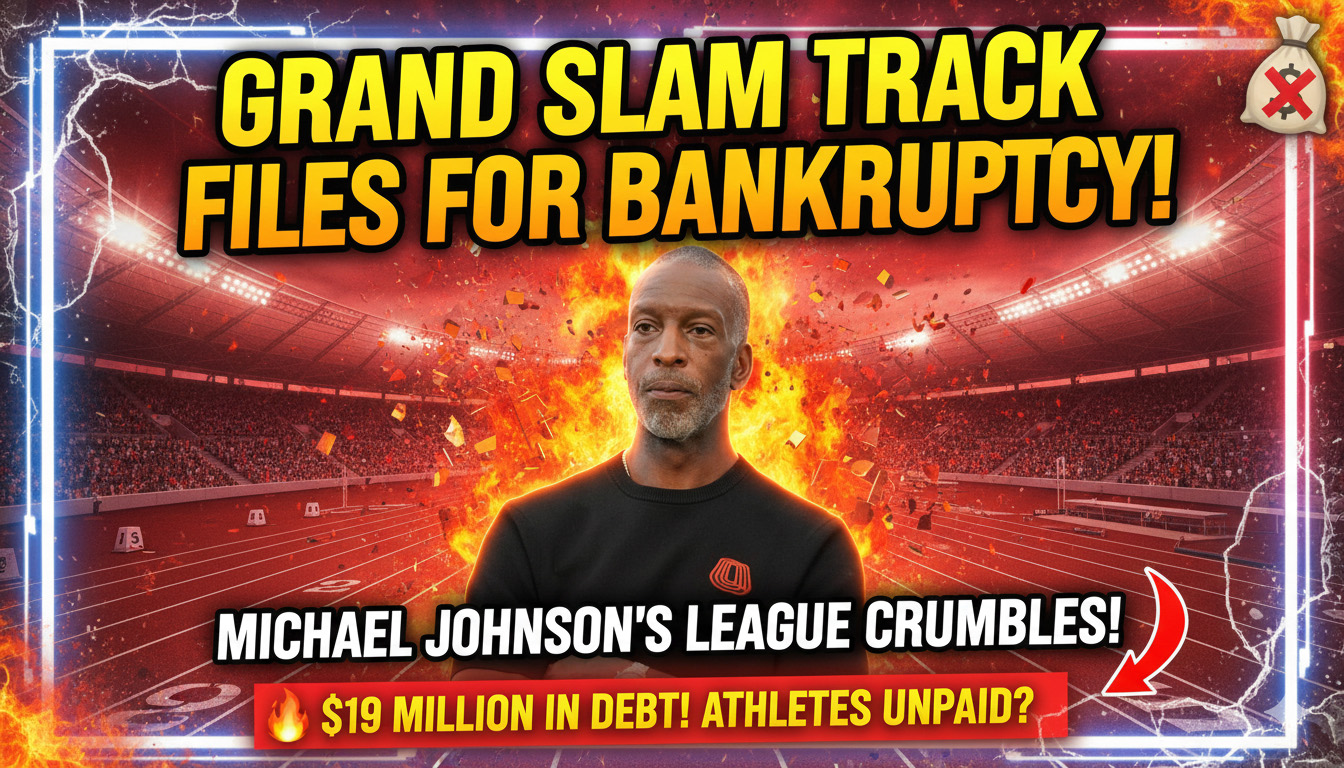
Grand Slam Track Files for Bankruptcy: How Michael Johnson's $30M Track Revolution Collapsed in One Season
The Olympic Legend's Bold Vision Crumbles Under $19M in Debt
LOS ANGELES — Grand Slam Track, the professional track and field league founded by four-time Olympic gold medalist Michael Johnson, filed for Chapter 11 bankruptcy protection Thursday, marking a stunning collapse for a venture that promised to revolutionize the sport just months ago.
The bankruptcy petition reveals a financial catastrophe: Grand Slam Track holds under $50,000 in assets while carrying between $10 million and $50 million in liabilities, with an estimated 200 to 999 creditors. The league owes approximately $19 million to athletes and vendors, leaving world-class competitors who signed on to Johnson's vision waiting for payment months after competing.
For Johnson, the 58-year-old sprinting icon who once dominated the 200m and 400m, the bankruptcy represents a painful reality check. When he launched Grand Slam Track in 2024, he boldly declared he could "save track." Today, he's overseeing a court-supervised reorganization while insisting he hasn't given up on his mission.
Grand Slam Track, the high-profile track & field startup league that promised to revolutionize the sport with a record-setting $12.6 million prize pool and major backing, has officially filed for Chapter 11 bankruptcy.
— CITIUS MAG (@CitiusMag) December 11, 2025
At launch, Grand Slam boasted $30M in funding, headlined by… pic.twitter.com/c46UH2cgsC
The Ambitious Vision: Transforming Track and Field
Johnson's concept was ambitious and, on paper, revolutionary. Grand Slam Track was designed to have four "slams" or meets throughout the season, with six event categories in which athletes could race for points and money. Winners of each race category would receive $100,000, with contracted athletes also receiving guaranteed salaries.
The model aimed to address track and field's fundamental problem: outside of Olympic years, elite athletes have few opportunities to compete for significant prize money and exposure. Most professional track meets are scattered, poorly attended, and offer modest payouts. Johnson envisioned a concentrated format featuring elite head-to-head racing that would give the sport consistent visibility and make stars out of his athletes.
Johnson launched the league with at least $30 million in promised funding, boasting partnerships with investors including Winners Alliance, hedge fund manager Bill Ackman, and others. The league promised a total prize pool of $12.6 million for the 2025 season.
The broadcast strategy seemed solid too. Grand Slam Track secured agreements with The CW network for over-the-air coverage and Peacock for streaming, giving the league mainstream visibility most track events never achieve.
Star power wasn't an issue either. The inaugural season featured Olympic champions Sydney McLaughlin-Levrone, Gabby Thomas, Kenny Bednarek, and Melissa Jefferson-Wooden, along with British stars Josh Kerr, Matthew Hudson-Smith, and Zharnel Hughes. These weren't B-list athletes—they were Olympic medalists and world champions.
On paper, Grand Slam Track had everything: funding, broadcast deals, star athletes, and a legendary founder. What could go wrong?
The Catastrophic Unraveling
Everything.
The inaugural season kicked off in Kingston, Jamaica in April 2025, and problems emerged immediately. Ticket sales were weak for the inaugural event, casting doubt on the concept. The opening meet drew embarrassingly sparse crowds despite featuring Olympic and world champions.
The league held subsequent events in Miramar (Miami) and Philadelphia, with attendance improving somewhat. But the league had to shorten the Philadelphia meet from three days to two, a troubling sign of financial strain.
Then came the knockout blow: Just two weeks before the season finale was scheduled at UCLA's Drake Stadium in Los Angeles, Grand Slam Track canceled the event. At the time, Johnson cited various reasons including venue issues and the "geopolitical climate of LA," but Johnson later admitted the cancellation was due to money problems.
The truth was far worse than initially disclosed.
The Investor Who Vanished
Johnson revealed to Front Office Sports that a key investor backed out of their full commitment, creating what he called "a major, major cash flow issue". The timing couldn't have been worse.
According to sources, the investor reneged on their eight-figure term sheet just days after attending Grand Slam's April debut in Kingston, saying they planned to invest their money elsewhere after President Donald Trump's tariff announcement.
Reports later identified the investor as Chelsea FC owner Todd Boehly and his firm, Eldridge Industries, who cited concerns such as poor attendance and economic uncertainty stemming from tariffs.
Johnson blamed broader economic volatility, noting "April, we saw a bit of a seismic shift in the economy due to tariffs", though he didn't mention Trump by name. Whether the tariff excuse was legitimate or simply a convenient exit strategy for an investor who saw weak ticket sales and wanted out remains unclear.
Regardless of the reason, the damage was catastrophic. Without the promised funding, Grand Slam Track couldn't meet its financial obligations to athletes or vendors.
Grand Slam Track, the pro track league which promised to revolutionise the sport, has filed for bankruptcy in the United States.
— AW (@AthleticsWeekly) December 11, 2025
This follows a disastrous opening season where the fourth and final event of 2025 – in Los Angeles in June – was cancelled.https://t.co/8Pz4vD1efV
Athletes Left Waiting, Creditors Rejected Settlement Offers
On October 3, the league announced that remaining investors had provided eight figures of emergency financing to pay athletes half of what they were owed. Grand Slam used the emergency funding to send approximately $5.5 million directly to athletes—roughly half of the $11 million they were owed.
Think about that for a moment: Olympic champions and world record holders competed in good faith, delivered performances, and then waited months to receive even 50% of their promised compensation.
Grand Slam then attempted to negotiate with vendors, offering to settle outstanding debts. In late November, Grand Slam Track offered creditors a settlement of 50% of the amounts owed to avoid bankruptcy. But there was a catch: The offer was to pay vendors 50% of total invoices, meaning half of everything they'd ever been owed, rather than half of outstanding debts.
Several vendors rejected Grand Slam's offer, finding the terms unacceptable. World Athletics, reportedly owed nearly $40,000 for licensing fees, rejected the proposal and insisted that athletes be prioritized.
With creditors unwilling to accept the settlement and no additional funding secured, bankruptcy became inevitable.
The Bankruptcy Filing: A Grim Financial Picture
Grand Slam Track filed for Chapter 11 bankruptcy protection in Delaware in December 2025, choosing reorganization over liquidation. The case has been assigned to Chief Judge Karen B. Owens of the U.S. Bankruptcy Court for the District of Delaware.
The numbers paint a devastating picture:
Assets: Under $50,000
Liabilities: Between $10 million and $50 million
Creditors: Between 200 and 999
Total Owed: Approximately $19 million to athletes and vendors
For context, Grand Slam Track now has roughly the same assets as a modestly successful food truck but owes more than most small cities' annual budgets.
Grand Slam has also laid off staff, though not its entire workforce. In October, the league had fewer than 10 employees remaining.
Athletes Face an Uncertain Future
The bankruptcy creates a particularly cruel situation for athletes. Athletes are classified as "unsecured creditors," meaning they're likely to be among the last in line to be paid through the court process. Secured creditors like registered businesses and banks get priority.
Under U.S. bankruptcy law, the payments athletes already received could theoretically be subject to clawback if certain conditions are met, though it's unclear if this will actually happen.
Johnson himself acknowledged the painful irony in August: "The cruelest paradox in all of this is we promised that athletes would be fairly and quickly compensated. Yet, here we are struggling with our ability to compensate them".
These weren't just any athletes. They were Olympic champions who chose to compete in Grand Slam Track based on Johnson's promises and reputation. Many likely turned down other opportunities or adjusted training schedules to accommodate the meets. Now they're unsecured creditors in a bankruptcy proceeding.
What Went Wrong? The Post-Mortem
Looking back, multiple factors combined to doom Grand Slam Track:
1. The Attendance Problem
Weak ticket sales at the Kingston opener revealed a fundamental problem: consumers weren't willing to pay to watch track and field, even with star athletes. Track has never been a spectator-driven sport in the modern era outside of major championships and the Olympics. Johnson bet he could change that dynamic; he couldn't.
2. The Investor Collapse
A major investor pulling out after seeing the Kingston attendance numbers created an immediate cash crisis. No amount of television deals or star power could overcome losing tens of millions in expected funding.
3. The Over-Promise
When asked what his biggest mistake was, Johnson admitted "We probably went too fast. We probably need to be more cautious". Grand Slam Track promised $12.6 million in prize money plus athlete salaries before proving the business model worked. That's a massive financial commitment based on projected revenue that never materialized.
4. The Economic Environment
Johnson cited economic volatility and tariff concerns as factors in the investor pullout. Whether legitimate or an excuse, the broader economic uncertainty didn't help a startup sports league trying to disrupt an established (if struggling) sport.
5. The Track and Field Reality
Track and field faces structural challenges no single league can solve: limited mainstream appeal outside Olympic years, lack of rivalries that drive fan engagement, and athletes who peak for specific championship meets rather than grinding through a season.
Can Grand Slam Track Return?
Despite everything, Johnson insists the league isn't dead. "While GST has faced significant challenges that have caused frustrations for many – myself included – I refuse to give up on the mission of Grand Slam Track and the future we are building together", Johnson said in a statement.
The league announced it's entering a "court-supervised reorganization" rather than liquidation, suggesting Johnson still believes Grand Slam Track can be salvaged. Nicholas Rubin, the chief restructuring officer, said the bankruptcy will "allow GST to address its outstanding liabilities while continuing constructive discussions with interested investors".
Johnson claimed the league's successes on linear television and social media had led to new investors approaching the league with funding. In June, sources indicated Grand Slam brought on new investors including Sundial Brands founder Richelieu Dennis and billionaire Robert F. Smith ahead of a potential second season.
Johnson said in August the circuit would not take place in 2026 as planned until athletes waiting to receive prize money for competing in 2025 had been paid. Whether the bankruptcy process will actually result in athletes being made whole remains to be seen.
The Broader Implications for Track and Field
Grand Slam Track's collapse raises uncomfortable questions about professional track and field's viability as a business.
If a league founded by one of the sport's greatest legends, backed by tens of millions in investor capital, featuring Olympic champions, with broadcast deals on major networks, still can't attract paying customers—what hope does track and field have as a commercial enterprise?
The reality is brutal: outside of the Olympics and major world championships, track and field struggles to generate mainstream interest. Americans might watch Sha'Carri Richardson or Noah Lyles at the Olympics, but they're not paying $50 for tickets to watch them run in April.
Grand Slam Track tried to solve this by concentrating talent, guaranteeing matchups between stars, and creating a points-based season structure. It wasn't enough.
Perhaps the sport's economics simply don't support the kind of professional league Johnson envisioned. Track athletes make their money through sponsorships and Olympic success, not from competing in regular-season events. Grand Slam Track tried to change that dynamic and ran into the hard reality that fans won't pay for something they're not interested in watching.
Lessons From a Failed Revolution
Chapter 11 bankruptcy allows Grand Slam Track to work under court supervision to restructure rather than face liquidation, giving Johnson a chance to find new funding and reimagine the league with a sustainable model.
But even if Grand Slam Track returns, the inaugural season serves as a cautionary tale about the gap between vision and execution, between what athletes deserve and what the market will support.
Johnson wanted to "save track." Instead, he may have demonstrated why the sport needs saving in the first place—and why it might be unsaveable as a standalone professional league.
Shortly after canceling the Los Angeles event, the league parted ways with two key executives, suggesting internal turmoil beyond just financial strain.
The athletes who believed in Johnson's vision are now unsecured creditors hoping to recover what they're owed through bankruptcy court. The investors who backed the league are facing significant losses. The vendors who provided services are fighting for payment.
And track and field, the sport Johnson hoped to revolutionize, remains exactly where it was before Grand Slam Track launched: a niche sport with Olympic-year spikes in interest and limited commercial appeal in between.
Conclusion: A Sobering Reality Check
Michael Johnson is a legend—four Olympic gold medals, world records, one of the greatest sprinters in history. His track record (pun intended) is impeccable. But even legends can't overcome fundamental market realities.
Grand Slam Track had everything a startup sports league could want except the one thing that matters most: paying customers willing to sustain the business model.
The league officially launched in June 2024 before its 2025 debut season, giving organizers time to build hype and market the product. The hype was there. The product delivered on paper—Olympic champions competing head-to-head. What didn't materialize was an audience willing to pay for it.
Now Johnson faces the humbling process of restructuring through bankruptcy, hoping to find a path forward that doesn't repeat the mistakes of the first season. Whether that's possible—whether track and field can support a professional league at all—remains an open question.
For now, Grand Slam Track joins a long list of ambitious sports startups that promised to revolutionize their sports but couldn't overcome the economic realities of running a professional league. The difference is this one was founded by an Olympic legend who genuinely believed he could change the game.
He couldn't. And that might be the most sobering lesson of all.