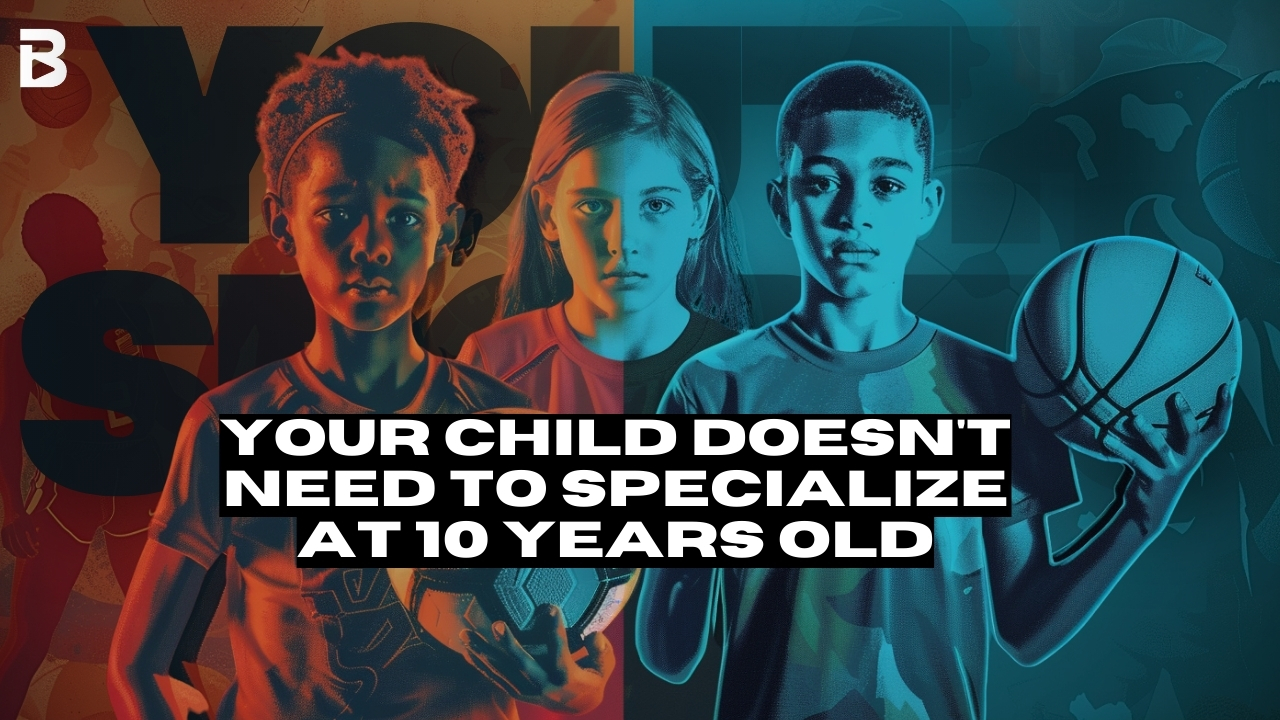
The sport specialization trend that dominated youth sports for 20 years is reversing. Here's what college coaches are telling parents now.
If you've been to a travel sports parent meeting in the last decade, you've heard the pitch: "If your kid wants to play in college, they need to specialize. Pick one sport. Commit now. Play year-round. Start at 10, or you'll be left behind."
For 20 years, that advice shaped youth sports in America. Parents mortgaged their weekends. Kids quit sports they loved. Family calendars became hostage to travel tournaments. The message was clear: specialization = college scholarship.
Then something happened.
College coaches started saying the opposite.
"Give me a three-sport athlete over a year-round specialist any day," says Mike Neighbors, University of Arkansas women's basketball coach. "The multi-sport kids have better instincts, fewer injuries, and they haven't burned out by freshman year."
He's not alone.
From D1 football to softball to soccer, college coaches are actively seeking multi-sport athletes — and they're telling parents the specialization advice they've been following is outdated, dangerous, and statistically wrong.
If your kid is currently playing one sport year-round, or if a travel coach is pressuring you to drop other sports, this is what you need to know.
Parents of young athletes:
— Jeremy Frisch (@JeremyFrisch) October 23, 2023
You're being sold a bill of goods…
Early specialization…
It's a fear campaign…
Its a billion dollar dumpster fire saying:
To become a great athlete you must:
Specialize early…
Train year-round…
Compete often…
If you don’t your child is going… pic.twitter.com/d1WD8R1Yyz
The Numbers That Changed Everything
Here's what college coaches see that travel coaches don't want you to know:
Among NCAA athletes surveyed:
- 88% played multiple sports in high school
- Only 12% specialized before high school
- Multi-sport athletes had a 30% lower injury rate
- Multi-sport athletes were more likely to earn playing time as freshmen
The injury data is even more stark:
The American Orthopaedic Society for Sports Medicine found that young athletes who specialize in one sport are:
- 70% more likely to suffer serious overuse injuries
- 2x more likely to require surgery before age 18
- 3x more likely to be sidelined for extended periods
Dr. James Andrews, one of the nation's leading orthopedic surgeons, operates on youth athletes constantly. His message to parents: "We're seeing injuries in 12-year-olds that we used to only see in 25-year-old professionals. Tommy John surgeries on 14-year-old pitchers. ACL tears in 13-year-old soccer players. These are overuse injuries from playing one sport twelve months a year."
When the surgeon who fixed Tom Brady's knee is telling you to let your kid play multiple sports, you should probably listen.
Patrick Mahomes Played Three Sports — And That's Why He's Patrick Mahomes
The best argument against early specialization isn't statistics. It's Patrick Mahomes.
The three-time Super Bowl champion, two-time MVP, and best quarterback on the planet didn't specialize in football until college.
Mahomes played:
- Football (quarterback)
- Baseball (pitcher - drafted by Detroit Tigers)
- Basketball (point guard)
His father, Pat Mahomes Sr., was a Major League pitcher. He could have pushed Patrick into baseball specialization at age 8. Instead, he encouraged him to play everything.
"Playing basketball made me a better football player," Mahomes has said repeatedly. "The footwork, the court vision, reading defenses in real-time — that came from basketball."
His arm strength? That came from baseball.
His improvisational ability? That came from playing multiple sports and learning to adapt.
The same pattern repeats across elite athletes:
Kyler Murray - Football and baseball through college (Heisman Trophy winner, #1 NFL draft pick, also drafted #9 by Oakland A's)
Russell Wilson - Football and baseball through college (Super Bowl champion, also drafted by Colorado Rockies)
Shohei Ohtani - Baseball and basketball in high school (two-time MVP, revolutionizing baseball)
Elena Delle Donne - Basketball and volleyball (WNBA MVP, 2x Olympic gold medalist)
Christian McCaffrey - Football, basketball, track (NFL All-Pro, his dad played three sports at Stanford)
Notice a pattern? The best athletes in the world played multiple sports as kids.
Not because they couldn't commit. Because playing multiple sports made them better at their primary sport.
Kids should not be allowed to hyper specialize in a sport before the age of 15 or 16 and even then it’s not great
— Cons (@CaptainCons) October 8, 2025
I’ve heard so many all-time pro athletes agree that playing multiple sports allowed the to develop skills that helped them in their eventual top sport
Not to… https://t.co/qA0Ym7wJzu
What College Coaches Actually Want (And It's Not What Travel Coaches Say)
Here's where the disconnect happens between what travel coaches tell you and what college coaches actually want.
Travel coaches have a financial incentive to push specialization. If your kid plays their sport year-round, you're paying:
- Club fees ($2,500-5,000/year)
- Tournament fees ($1,500-3,000/year)
- Travel costs ($3,000-8,000/year)
- Private training ($2,000-10,000/year)
Total: $9,000-26,000 per year for ONE sport.
If your kid quits to play basketball in the winter, that revenue disappears.
College coaches don't have that same incentive. They just want the best athletes. And increasingly, they're finding those athletes played multiple sports.
Here's what D1 coaches told us they look for:
Football (Big Ten defensive coordinator):
"Give me a kid who played basketball or wrestled. They have better footwork, better body control, and they know how to compete in confined spaces. The kids who only played football often look robotic."
Baseball (SEC head coach):
"Show me a pitcher who played basketball. Those kids have better arm paths, better deceleration, and they understand team concepts. The year-round travel ball kids come in with dead arms and no game sense."
Women's Soccer (Pac-12 head coach):
"Multi-sport athletes make decisions faster. They've seen different game situations, different coaching styles, different competitive environments. The soccer-only kids are often tactically rigid."
Women's Basketball (ACC assistant coach):
"If I'm recruiting two guards with similar stats, and one played volleyball or ran track, I'm taking the multi-sport kid every time. Better hand-eye coordination, better conditioning base, and they're not burned out by year three."
The message is consistent: College coaches want athletes, not specialists.
The Age-By-Age Guide: When Specialization Actually Makes Sense
The question isn't whether to specialize. It's when to specialize.
Here's what the research and college coaches recommend:
Ages 6-12: Play Everything
This is the "sampling phase." Kids should be trying multiple sports, developing general athletic skills, and figuring out what they actually enjoy.
What to do:
- Let them play 2-4 different sports per year
- Focus on fun and skill development, not winning
- Change sports by season (soccer in fall, basketball in winter, baseball in spring, swimming in summer)
- Avoid year-round anything
Red flags at this age:
- Any coach telling you "commit now or you'll fall behind"
- Year-round training in one sport
- Missing school for tournaments
- Your kid saying they're "tired" of their sport
Success story: Abby Wambach, two-time Olympic gold medalist and World Cup champion in soccer, played soccer, basketball, and ran track through middle school. She didn't focus solely on soccer until high school.
Ages 13-15: Identify Primary Sport, But Keep Playing Others
This is when kids start to naturally gravitate toward one sport. That's healthy. But they should still play at least one other sport.
What to do:
- Let them identify their "primary" sport
- Encourage them to play at least one other sport
- Focus on position-specific skills in primary sport
- Use secondary sports for general conditioning and mental break
Why this matters:
- Prevents overuse injuries during critical growth years
- Maintains general athleticism
- Reduces burnout risk
- Keeps college options open
Red flag at this age:
- Playing primary sport 11-12 months per year
- Skipping other sports for "optional" practices
- Nagging injuries that don't heal
Success story: Christian McCaffrey played football, basketball, and ran track through high school. He's said the track work made him faster, and basketball improved his vision and cutting ability. Result: Stanford scholarship, #8 NFL draft pick, multiple Pro Bowls.
Ages 16-18: Specialization Can Make Sense (For Most Sports)
By high school, most athletes have identified their college sport. This is when increased focus makes sense.
What to do:
- Focus on primary sport during that season
- Consider playing one other sport during off-season (not mandatory)
- Use off-season for strength training and recovery
- Start recruitment process for primary sport
Sports where earlier specialization may be necessary:
- Gymnastics (peak years are earlier)
- Figure skating (peak years are earlier)
- Swimming (volume of training required)
- Tennis (individual sport dynamics)
Even in these sports, cross-training in other activities helps prevent burnout and injury.
Success story: Sabrina Ionescu, #1 WNBA draft pick, played basketball, volleyball, and ran track through her sophomore year of high school. She didn't specialize in basketball exclusively until junior year. Result: Three-time Wade Trophy winner at Oregon, WNBA champion.
Youth sports have become so transactional, influenced by AAU and agents. This is contributing to problems like the transfer portal & rising player injuries in the NBA. #YouthSports #NBAPlayers pic.twitter.com/iYho8LBMyX
— BushyHeadClothing (@BushyHeadclothe) December 11, 2025
The Injury Epidemic Nobody Wants to Talk About
Dr. Neeru Jayanthi, director of primary care sports medicine at Emory University, has studied youth sports specialization for over a decade.
His findings are terrifying for parents of specialized athletes:
Specialized youth athletes are:
- 36% more likely to suffer serious overuse injuries
- 2x more likely to have hip and knee injuries
- 2.3x more likely to suffer elbow and shoulder injuries (particularly pitchers and quarterbacks)
"The body needs variety," Dr. Jayanthi says. "When you repeat the same motion thousands of times per year during developmental years, you're asking for catastrophic breakdown."
Real examples from orthopedic surgeons:
Dr. James Andrews:
"I'm doing Tommy John surgery on 14-year-old pitchers because they've been throwing year-round since they were 10. Their ligaments literally shred from overuse. I tell parents: let them play basketball in the winter. Their arms need rest."
Dr. Lisa Callahan, Women's Sports Medicine Center, Hospital for Special Surgery:
"We see 13-year-old soccer players with stress fractures in their shins and feet from playing year-round. These are injuries we used to only see in Olympic marathoners. The bone doesn't have time to recover when you're playing 80-100 games per year."
Dr. Mininder Kocher, Boston Children's Hospital:
"ACL tears in middle schoolers have quadrupled in the last 20 years. These kids are playing one sport, making the same cutting movements, overloading the same ligaments, and then they blow out their knee during a routine play."
The medical community is united on this: Year-round specialization is causing an injury epidemic in youth sports.
The Cost Breakdown: What You're Really Paying For
Let's talk money, because this is where the pressure to specialize really lives.
Cost of playing ONE sport year-round:
Travel Baseball (ages 12-14):
- Club fees: $3,500-5,000
- Tournament entry: $2,000-3,500
- Travel (hotels, gas, flights): $4,000-8,000
- Equipment: $800-1,500
- Private lessons: $3,000-8,000
- Total: $13,300-26,000 per year
Travel Soccer (ages 12-14):
- Club fees: $2,500-4,000
- Tournament entry: $1,500-2,500
- Travel: $3,000-6,000
- Equipment: $500-1,000
- Private training: $2,000-6,000
- Total: $9,500-19,500 per year
Travel Basketball (ages 12-14):
- Club fees: $3,000-5,000
- Tournament entry: $2,000-3,000
- Travel: $3,500-7,000
- Equipment: $400-800
- Skills training: $2,500-7,000
- Total: $11,400-22,800 per year
Cost of playing THREE sports (school-based):
- School fees: $150-300 per sport = $450-900
- Equipment: $500-1,000 total
- Minimal travel (local games)
- Total: $1,000-2,000 per year
The math is staggering: Playing three school sports costs roughly $2,000 per year. Playing one travel sport year-round costs $10,000-25,000 per year.
And the college scholarship odds? They're almost identical.
The Statistics That Travel Coaches Don't Share
Travel coaches sell specialization by implying it increases scholarship odds. The data says otherwise.
NCAA scholarship statistics:
- Only 2% of high school athletes receive athletic scholarships
- Of those, most are partial scholarships (not full rides)
- 88% of college athletes played multiple sports in high school
- The average athletic scholarship is worth $11,000 (not the full $50,000+ parents imagine)
Let's do the math:
If you spend $15,000/year for 6 years (ages 10-16) on travel specialization, you've invested $90,000.
If your kid gets a partial scholarship worth $11,000/year for 4 years, that's $44,000 in scholarship money.
You spent $90,000 to receive $44,000. That's a 51% loss.
And this assumes your kid actually gets a scholarship, which 98% of high school athletes don't.
Now compare that to the multi-sport kid who plays school sports for $2,000/year x 6 years = $12,000 total investment.
If they get the same $44,000 scholarship, that's a 267% return.
The math favors multi-sport athletes, not specialists.
How to Handle the Pressure (Because It's Coming)
Once you decide your kid should play multiple sports, you'll face pressure from travel coaches. Here's how to handle it:
When the travel coach says: "If they're serious about this sport, they need to commit year-round."
You say: "We're committed to developing them as an athlete, not just in one sport. College coaches have told us they prefer multi-sport athletes, and we're following that guidance."
When the coach says: "They'll fall behind the kids who train year-round."
You say: "Actually, research shows multi-sport athletes have fewer injuries and better long-term development. We're making the decision that's best for our child's health and athletic future."
When the coach says: "They might lose their spot on the team."
You say: "If playing another sport in the off-season means losing their spot, this isn't the right program for us. We're looking for coaches who understand athlete development."
When the coach says: "They're talented enough to get a scholarship, but only if they focus."
You say: "88% of college athletes played multiple sports in high school. We're confident playing multiple sports will help, not hurt, their chances."
The key: Be polite but firm. You're the parent. This is your kid's body, your kid's childhood, and your money.
Real Success Stories: Kids Who Played Multiple Sports and Got Recruited
Let's look at real examples of athletes who played multiple sports and earned college scholarships:
Sarah Mitchell - Volleyball scholarship to Penn State
- Played volleyball, basketball, and ran track through junior year
- Specialized in volleyball senior year only
- Full scholarship to Penn State
- Parents' quote: "Her basketball experience made her a better setter. The court awareness translated directly."
Marcus Freeman - Football scholarship to Ohio State (now Notre Dame head coach)
- Played football, basketball, baseball through high school
- Credits basketball with teaching him how to read offensive schemes
- Became one of the top linebackers in the country
- Now coaching at the highest level
Jordan Chiles - Gymnastics, UCLA (Olympic silver medalist)
- Despite gymnastics being a "specialize early" sport, Chiles also ran track and played soccer through middle school
- Says the variety kept her mentally fresh
- Competed at 2024 Olympics
Bryan Foster - Basketball scholarship to Virginia Tech
- Played basketball, football, and ran track through junior year
- Didn't play AAU basketball until age 15
- Full D1 scholarship
- Parents saved $80,000+ by avoiding early travel ball
The pattern repeats: Multi-sport athletes get recruited at the same (or higher) rates as specialists, with fewer injuries and less money spent.
What Your Kid Should Actually Be Doing By Age
Here's a practical timeline based on what college coaches and sports medicine doctors recommend:
Ages 6-10:
- Play 3-4 different sports per year
- Zero specialization
- Focus: Fun, general motor skills, trying new things
- Warning sign: Any coach pressuring specialization
Ages 11-13:
- Play 2-3 sports per year
- Start identifying which sport(s) they enjoy most
- Focus: Skill development, competition, learning positions
- Warning sign: Year-round anything, nagging injuries
Ages 14-16:
- Play 1-2 sports (one primary, one secondary)
- Begin position-specific training in primary sport
- Focus: High-level competition, strength training, recovery
- Warning sign: Overuse injuries, burnout, dreading practice
Ages 17-18:
- Focus on primary sport during season
- Optional: Play secondary sport or focus on training
- Focus: Recruitment, peak performance, college preparation
- Warning sign: Chronic injuries, mental fatigue
The key: Progression, not panic. Let your kid's development and interests guide the timeline, not a travel coach's revenue needs.
The Sports Where Specialization Still Matters (But Not As Early As You Think)
There are a handful of sports where earlier specialization is necessary due to the nature of the sport:
Gymnastics:
- Peak competitive years are 14-20
- Specialization often begins around age 10-12
- Still benefit from cross-training in dance, swimming, track
Figure Skating:
- Peak years are mid-teens
- Specialization often begins around age 10-12
- Cross-training in ballet, pilates helpful
Swimming:
- High training volume required
- Specialization often begins around age 12-14
- Many elite swimmers still played water polo or other sports
Tennis:
- Individual sport dynamics different from team sports
- Specialization often begins around age 12-14
- Many pros played other racquet sports or soccer
Important: Even in these sports, total specialization before age 10 is rarely necessary. And even when specializing, cross-training reduces injury risk.
For team sports (football, basketball, baseball, soccer, volleyball, lacrosse, softball), specialization before high school is almost never necessary.
Youth sports have become so transactional, influenced by AAU and agents. This is contributing to problems like the transfer portal & rising player injuries in the NBA. #YouthSports #NBAPlayers pic.twitter.com/iYho8LBMyX
— BushyHeadClothing (@BushyHeadclothe) December 11, 2025
What to Do Right Now
If your kid is currently playing one sport year-round, here's what to do:
1. Have an honest conversation with your kid Ask them: "Do you want to play [other sport], or do you want to focus on [primary sport]?"
Listen to their answer. Not what you want. Not what the coach wants. What THEY want.
If they say "I miss playing basketball" or "I wish I could try lacrosse," that's your answer.
2. Evaluate their injury history Are they dealing with:
- Chronic pain that won't go away?
- The same injury recurring?
- Fatigue or lack of enthusiasm?
These are signs their body needs a break from the repetitive motion of one sport.
3. Do the math on what you're spending Calculate your actual annual investment in their sport:
- Club fees
- Tournament fees
- Travel costs
- Equipment
- Private training
Then ask: "Is this the best use of our family's resources?"
4. Talk to college coaches (not travel coaches) Reach out to college coaches in your kid's sport. Ask them directly: "Do you prefer multi-sport athletes or specialists?"
You'll get your answer in 30 seconds.
5. Make the decision that's best for YOUR family Not the travel coach's family. Not the other parents' family. Yours.
If that means playing multiple sports, do it.
If that means stepping away from year-round travel, do it.
If that means changing clubs, do it.
Your kid's health, happiness, and athletic development matter more than a travel coach's opinion.
The Bottom Line: College Coaches Changed Their Minds. You Can Too.
For 20 years, the youth sports industrial complex convinced parents that early specialization was the path to college scholarships.
The data never supported it. The injury rates kept climbing. The costs became unsustainable. And kids started burning out before high school.
Now, college coaches are saying what sports medicine doctors have been saying all along: Let kids play multiple sports.
Not because it's easier. Not because it's cheaper (though it is).
Because it produces better athletes with fewer injuries who love sports more.
Patrick Mahomes played three sports. So did Kyler Murray. So did Elena Delle Donne. So did 88% of current NCAA athletes.
Your kid can too.
And when they're ready to showcase their talents to college coaches — whether that's in one sport or multiple sports — platforms like BallerTube let them create profiles that highlight their full athletic abilities. Because college coaches don't just want specialists anymore.
They want athletes.
The kind who played multiple sports.
The kind who love competing.
The kind who aren't already broken down by age 16.
Your kid can be that athlete. But first, you might need to ignore the travel coach and listen to the college coaches instead.
They've been trying to tell us for years. It's time we listened.