Drake Maye Overwhelmed: A Brutal Super Bowl Debut
Second-year quarterback Drake Maye entered Super Bowl 60 as the NFL's MVP runner-up, having led the league in completion percentage (72%), yards per attempt (8.9), and passer rating (113.5) during a remarkable regular season. The 23-year-old had become the youngest quarterback in NFL history to lead the league in both completion percentage and passing yards per attempt, establishing himself as one of the game's brightest young stars.
All of that brilliance evaporated under Seattle's relentless defensive pressure.
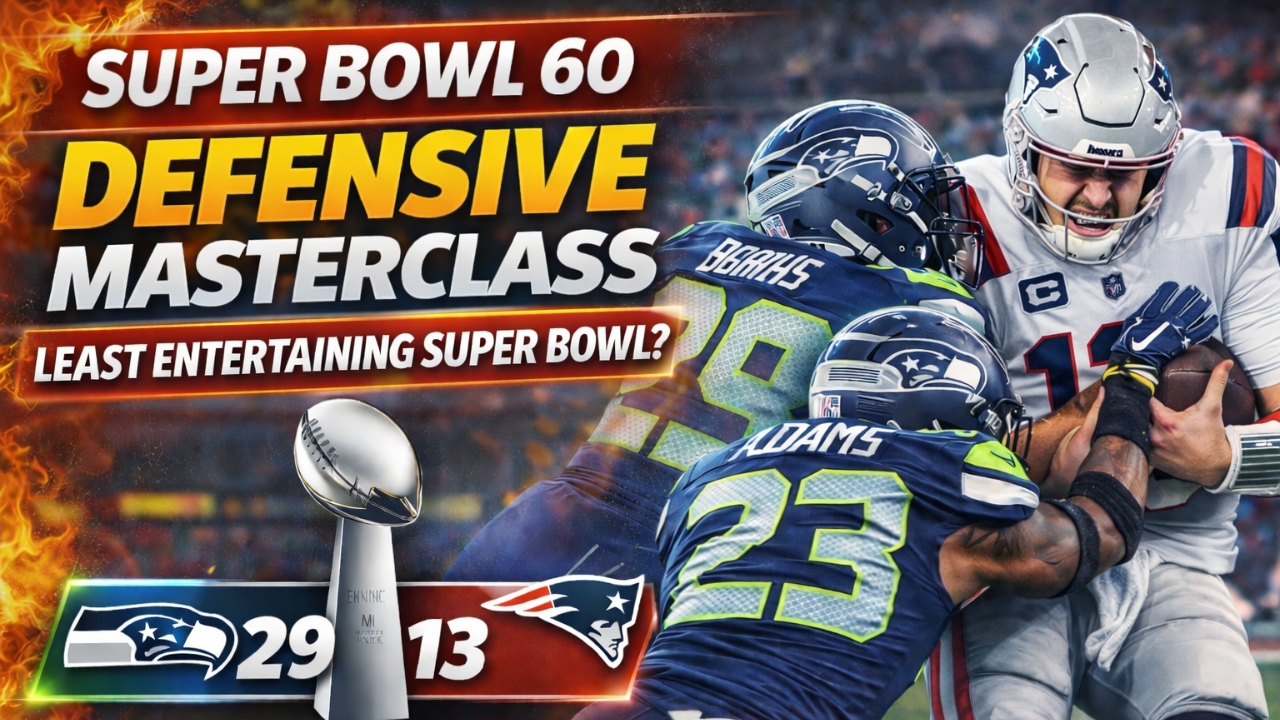
Maye was sacked six times—one shy of the Super Bowl record—and finished completing just 19 of 38 passes for 218 yards, two touchdowns, and two interceptions. He also lost a fumble that set up Seattle's first touchdown. The statistics tell only part of the story; watching Maye scramble desperately behind a Patriots offensive line that couldn't protect him painted the fuller, more painful picture.
This wasn't just a quarterback having an off game—this was a young talent completely rattled by the moment and overwhelmed by an elite defense executing a flawless gameplan. Maye looked in over his head from the opening drive, never finding the rhythm or confidence that made him so dynamic during New England's playoff run.
The Patriots managed just 48 passing yards in the first half with Maye completing only 6 of 11 passes while absorbing three sacks for 30 yards lost. He didn't complete a pass for more than 21 yards until the fourth quarter, when the game was essentially decided and Seattle's defense had already imposed its will completely.
"The pressure got to him early and he never recovered," analysts observed postgame. "When you can't trust your protection and every throw feels rushed, it's nearly impossible to execute at this level."
Rookie left tackle Will Campbell, thrust into protecting Maye's blind side on football's biggest stage, struggled throughout against Seattle's elite pass rushers. Campbell left the locker room after the game without taking questions—a telling sign of how difficult his Super Bowl debut had been. When your offensive tackle can't face reporters, you know the protection broke down repeatedly.
Seattle's Defense: All-Time Performance Creates Unwatchable Football
The Seahawks' defensive performance ranks among the best in Super Bowl history by every statistical measure. Seattle sacked Maye six times, intercepted him twice, recovered a fumble, held the Patriots to just one first down in the entire second quarter, and allowed zero points through three quarters.
The "Dark Side" defense—deliberately evocative of the legendary "Legion of Boom" unit that won Seattle's first Super Bowl in 2014—completely suffocated New England's offense with a gameplan that defensive coordinator Aden Durde executed to perfection. Durde became the first British-born coordinator to coach in a Super Bowl, and his defense made history with one of the most dominant performances ever seen in the championship game.
Edge rushers Derick Hall and Byron Murphy II each recorded two sacks. Devon Witherspoon and Rylie Mills added one apiece. The constant pressure prevented Maye from ever settling into rhythm, forcing quick throws, scrambles, and mistakes. Linebacker Uchenna Nwosu returned an interception 44 yards for a touchdown after Devon Witherspoon forced a Maye fumble. Safety Julian Love intercepted a fourth-quarter pass to extinguish any hope of a Patriots comeback.
By every defensive metric, Seattle's performance deserves celebration. The problem? Defensive dominance—no matter how historically impressive—doesn't translate to entertainment value for the millions of casual fans tuning in expecting offensive fireworks and dramatic moments.
A Game That Never Found Its Rhythm
The first touchdown didn't come until early in the fourth quarter, when Sam Darnold found tight end A.J. Barner on a 16-yard scoring strike following Derick Hall's strip-sack of Maye. That touchdown put Seattle ahead 19-0 and essentially ended any remaining competitive drama.
Before that moment, viewers endured three quarters dominated by field goals, punts, and stalled drives. Jason Myers kicked a Super Bowl-record five field goals for Seattle—an accomplishment that highlights just how many times the Seahawks' offense bogged down inside New England territory without finishing drives with touchdowns.
The odds of no touchdown being scored in the entire game were 125-1 at sportsbooks. Bettors holding those tickets came agonizingly close to cashing what would have been the ultimate longshot, missing by just one fourth-quarter score.
Three quarters of field goal attempts, defensive stands, and three-and-outs don't create Super Bowl memories. They create bathroom breaks, extended conversations at viewing parties, and fans checking their phones instead of staying glued to the action.
The Patriots' offense was virtually nonexistent for three quarters. New England managed just one first down in the entire second quarter—a stunning indictment of how completely Seattle's defense controlled the game. Maye faced constant harassment, never finding the time or space to utilize the deep-ball accuracy that made him one of the league's most exciting young quarterbacks during the regular season.
When Maye finally connected with Mack Hollins on a 35-yard touchdown pass to cut the deficit to 19-7 with 12:27 remaining, the score momentarily suggested potential for a competitive finish. But Seattle's defense immediately responded with back-to-back interceptions on New England's next two possessions, crushing any momentum and closing the door on a Patriots comeback.
Julian Love's interception with 8:48 remaining sealed the outcome, allowing Seattle to run clock and secure the franchise's second Lombardi Trophy while viewers accepted they'd witnessed a defensive clinic rather than an entertaining football game.
Kenneth Walker's Workmanlike MVP Performance
Kenneth Walker paced Seattle's offense with 135 rushing yards on 27 carries, earning Super Bowl MVP honors—a rare instance of a running back winning the award over the victorious quarterback. Walker's steady, grinding performance kept drives alive, controlled the clock, and set up Myers' record-tying five field goals.
But 5.0 yards per carry, while effective, doesn't produce highlight-reel moments. Walker never broke a long touchdown run. He didn't produce any explosive plays that shifted momentum dramatically. His contribution was critical to Seattle's victory, but workmanlike rather than spectacular.
Sam Darnold, completing his remarkable redemption arc from draft bust to Super Bowl champion, managed the game competently without committing turnovers. He finished 19-of-38 for 202 yards and one touchdown—pedestrian numbers that mattered only because his defense made them sufficient.
Darnold's greatest achievement was protecting the football. After leading the league in turnovers during the regular season, he went the entire playoffs without committing one—an impressive accomplishment that reflected maturity and smart decision-making. But playing mistake-free football, while strategically sound, rarely creates the dramatic moments that define memorable Super Bowls.
The Near Misses That Compounded Frustration
Beyond the actual game results, multiple near-miss plays compounded viewer frustration. Darnold missed a wide-open Jaxon Smith-Njigba downfield on a throw that would have resulted in a touchdown and potentially blown the game open in the first half. Instead, the incompletion led to another punt and another defensive series.
Maye narrowly avoided additional interceptions on poorly placed throws that Seattle defenders nearly hauled in. Patriots receivers dropped potential completions under tight coverage. The defense consistently disrupted timing routes and forced check-downs that gained minimal yardage.
These near-miss moments—the kind that create genuine tension in well-played competitive games—instead contributed to the frustrating viewing experience. Nothing fully developed. No explosive plays broke the monotony. The game felt like watching a boxer repeatedly land body blows without ever delivering the knockout punch that electrifies crowds and creates memorable moments.
Star receiver Jaxon Smith-Njigba, the NFL's Offensive Player of the Year, left the game in the third quarter for concussion evaluation, robbing viewers of seeing one of the league's most dynamic playmakers potentially make game-changing plays. His absence further limited the offensive firepower on display.
College Football's Superior Entertainment Value
While Super Bowl 60 disappointed with its defensive slog, the 2025 College Football Playoff consistently delivered entertaining, high-scoring football throughout its expanded 12-team format. The contrast between the two products became impossible to ignore for fans who watched both.
Indiana's improbable run to a national championship captivated audiences, with the title game averaging 30.1 million viewers—a 36% increase from the previous year. The Hoosiers' Cinderella story, dominant performances, and exciting offensive football created compelling television that kept viewers engaged from kickoff through the final whistle.
The Rose Bowl quarterfinal between Indiana and Alabama drew 23.9 million viewers as the Hoosiers demolished the Crimson Tide 38-3, delivering the kind of offensive explosion that creates highlight-reel moments. The Cotton Bowl featured Miami's thrilling victory over Ohio State in a competitive game that averaged 19.0 million viewers.
Even the semifinal games delivered compelling football, with the Peach Bowl averaging 18.0 million as Indiana advanced past Oregon in another high-quality performance. Throughout the playoff, viewers got dramatic finishes, explosive offensive plays, genuine upsets, and the kind of unpredictable chaos that makes sports entertaining.
The numbers tell the story: College Football Playoff viewership increased 16% year-over-year. Regular season college football viewership grew 4%. The Rose Bowl alone drew 23.9 million viewers—becoming the fourth most-watched Rose Bowl on record and proving college football's ability to deliver massive audiences when the product entertains.
Compare those engagement metrics to Super Bowl 60's defensive grind, and the contrast becomes stark. While the NFL remains wildly popular and typically delivers entertaining football throughout the regular season and playoffs, this particular Super Bowl failed to meet the entertainment standards fans expect from championship games.
Why This Game Fell Flat
Several factors combined to make Super Bowl 60 uniquely unenjoyable:
Overwhelming Defensive Dominance - Seattle's defense was too good, creating a mismatch that eliminated competitive drama by halftime. Blowouts can be entertaining when offenses score at will, but defensive domination creates long stretches without exciting plays.
Offensive Line Failure - New England's inability to protect Maye meant he never had opportunities to showcase the arm talent and decision-making that made him a star. Watching a quarterback run for his life isn't entertaining—it's painful.
Conservative Playcalling - Both teams played cautiously, unwilling to take risks that might produce explosive plays or dramatic momentum swings. Field position battles and punting competitions don't create Super Bowl moments.
Lack of Star Performances - Neither Maye nor Darnold delivered memorable performances. Walker's MVP was deserved but workmanlike. Smith-Njigba left with a concussion. The game lacked individual brilliance that transcends team outcomes.
No Competitive Drama - By the time Seattle went up 19-0 in the fourth quarter, the outcome felt inevitable. Competitive games create tension that keeps viewers engaged. Blowouts—especially low-scoring defensive blowouts—lose casual viewers.
The NFL's Typical Entertainment Value
It's important to note that Super Bowl 60's entertainment failure doesn't indict the entire NFL product. The league remains incredibly popular for good reason—NFL football typically delivers week after week. Regular season games feature offensive innovation, star quarterbacks making spectacular throws, dramatic finishes, and the kind of high-level competition that makes professional football compelling.
The playoffs leading to Super Bowl 60 provided plenty of entertainment. The conference championship games delivered drama. Wild Card weekend produced upsets and memorable moments. The NFL's product works precisely because it usually balances offensive firepower with defensive excellence in ways that create competitive, entertaining games.
This Super Bowl was an outlier—a perfect storm of defensive dominance, offensive line failure, conservative coaching, and competitive imbalance that produced a historically unenjoyable championship game. It happens. Not every Super Bowl can be a classic.
But when college football consistently delivers more entertaining playoff games than professional football's championship, it raises questions about which product fans will prioritize in an increasingly crowded sports landscape.
The Bigger Picture: Player Compensation and Product Quality
The entertainment value discussion connects directly to player compensation. College football players now earn substantial money through NIL deals, with top prospects securing six and seven-figure packages while still in school. The expanded College Football Playoff generates massive television revenue, and players receive a share through NIL opportunities tied to playoff appearances and championship runs.
Meanwhile, NFL players make significantly more through salaries and endorsements, but the professional game's entertainment value can't be taken for granted. When a Super Bowl delivers a defensive snoozer while college playoff games consistently provide fireworks, fans notice.
For young athletes building careers through platforms like BallerTube, both pathways offer financial opportunity. College football's NIL era means elite high school prospects can earn substantial money while developing their skills at the amateur level. The NFL remains the ultimate goal, but college football's entertainment value and compensation opportunities make it an increasingly viable endpoint for players who don't reach the professional ranks.
Looking Forward
The Seahawks deserve credit for a historically dominant defensive performance. Winning a Super Bowl requires no apologies, and Seattle's "Dark Side" defense will be remembered among the greatest championship performances.
But Super Bowl 60 will also be remembered as one of the least entertaining championship games in recent memory—a defensive clinic that failed to deliver the drama, explosive plays, and competitive tension that define great Super Bowls.
The NFL will bounce back. Next year's Super Bowl will likely deliver better entertainment. The league's product remains strong, and one disappointing championship game doesn't change that.
However, college football's consistently entertaining playoff performances demonstrate that amateur football has evolved into a genuinely compelling product that rivals—and sometimes exceeds—professional football's entertainment value. That reality represents a significant shift in the sports landscape that both levels of football must acknowledge moving forward.
For now, Seattle celebrates a championship won through defensive dominance. Patriots fans lament a young quarterback overwhelmed on football's biggest stage. And viewers worldwide remember Super Bowl 60 as the defensive snoozer that highlighted just how entertaining college football has become by comparison.