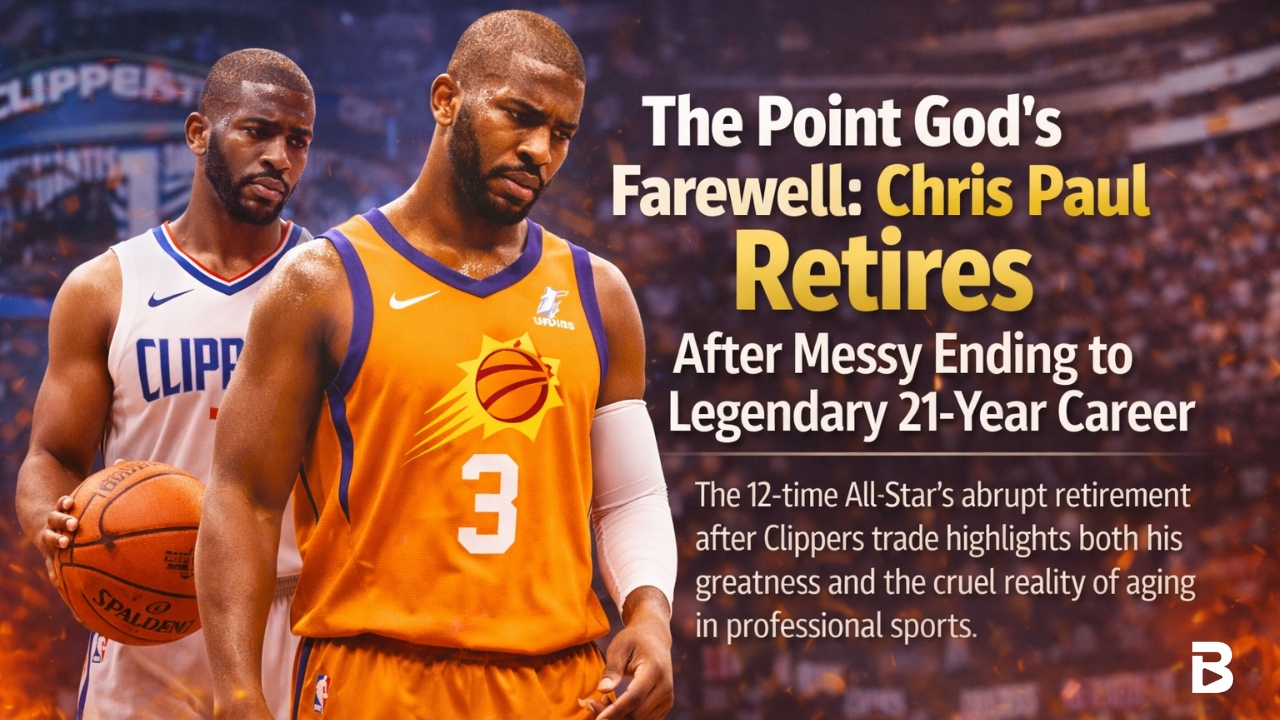
Chris Paul's NBA career ended not with the championship parade he desperately chased for two decades, but with an Instagram post on a Friday afternoon. Hours after being waived by the Toronto Raptors—a team he never suited up for—the 40-year-old point guard known as "CP3" and "The Point God" announced his retirement, closing the book on one of the most accomplished yet unfulfilled careers in basketball history.
"This is it! After over 21 years I'm stepping away from basketball," Paul wrote on Instagram, his voice tinged with the bittersweet reality of an ending nobody envisioned. "As I write this, it's hard to really know what to feel, but for once—most people would be surprised—I don't have the answer lol! But, mostly I'm filled with so much joy and gratitude!"
The announcement came on the first day of NBA All-Star Weekend, hosted by the Los Angeles Clippers at their gleaming Intuit Dome—a cruel irony given that the Clippers had unceremoniously dumped Paul just weeks earlier in the middle of a road trip in Atlanta. The franchise he helped transform into a perennial contender had sent him home like yesterday's news, trading him to Toronto in a salary dump before the February 4 deadline.
Paul never reported to the Raptors. He never played another NBA game. And now, one of the greatest point guards to ever play basketball walks away without the one thing that defines NBA greatness in the modern era: a championship ring.
The Messy, Undignified End
Chris Paul's final season was supposed to be a triumphant homecoming. After spending 2024-25 bouncing between Golden State and San Antonio, Paul returned to the Clippers—the franchise where he achieved his greatest success during the "Lob City" era alongside Blake Griffin and DeAndre Jordan—for one last run at glory.
It lasted 16 games.
According to ESPN reports, Paul's leadership style clashed with the current Clippers roster. The 40-year-old veteran, known throughout his career for his intense competitiveness and demanding standards, reportedly struggled to connect with a younger generation of players who didn't share his approach to the game. What was once celebrated as "leadership" had become, in the eyes of some, overbearing and outdated.
In December 2025, the Clippers sent Paul home from a road trip in Atlanta. He posted an Instagram Story that night with a stark caption: "Just Found Out I'm Being Sent Home." The public nature of the embarrassment highlighted just how far Paul's stock had fallen. This wasn't a beloved veteran being respectfully transitioned into retirement—this was a messy divorce playing out in real time.
The Clippers traded Paul to Toronto on February 4, 2026, in a three-team deal designed purely to clear salary cap space. Toronto never expected Paul to report. The Raptors waived him on February 13. Paul, rather than seeking an eighth team to extend his career a few more months, chose dignity over desperation.
The ending was ugly, undignified, and completely at odds with the standard Chris Paul set throughout his Hall of Fame career. But it was also, unfortunately, typical of how the NBA treats aging superstars whose bodies can no longer cash the checks their resumes have written.
READ FULL STORY ON BALLERTUBEhttps://t.co/zkAoqnbJmp pic.twitter.com/iEmW1bqQca
— BallerPost (@BallerPost) February 13, 2026
The Accolades: A Hall of Fame Resume
Despite the messy conclusion, Chris Paul's career accomplishments place him firmly among basketball's all-time elite. The numbers and honors tell the story of sustained excellence across more than two decades:
Individual Honors:
- 12-time NBA All-Star (2008-2016, 2020-2022)
- 11-time All-NBA selection (4 First Team, 3 Second Team, 4 Third Team)
- 9-time NBA All-Defensive Team (7 First Team, 2 Second Team)
- 2006 NBA Rookie of the Year
- 2013 NBA All-Star Game MVP
- NBA 75th Anniversary Team (2021)
- 2-time Olympic Gold Medalist (2008, 2012)
Statistical Dominance:
- Led the NBA in assists 5 times (2008, 2009, 2014, 2015, 2022)
- Led the NBA in steals a record 6 times (2008, 2009, 2011-2014)
- Career averages: 16.8 points, 9.2 assists, 4.4 rebounds, 2.0 steals per game
- 2nd all-time in career assists (12,092+) behind only John Stockton
- 2nd all-time in career steals (2,684+) behind only John Stockton
- 4th all-time in scoring among point guards (23,058+ points)
- 36th on the NBA's all-time scoring list
- 500+ career double-doubles (4th guard in NBA history)
- 50 career games with 10+ assists and zero turnovers (NBA record)
Paul also retires 5th all-time in career earnings with $408.2 million, trailing only LeBron James, Kevin Durant, Stephen Curry, and James Harden—a testament to both his on-court value and business acumen.
Perhaps most remarkably, Paul was the 11th player in NBA history to reach 20 seasons, and only the second player (alongside LeBron James) to achieve 20,000 career points and 10,000 career assists. He played 1,370 regular season games and 149 playoff games across seven different franchises.
The Championship Chase: So Close, Yet So Far
The elephant in the room—the missing piece that will forever color discussions of Chris Paul's legacy—is the absence of an NBA championship.
Paul came closest in 2021, leading the Phoenix Suns to the NBA Finals for the first time since 1993. At age 36, finally reaching the sport's biggest stage after 16 seasons, Paul played brilliantly against the Milwaukee Bucks, averaging 21.8 points and a series-high 8.2 assists per game. The Suns led 2-0 before Milwaukee, led by Giannis Antetokounmpo's historic performance, won four straight to claim the title.
Paul's loss in the 2021 Finals epitomizes his career-long playoff struggles. Despite his regular season excellence, Paul's teams repeatedly fell short when it mattered most:
- With the New Orleans Hornets (2005-2011), Paul made the playoffs four times but never advanced past the second round
- During the "Lob City" Clippers era (2011-2017), the team never reached the Western Conference Finals despite championship expectations
- With Houston (2017-2019), Paul's Rockets pushed the Warriors to seven games in the 2018 Western Conference Finals before his hamstring injury derailed their title hopes
- In Oklahoma City (2019-2020), Paul exceeded expectations but lacked championship-caliber talent
- After Phoenix (2021), Paul spent his final years chasing one more opportunity that never materialized
The lack of a ring will be used by critics to diminish Paul's legacy, just as it has been wielded against Charles Barkley, Karl Malone, and other all-time greats who never won championships. Fair or not, championships define NBA legacies in ways that individual excellence alone cannot.
Leadership and Controversy
Chris Paul's career was defined not just by statistics but by his role as one of basketball's most influential leaders—both on and off the court.
Paul served as President of the National Basketball Players Association from 2013 to 2021, navigating complex labor negotiations and advocating for player rights during a transformative era for the league. His intelligence, business acumen, and willingness to engage with difficult issues earned him respect throughout the sport, even from those who found his on-court intensity difficult to manage.
On the court, Paul's leadership style was famously intense. He demanded perfection from teammates, held players accountable for mistakes, and approached every game—even meaningless regular season contests—with playoff-level intensity. This approach helped mediocre teams overachieve but reportedly created friction with younger players less accustomed to such demanding standards.
His time at Wake Forest was briefly marred by a 2005 incident where he punched NC State guard Julius Hodge in the groin, earning a suspension and temporarily damaging his image. Throughout his NBA career, Paul developed a reputation for lobbying referees, drawing criticism for his relentless pleading for calls. Some viewed it as gamesmanship; others saw it as unsportsmanlike.
The tension between Paul's leadership qualities and his intensity reached a breaking point in his final season with the Clippers, where reports indicated younger players chafed under his demanding approach. What worked in Paul's prime—when his talent backed up his demands—became problematic when his 40-year-old body could no longer dominate games the way his 25-year-old self once did.
Where Chris Paul Ranks Among All-Time Point Guards
Debating Chris Paul's place among history's greatest point guards inevitably becomes subjective, colored by how heavily one weights championships versus individual excellence. Here's where Paul stands:
Tier 1: The Undisputed GOAT Magic Johnson stands alone atop point guard history. Five championships, three MVPs, three Finals MVPs, and the statistical dominance to match. No debate.
Tier 2: The Championship Point Guards Stephen Curry (4 championships, 2 MVPs, revolutionized basketball), Isiah Thomas (2 championships, Finals MVP, "Bad Boy" Pistons leader), and Oscar Robertson (1 championship, MVP, triple-double machine) occupy this tier. Championships elevate them above those without rings.
Tier 3: The Elite Without Rings This is where Chris Paul resides alongside John Stockton. The debate between Paul and Stockton reveals fascinating contrasts:
Stockton holds the all-time records for assists (15,806) and steals (3,265)—numbers that may never be broken. He played 19 seasons with one franchise, reached two NBA Finals, and epitomized consistency and durability.
Paul's peak was arguably higher than Stockton's. At his best (2007-2009), Paul was the league's best player not named LeBron James or Kobe Bryant. He combined elite scoring, playmaking, and defense in ways Stockton didn't. Paul's 11 All-NBA selections and 9 All-Defensive Team honors exceed Stockton's 11 All-NBA and 5 All-Defensive honors.
Stockton's longevity and franchise loyalty create a compelling case. Paul's peak dominance and versatility counter it. Most analysts place them in the same tier, with Paul's superior peak competing against Stockton's superior longevity.
Other Comparisons:
- vs. Jason Kidd: Paul surpassed Kidd for 2nd all-time in both assists and steals, settling that debate
- vs. Steve Nash: Nash won 2 MVPs (which Paul never did), but Paul's superior defense and more complete game give him the edge
- vs. Russell Westbrook: Westbrook's MVP and triple-double dominance compete with Paul's efficiency and defense; most favor Paul's two-way excellence
- vs. Gary Payton: "The Glove" won a championship and a DPOY award, but Paul's offensive superiority tips the scales
The Verdict: Chris Paul ranks somewhere between 3rd and 5th all-time among point guards, depending on how one values championships. Most objective assessments place him 4th behind Magic, Curry, and Stockton, with legitimate arguments for 3rd if peak performance outweighs longevity in one's criteria.
The Legacy: What Chris Paul Means to Basketball
Beyond statistics and championship counts, Chris Paul's legacy encompasses his impact on how basketball is played and understood.
The Pure Point Guard in Modern Basketball: Paul represented perhaps the last great pure point guard—a player whose primary function was orchestrating offense, setting up teammates, and controlling tempo. In an era where "positionless basketball" has blurred traditional roles, Paul's mastery of traditional point guard play feels increasingly anachronistic, which makes his excellence all the more remarkable.
The Cerebral Player: Paul's basketball IQ was legendary. He processed the game at a level few players ever achieve, anticipating plays before they developed and exploiting defensive weaknesses with surgical precision. Young point guards studied Paul's film to learn how to dissect defenses without explosive athleticism.
The Winner Without a Ring: Paul's career forces basketball fans to grapple with uncomfortable questions about how we define greatness. Is sustained excellence over 20+ years diminished by the absence of championships? Should team success be held against players who performed brilliantly but lacked the supporting cast, luck, or health to win titles?
Paul's résumé proves you can be one of the greatest ever at your position without winning a championship. Whether that's sufficient for casual fans remains debatable, but serious basketball students recognize Paul's greatness transcends ring count.
The Business of Basketball: Paul's role as NBPA President and his savvy endorsement portfolio (Jordan Brand, State Farm) demonstrated how modern players could leverage their platforms for influence beyond the court. His leadership during critical labor negotiations helped shape the player-empowerment era that defines today's NBA.
Conclusion: Remembering the Point God
Chris Paul's retirement closes a chapter on one of basketball's most compelling careers—a story of sustained excellence, near-misses, leadership, controversy, and ultimately, unfulfilled championship dreams.
The messy ending with the Clippers doesn't erase 21 years of brilliance. The lack of a championship ring doesn't diminish his standing as one of history's greatest point guards. The reports of difficult personality don't negate his advocacy for players' rights and his cerebral approach to the game.
Chris Paul retires as the only player besides John Stockton to rank in the top two all-time in both assists and steals. He retires as one of seven players to reach 21 NBA seasons. He retires with over $400 million in career earnings and endorsement deals that will extend his wealth for life. He retires with Olympic gold medals, All-Star selections, and the respect of basketball purists worldwide.
Most importantly, Chris Paul retires having played the game with maximum effort, intelligence, and competitive fire every single night. Whether coaching 16-year-olds or guarding LeBron James in the playoffs, Paul approached basketball with the utmost respect—his words, not mine—and that consistency of effort across two decades earns admiration regardless of championship count.
The Point God never got his ring. But he got everything else basketball had to offer. And for a 6-foot point guard from Winston-Salem who became one of the greatest floor generals in basketball history, that's a legacy worth celebrating—messy ending and all.
First-ballot Hall of Famer. Top-five point guard ever. One of the smartest players to ever step on a court. And now, finally, retired.
It's been a pleasure, CP3. The game will miss you.