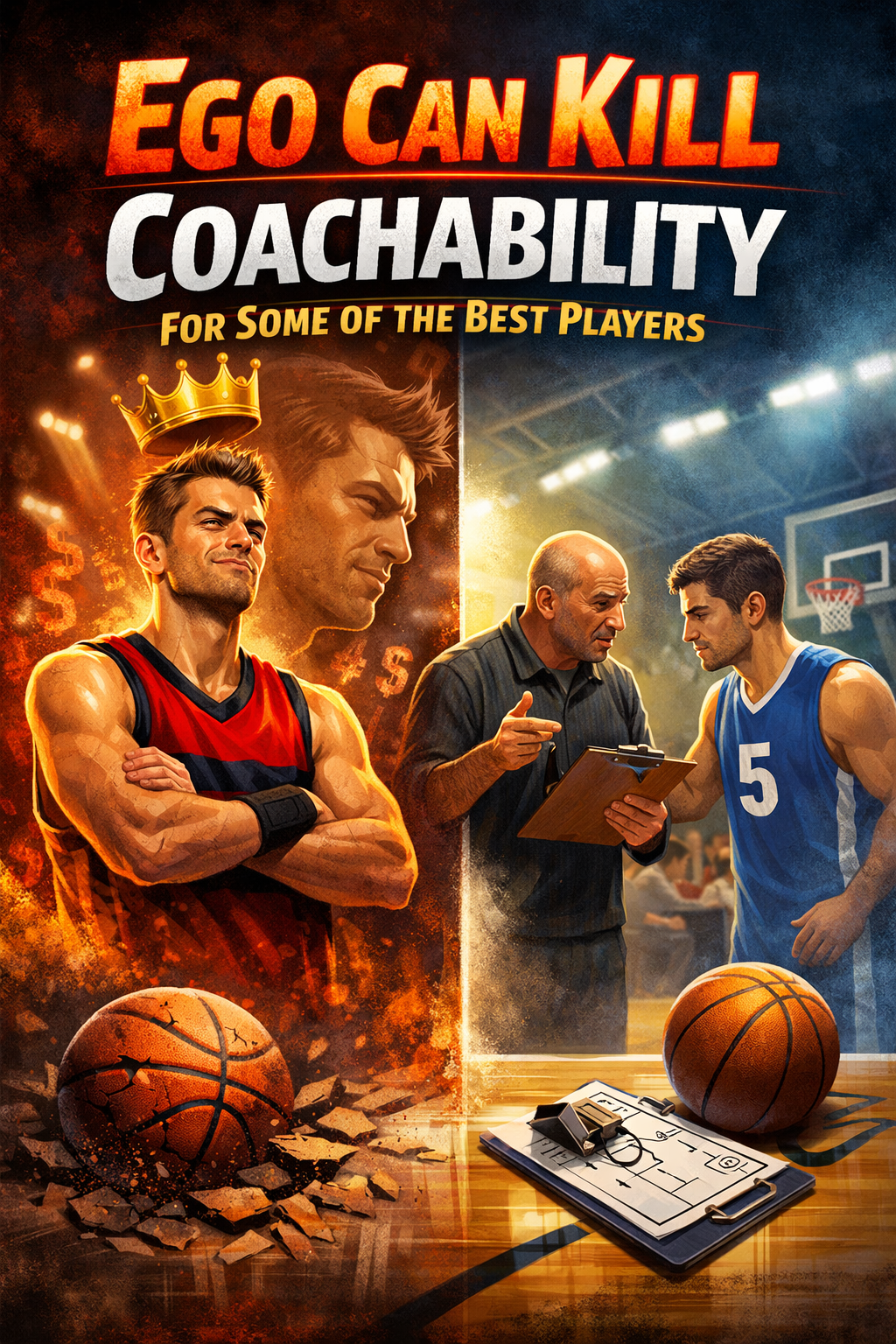
Talented players are getting recognized earlier than ever. One of the most ridiculous things I see is players being ranked in middle school, and on Instagram and X, a teenager becomes a “star” before ever stepping onto a college campus.
Read this carefully—behind all the hype lies a dangerous truth: ego can quickly destroy coachability, even for some of the most talented players.
Coachability means a player’s readiness to receive feedback, respond to teaching, handle criticism, and consistently improve. Sports psychologists consistently show that players who respond positively to coaching and stay open to learning develop faster and perform better over time.
👉 This is something many families struggle to navigate when expectations don’t match reality:
Read: Stuck on the Bench – A Parent’s Guide
I believe one major problem is that success at the high school or AAU level can create a false sense of greatness.
Sometimes Talent Can Create Mental Hazards
This is where ego starts.
When players begin to believe they know everything, they stop listening. Film sessions turn into arguments instead of opportunities to improve. Instead of asking, “How can I get better?” the mindset shifts to, “Coach, why are you criticizing me?”
Ego vs. Maturity
The difference between good players and truly elite players is often humility—the ability to accept coaching and make adjustments.
Coachability includes:
- Openness to learning
- Positive response to feedback
- Respect toward coaches
- Ability to handle criticism
- Accountability for team success
The Awakening Awaits at the Next Level
College basketball exposes ego quickly.
At that level, almost everyone was a star before. Every teammate. Every opponent. Coaches now demand accountability, defense, and role acceptance.
Players who reject coaching will struggle—no matter how talented they are.
Many players realize too late that scoring alone isn’t enough. If you can’t defend, move without the ball, accept a role, or handle criticism, your minutes will disappear.
In fact, some of the most talented high school players never reach their full potential simply because they refuse to be coached.
Most Great Players Are the Most Coachable
This isn’t always the case—but often, the best players have the lowest egos.
They embrace feedback. They ask questions. They study film. They accept tough coaching because they understand that growth never stops.
Disciplined, consistent, and focused players tend to stay the most humble.
Who Fuels Ego? Parents and Social Media
Ego doesn’t appear overnight—it’s fed.
Sometimes the people around players unintentionally build it. Parents may blame coaches instead of encouraging accountability. Social media praise creates the illusion that the player has already “made it.”
Instead of truth, players receive validation—and that’s where coachability starts to disappear.
The Truth Every Player Needs to Understand
Here’s the reality:
If a player cannot be coached, they will not reach their full potential—no matter how talented they are.
Basketball is a game of constant adjustment.
Players who accept coaching grow. Players who reject it don’t.
Talent might open doors—but humility and coachability keep them open.
A Real Example of This Reality
👉 This situation shows how quickly things can change when roles, expectations, and ego collide:
Read: Indiana Player Leaves After Being Benched
Every young player dreams of playing college basketball—or even reaching the NBA one day. But those dreams depend on more than talent, rankings, or highlights.
They depend on humility.
Because in basketball, ego might make you look like a star today—but being coachable determines whether you actually become one tomorrow.