
Parents want it. Players think they need it. Coaches sell it. AAU Circuits are built around it. Social media is flooded with it.
“More games. More tournaments. More recruitment excitement.”
That’s the angle.
But somewhere along the way, basketball got turned upside down.
Because the truth is—more exposure doesn’t always mean more players are developing in their craft. And for a lot of players, they either stagnate or have gotten worse.
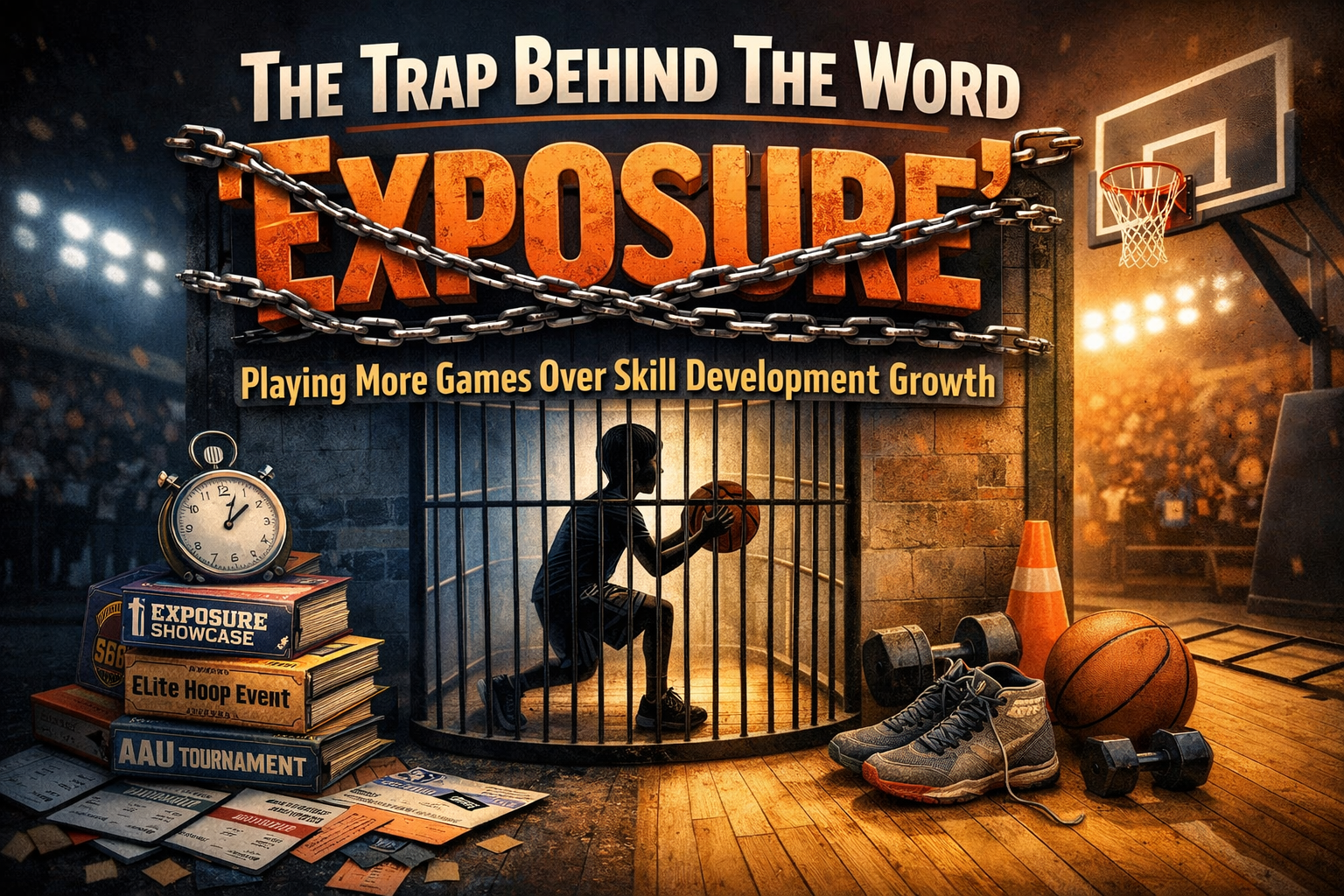
Welcome to the trap behind the word ‘exposure’.
The Misconception of Being Seen
Let’s be honest: exposure ‘feels’ like improvement.
You’re traveling every weekend. You’re playing in front of college coaches. Your schedule is loaded. Your name is on the flyers. Your highlights are getting posted, likes, and outstanding comments.
It looks like you’re climbing to the top.
But what’s actually happening?
A lot of players are just repeating the same habits… at a higher volume.
Same moves. Same mistakes. Same decision-making.
Just in different venues.
Exposure without growth is just activity noise. And activity noise can trick you into thinking you’re improving when you’re not.
And if you’re not careful, those habits don’t just stay on the court—they start affecting how coaches evaluate you. That’s why understanding things like being a good teammate actually matters more than most people realize:
When Games Are Not Really Grinding
There was a time when skill development and growth were the foundation.
Practice. Skill work. Film. Strength training. Repetition.
Now? Overloading on playing games is replacing all of that.
Players are playing 5–7 games in a weekend but barely getting real training in between. There’s no time to fix weaknesses. No time to break down film. No time to create anything new.
It becomes survival of the fittest basketball.
You’re not playing to improve—you’re only playing to perform.
And those are two completely different standards.
When your entire focus is on performing, you start avoiding mistakes instead of learning from them. You stop experimenting. You stop expanding your game.
You start to minimize yourself.
The AAU Circuit Culture Problem
Let’s talk about this…
The rise of AAU circuits and travel teams has created a system where volume is rewarded more than skill development and growth.
More tournaments = more exposure.
More exposure = more perceived value.
But here’s the part that people do not want to say out loud:
A lot of these AAU circuit settings are not built for development.
They’re built for a visibility show.
Coaches are trying to win games in short windows. There’s limited practice time. Roles are assigned quickly. Mistakes get punished quick.
So what do players do?
They play it safe.
They stick to what they already know. They don’t take risks. They don’t expand their skill set. Because if they struggle, their minutes vanish.
That’s not development. That’s supervision.
The Highlight Reel Culture Is A Major Trap
Social media made this even more destructive.
Now, players aren’t just chasing exposure—they’re chasing highlight reel moments.
The clip. The mixtape. The viral post.
And that changes how the game is played.
Instead of making the right basketball play, players start making the flashy play. Instead of building a complete game, they focus on what looks good in 15–20 seconds.
You’ll see a player drop 25 in highlights… but struggle with decision-making, defense, the mental side, or consistency over a full game.
Because highlights don’t show bad habits.
They show glimmer moments.
And too many players are building their identity off glimmer moments instead of substance.
And even when players do capture film, most don’t actually maximize it the right way. If you’re serious about exposure the right way, understanding how to properly use your film matters:
Playing Up Is Not Always Building Up
Another piece of the falsehood of exposure is the addiction to “playing up.”
Everybody wants to play on the highest circuit. The biggest stage. Against the top competition.
And there’s value in that—when the time is right.
But a lot of players skip steps.
They jump into high-level environments before they’ve built a solid foundation. So instead of growing, they get exposed.
Not in the recruiting sense—in the skill development sense.
They struggle to create separation. They can’t make reads at speed. They take poor angles. They rely on athleticism that doesn’t translate.
And instead of addressing those holes, they just keep playing more games.
Hoping it clicks somehow.
But development doesn’t happen through hope.
It happens through intention.
The Cost of Always Being “On”
There’s also something deeper happening mentally.
When players are constantly in game mode, they never get a chance to step back and actually learn.
Every weekend is pressure. Every possession matters. Every mistake feels magnified.
That kind of environment doesn’t create growth—it creates anxiety.
So players tighten up.
They stop playing freely. They stop being creative. They stop trusting their process.
And over time, that pressure chips away at confidence.
Skill Development Growth Is Boring (And That’s the Point)
Here’s the part nobody wants to say:
Real development isn’t flashy.
It’s repetitive. It’s uncomfortable. It’s slow.
It’s thousands of shots when nobody’s watching. Film sessions breaking down mistakes. Working on your weak hand until it’s no longer weak.
It’s doing things that don’t get posted.
But that’s where real players are built.
Not in packed gyms. Not on AAU circuits.
Behind closed doors.
What College Coaches Actually Want
This is where the disconnect really shows.
Players chase exposure.
Coaches evaluate substance.
They’re not just looking at points.
They’re watching how you think. How you move. How you respond. How consistent you are.
Can you fit a system? Can you handle structure? Can you grow?
If your game is built on flashes but lacks a foundation—it shows quickly.
And no amount of exposure can hide that.
The Players Who Get It Right
The players who separate themselves understand balance.
They use exposure as a tool—not a crutch.
They compete—but they train.
They play—but they study.
They perform—but they develop.
They’re not chasing attention.
They’re building something real.
Resetting the Strategy
So what does the fix look like?
It starts with a mindset shift.
Exposure should be the result of development—not a replacement for it.
Ask yourself:
- What am I actually improving?
- What are my weaknesses?
- Am I working on them consistently?
- Am I playing to grow or just to be seen?
Sometimes the best move isn’t more games.
It’s less.
More training. More focus. More foundation.
Quality Over Quantity
At the end of the day:
Quality beats quantity.
Five meaningful games > fifteen empty ones.
One focused workout > an entire weekend of inconsistent play.
Progress isn’t about being busy.
It’s about getting better.
My Final Outlook: Don’t Get Caught
The exposure trap is real.
And it looks like success from the outside.
But the players who reach their full potential see through it.
They understand:
- Exposure without development is meaningless
- Playing more doesn’t equal getting better
- The real work happens away from the spotlight
So don’t just chase being seen.
Chase being ready.
Because when your game is built the right way…
Exposure won’t be something you chase.
It’ll come find you.