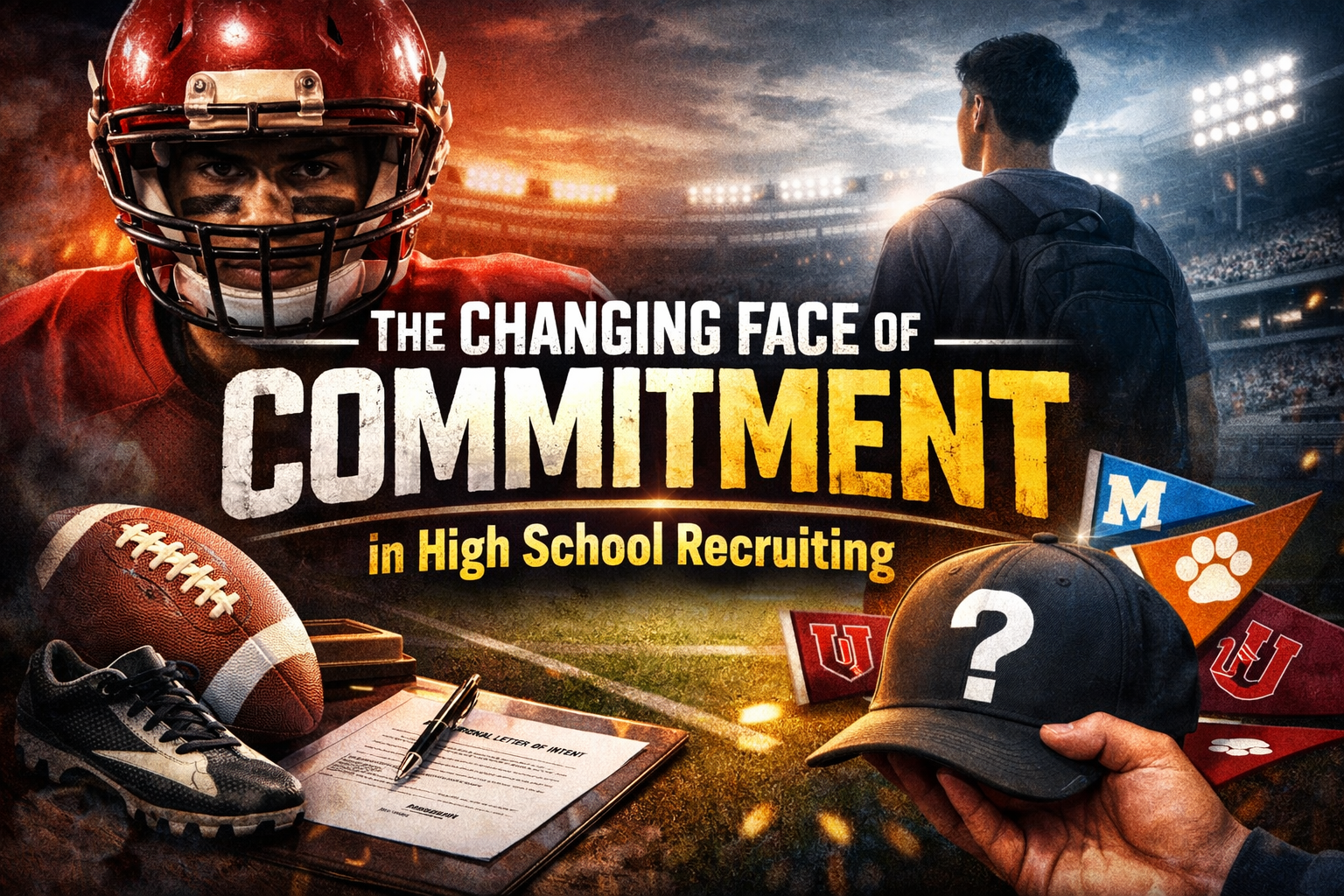
High school recruiting has always been built on hope. Hope from players chasing dreams, from families investing time, energy, and sacrifice, and from coaches trying to forecast the potential of teenagers still figuring themselves out. But in today’s college sports landscape—especially with the explosion of the transfer portal—that hope increasingly collides with a hard truth: a “commitment” doesn’t always mean what it once did.
For decades, a high school player’s commitment carried weight. It signaled trust, a shared vision, and the promise of development. It was a handshake agreement in spirit, if not in legal terms—a plan that would ideally unfold over four years. Today, that promise has shifted. Players commit, sign, arrive on campus—and sometimes enter the transfer portal after only one season, or even sooner.
For everyone involved, from coaches to high school gyms across the country, this trend raises a crucial question: what does commitment really mean anymore?
The Illusion of Stability
At first glance, a high school commitment still looks monumental. Social media graphics, signing ceremonies, and the pride of school communities create a sense of certainty. Parents breathe a sigh of relief. Coaches celebrate. Fans cheer.
But behind the headlines, reality often looks very different.
Players are committing younger and younger, sometimes before they’re fully developed physically, emotionally, or academically. Decisions are made based on relationships with coaching staffs that may not last, on visions that can shift overnight, or on promises that don’t survive the pressures of a season.
And then they get to campus.
The transition is jarring. The speed of the college game, the competition for minutes, and the pressure to perform immediately hit hard. High school stars suddenly become one name on a long roster. For many, the first taste of reality is humbling.
When playing time doesn’t materialize, or when the environment doesn’t feel like the right fit, the transfer portal is always an option. What used to be a last resort has become, in many cases, the first solution.
The Transfer Portal Effect
The transfer portal has created opportunity, no doubt. It gives players a chance to find better fits, escape bad situations, and take control of their careers. But it’s also changed how commitment is perceived.
For many players, committing out of high school is no longer the final stop—it’s the first step. It’s a way to “get their foot in the door,” prove themselves, and then reassess. That safety net shifts behavior. The permanence of commitment erodes when players know there is an exit strategy built in.
Coaches, too, are adapting. Programs that once invested heavily in developing high school talent are now increasingly relying on transfers to fill immediate needs. Why wait two or three years for a freshman to grow when a player already proven at the college level is available now?
The result: high school recruits are no longer the sure investments they once were. And as their perceived value shifts, the idea of commitment loses its weight.
https://www.ballertube.com/news/266/the-transfer-portal-s-dark-secret-what-happens-to-the-17-000-athletes-who-don-t-get-picked-up/
How This Affects High School Players
This new reality puts high school athletes in a challenging position. They’re asked to make life-altering decisions in an environment that is increasingly fluid.
A player might commit because of a coach, only to see that coach leave before the season even starts. They might be promised a role on the team, only for a transfer to claim that spot. They might commit early for security, then realize they rushed the decision.
And when they see college players transferring after one season—or even one semester—they begin to internalize the idea that commitments aren’t binding.
That trickles down. Younger players start viewing commitment as flexible. Families become cautious, skeptical, even wary. The word “commitment” itself begins to lose its meaning.
Real Scenarios
The stories are everywhere if you know where to look.
- A player commits as a junior because the offer feels too good to pass up. By senior year, the roster has shifted, the system has changed, and the opportunity looks different—but the player feels locked in.
- A mid-major freshman plays limited minutes, enters the transfer portal in the spring, and suddenly faces an entirely new recruiting process against older, more experienced athletes.
- A player selects a school because of a strong bond with an assistant coach—only to watch that coach take another job months later.
These aren’t rare exceptions. They’re becoming increasingly common.
Social Media vs. Reality
Social media amplifies the perception of certainty. Commitment posts are polished, celebratory, and often final. Graphics proudly proclaim “100% committed” as if nothing could ever change.
What they don’t show is what comes a year later when a player enters the transfer portal. There’s no graphic, no ceremony, no applause. Often, the change is quiet, sometimes confusing, sometimes disappointing. For high school players watching, it can be eye-opening: recruiting doesn’t end with a commitment—it evolves.
Development vs. Immediate Results
Another driver behind these changes is the shift in college sports toward immediate results. Programs are under pressure to win now. Coaches are judged by yearly results. Freshmen, who may have once been given time to develop, are now competing with older, more experienced transfers.
The outcome is predictable: if a freshman doesn’t make an immediate impact, they may be left behind—or prompted to leave. This cycle—freshmen leaving, coaches recruiting transfers, high school players becoming less central—further erodes the idea of a four-year commitment.
The Emotional Toll
It’s not just a logistical issue; it’s deeply emotional.
For a high school athlete, committing to a college program is personal. It reflects years of effort, support, and sacrifice. When the experience doesn’t go as planned—when a player doesn’t fit, isn’t valued, or must start over—it can be devastating.
Pressure comes from every angle: proving the decision was right, living up to social media expectations, and facing the disappointment of those who celebrated their original commitment. Entering the portal isn’t just a strategic move—it’s an emotional one. It means leaving teammates, routines, and dreams behind.
For younger athletes observing, it adds another layer of uncertainty.
What Coaches Aren’t Saying Out Loud
Coaches are navigating this uncertainty, too. They juggle roster management, recruiting, and winning while knowing that the timeline for high school recruits is risky. If a player needs time to develop, will they stay? Or leave before the investment pays off?
Players notice patterns, too. Programs that regularly bring in transfers at certain positions send signals. Trust is harder to build, and easier to lose.
Strategies for High School Players
The recruiting landscape has changed, but players and families can adapt.
1. Understand that commitment is a step, not the end. Asking the right questions matters:
- What is the coach’s track record with player development?
- How does the program balance high school recruits and transfers?
- What happens if the coaching staff changes?
- What is a realistic timeline for playing time?
- How many players at my position have transferred in or out recently?
2. Exercise patience. Early commitments can provide security, but they can also limit flexibility. Building relationships and evaluating programs carefully is essential.
3. Focus on development. Wherever a player lands, the goal should be to grow—physically, mentally, and technically. In a world of movement and uncertainty, adaptability is the most valuable trait a player can have.
https://www.ballertube.com/news/109/the-transfer-portal-is-officially-open-hundreds-of-players-on-the-move-this-season-as-the-portal-opens-up/
Rethinking Commitment
Perhaps “commitment” needs a new definition. It may be less about permanence and more about mutual alignment and intent. Trust, communication, and shared goals remain crucial, but the reality is that situations change. Players change, coaches change, programs evolve.
The modern commitment is dynamic. It’s a living agreement that requires awareness and adaptability.
My Final Outlook
This isn’t just about transfers or recruiting trends—it’s about how the game itself is evolving. High school athletes still dream of competing at the next level, of growth, and of success. But the path is no longer linear.
It’s layered, flexible, and requires resilience. The notion of a “false commitment” isn’t deception—it’s the result of expectations colliding with reality.
Success now isn’t defined solely by the choice of school, but by how a player navigates changes and finds the right fit. That adaptability—learning to respond when things don’t go as planned—is the real commitment today.
Because in the end, it’s not about where a player starts. It’s about where they grow, and how they handle the journey in a world that doesn’t guarantee anything.