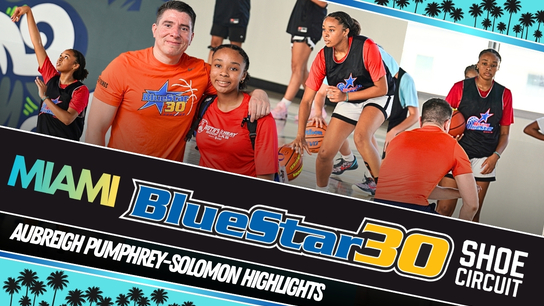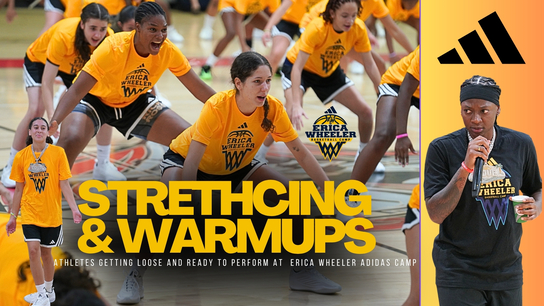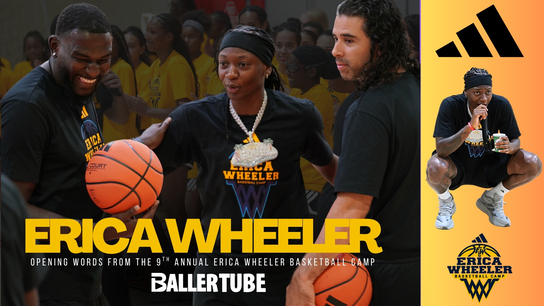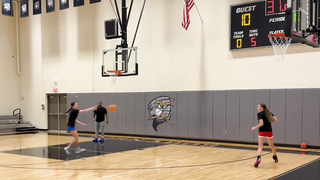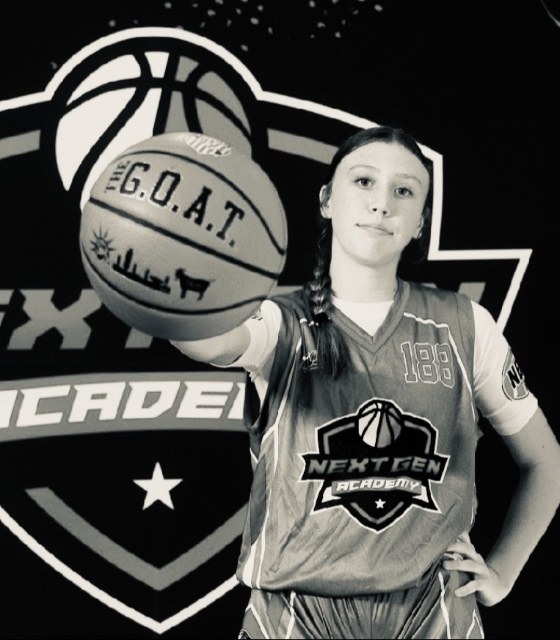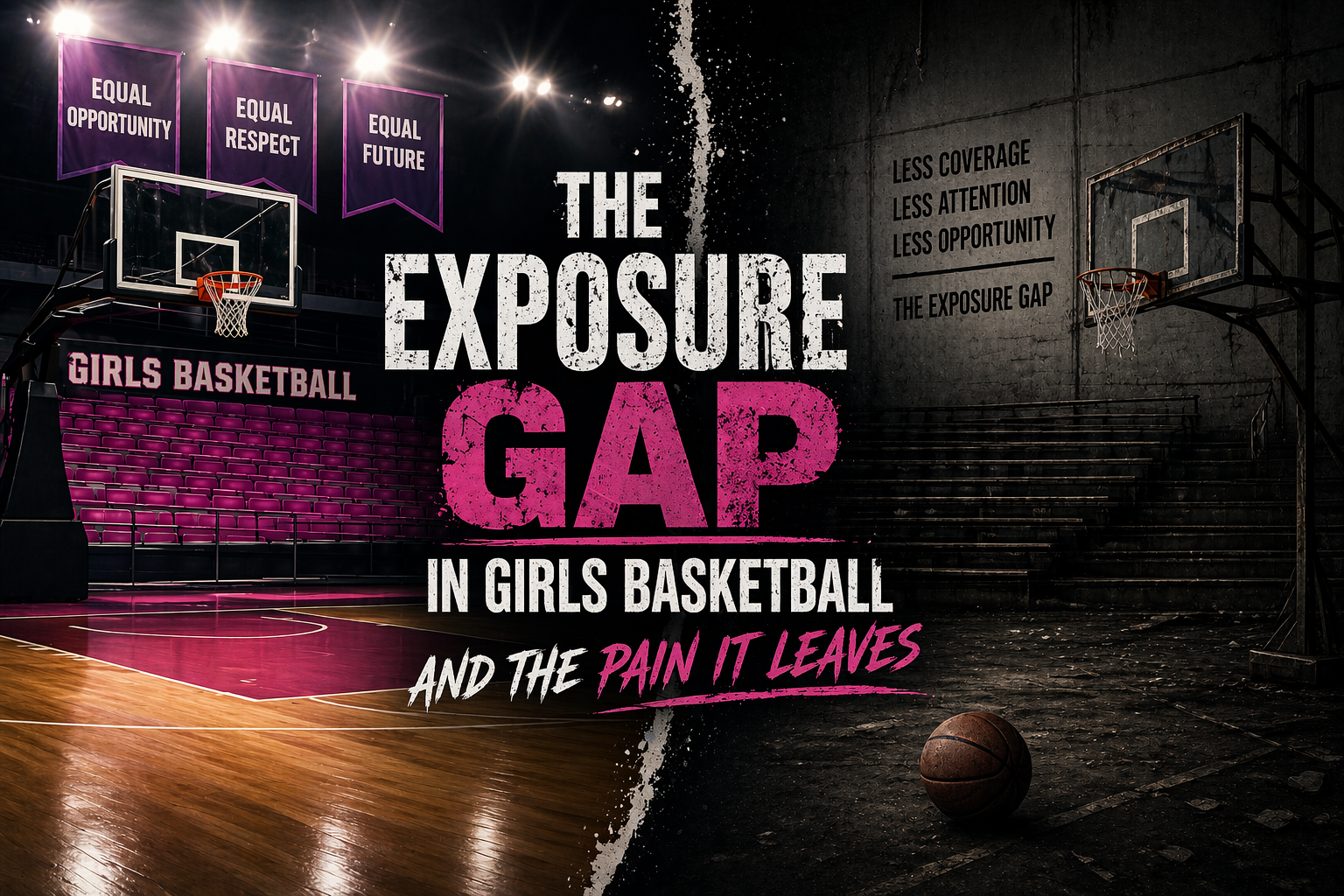
Walk into almost any high school gym on a Friday night and you’ll feel it right away. Energy, noise, community. But look closer at the schedule, the crowd size, the media presence, and the buzz online—and a pattern starts to emerge. When the boys play, the gym is packed, cameras are rolling, and highlights hit social media before the final buzzer. When the girls play, even if the product on the floor is just as good—or better—the spotlight dims.
This is the exposure gap in girls basketball. And while people talk about it in general terms, the real story is deeper, more layered, and more personal. Because exposure isn’t just about attention—it’s about opportunity. And when opportunity isn’t distributed evenly, the consequences ripple through every level of the game.
The truth is simple: exposure shapes who gets seen, who gets recruited, who gets funded, and ultimately, who gets to keep playing.
What the Exposure Gap Really Looks Like
The exposure gap isn’t always loud or obvious. It’s not always about someone actively choosing to ignore girls basketball. More often, it shows up in subtle, consistent ways.
It’s fewer media outlets covering girls games.
It’s highlight pages posting ten boys clips for every one girls clip.
It’s college coaches showing up to certain events but skipping others.
It’s social media algorithms pushing some content while burying the rest.
It’s also about timing and priority. Girls games are often scheduled earlier in the day or before boys games, meaning smaller crowds and less attention. Even when girls programs are successful, they rarely receive the same promotional push from schools or communities.
And in the digital age, exposure is currency. If you’re not being seen, you’re falling behind—no matter how talented you are.
https://www.cbssports.com/high-school/basketball/news/high-school-basketball-rankings-city-of-palms-classic-to-feature-10-teams-featured-in-this-weeks-maxpreps-top/
Talent Isn’t the Issue
Let’s be clear: the gap has nothing to do with talent.
Across the country, there are girls playing high-level basketball—skilled, physical, smart, and competitive. The game has evolved. Players are more versatile. Skill development is at an all-time high. The IQ is there. The toughness is there.
But talent without visibility doesn’t move the needle.
A player can dominate her league, lead her team deep into the playoffs, and still go unnoticed simply because no one is watching. Meanwhile, a less accomplished player in a more visible environment can rack up offers and attention.
That imbalance creates a frustrating reality: it’s not just about how well you play—it’s about where and who sees you play.
Who Gets Hurt the Most
The exposure gap doesn’t affect every player equally. Some find ways around it. Others don’t. And the ones who struggle the most often fall into a few specific groups.
1. Small-School Athletes
If you’re playing at a smaller high school or in a rural area, the challenge is doubled.
You’re already dealing with fewer resources, less competition, and limited access to high-level events. Add the exposure gap on top of that, and it becomes even harder to get noticed.
These players often rely heavily on word of mouth or self-promotion. They may not have consistent film, professional highlights, or access to recruiting networks. And without those tools, even standout performances can go unseen.
https://www.ballertube.com/news/50/caitlin-clark-shines-in-career-high-performance-against-chicago-sky/
2. Late Bloomers
Not every player is a star at 14 or 15. Some develop later—physically, mentally, or skill-wise.
But the recruiting timeline doesn’t always wait.
Players who hit their stride as juniors or seniors often find themselves behind in exposure. Coaches have already filled spots. Attention has shifted to younger classes. And without a strong early presence, it becomes difficult to catch up.
For these players, the exposure gap isn’t just about visibility—it’s about timing.
3. Role Players Who Do the “Right Things”
Basketball isn’t just about scoring. Defense, rebounding, leadership, communication—these are all critical parts of winning.
But they don’t always translate to highlights.
Players who impact the game in less flashy ways often get overlooked in an exposure-driven environment. If the system rewards clips and stats over substance, those players can disappear from the conversation.
And yet, at the next level, those are often the exact players coaches need.
4. Athletes Without Strong Support Systems
Some players have built-in advantages—access to trainers, travel teams, media connections, and mentors who understand the recruiting process.
Others don’t.
Without guidance, it’s easy to miss key opportunities: the right camps, the right events, the right ways to communicate with coaches. It’s easy to post the wrong kind of content—or no content at all.
The exposure gap widens when knowledge isn’t shared equally.
5. Undersized or “Non-Traditional” Prospects
Players who don’t fit the typical mold—whether it’s size, position, or style—often rely on exposure to prove themselves.
If you’re a smaller guard, a hybrid forward, or someone whose game doesn’t fit neatly into a box, you need visibility to show how you impact winning.
Without it, assumptions take over.
The Role of Grassroots and Club Basketball
Grassroots basketball has become one of the biggest drivers of exposure. Travel teams, showcase events, and national tournaments create opportunities for players to be seen by college coaches and media outlets.
But even here, the gap exists.
Not all circuits are created equal. Some events draw hundreds of coaches and major media coverage. Others fly under the radar. The difference between the two can shape a player’s entire recruiting journey.
Access is also an issue. Playing on a top team often requires financial resources—fees, travel costs, gear, and more. Families who can’t afford those expenses may miss out on key exposure opportunities.
So while grassroots basketball can be a bridge, it can also become another layer of separation.
https://www.ballertube.com/news/156/jasai-miles-commits-to-the-university-of-indiana-a-game-changer-for-the-hoosiers-new-regime/
Social Media: Opportunity and Illusion
Social media has changed the game. Players now have the ability to build their own platforms, share highlights, and connect directly with coaches.
In theory, this should help close the exposure gap.
In reality, it’s complicated.
Players who understand branding, consistency, and storytelling can use social media to their advantage. But not everyone has that knowledge. And not all content gets treated equally.
Algorithms favor engagement. Engagement often favors entertainment. And entertainment doesn’t always align with the full picture of a player’s value.
A flashy clip can go viral. A fundamentally sound performance might not.
There’s also pressure. Players feel like they need to post constantly, chase views, and measure their worth through likes and followers. That can distract from development and create a false sense of what matters.
Exposure becomes a numbers game instead of a basketball conversation.
The Recruiting Reality
College coaches don’t have unlimited time. They rely on networks, recommendations, and events to identify talent.
When exposure is uneven, so is recruiting.
Coaches may miss players who would fit perfectly in their system simply because they weren’t in the right place at the right time. Meanwhile, players with more visibility—even if they’re not a perfect fit—get more opportunities.
This isn’t about effort. Coaches work hard. But the system they operate in isn’t perfectly balanced.
And for players, that means the margin for error is smaller.
The Mental Toll
The exposure gap isn’t just logistical—it’s emotional.
Imagine putting in years of work, improving every day, helping your team win, and still feeling invisible.
It’s frustrating. It’s discouraging. And over time, it can wear players down.
Some start to question their ability. Others lose motivation. Some step away from the game entirely—not because they don’t love it, but because they don’t see a path forward.
That’s one of the most damaging effects of the gap: it quietly pushes players out.
Why This Matters Beyond Basketball
This isn’t just a sports issue.
Exposure in athletics often translates to scholarships, education opportunities, and career pathways. When girls basketball players don’t receive the same visibility, it can limit those opportunities.
It also shapes perception. Media coverage influences how people view the game—its importance, its excitement, its value.
When girls basketball is underrepresented, it reinforces outdated narratives. When it’s showcased properly, it challenges them.
Closing the Gap—What Needs to Change
Fixing the exposure gap isn’t about one solution. It requires effort from multiple angles.
Media Platforms: Coverage has to be intentional. Not occasional, not reactive—consistent. Highlight the games, the players, the stories. Treat girls basketball as a priority, not an afterthought.
Schools and Programs: Promote girls teams the same way you promote boys teams. Social media, game-day atmosphere, community engagement—it all matters.
Event Organizers: Schedule games in ways that maximize visibility. Ensure girls events have access to coaches, media, and quality facilities.
Coaches: Be proactive in sharing film, advocating for players, and connecting them with opportunities.
Players: Take ownership where you can. Build your presence, create quality content, and focus on development—but don’t fall into the trap of chasing attention over growth.
Communities: Show up. Support matters. Attendance, energy, and local buzz all contribute to visibility.
The Bigger Picture
There’s progress being made. More eyes are paying attention to girls basketball than ever before. The skill level is undeniable. The stories are compelling. The product is strong.
But the exposure gap hasn’t disappeared—it’s just evolving.
And if the goal is true equity in the game, it’s not enough to celebrate the top tier. The focus has to extend to the players in the middle, the ones on the margins, the ones still waiting to be seen.
Because that’s where the gap does the most damage.
My Final Outlook
Exposure isn’t everything—but without it, everything becomes harder.
The players who are hurt most by the exposure gap aren’t always the ones you hear about. They’re the ones grinding in empty gyms, playing in under-covered games, and hoping someone, somewhere, is paying attention.
The challenge for the basketball world is simple: widen the lens.
Because when more players are seen, more stories are told. And when more stories are told, the game grows—not just at the top, but everywhere it’s being played.