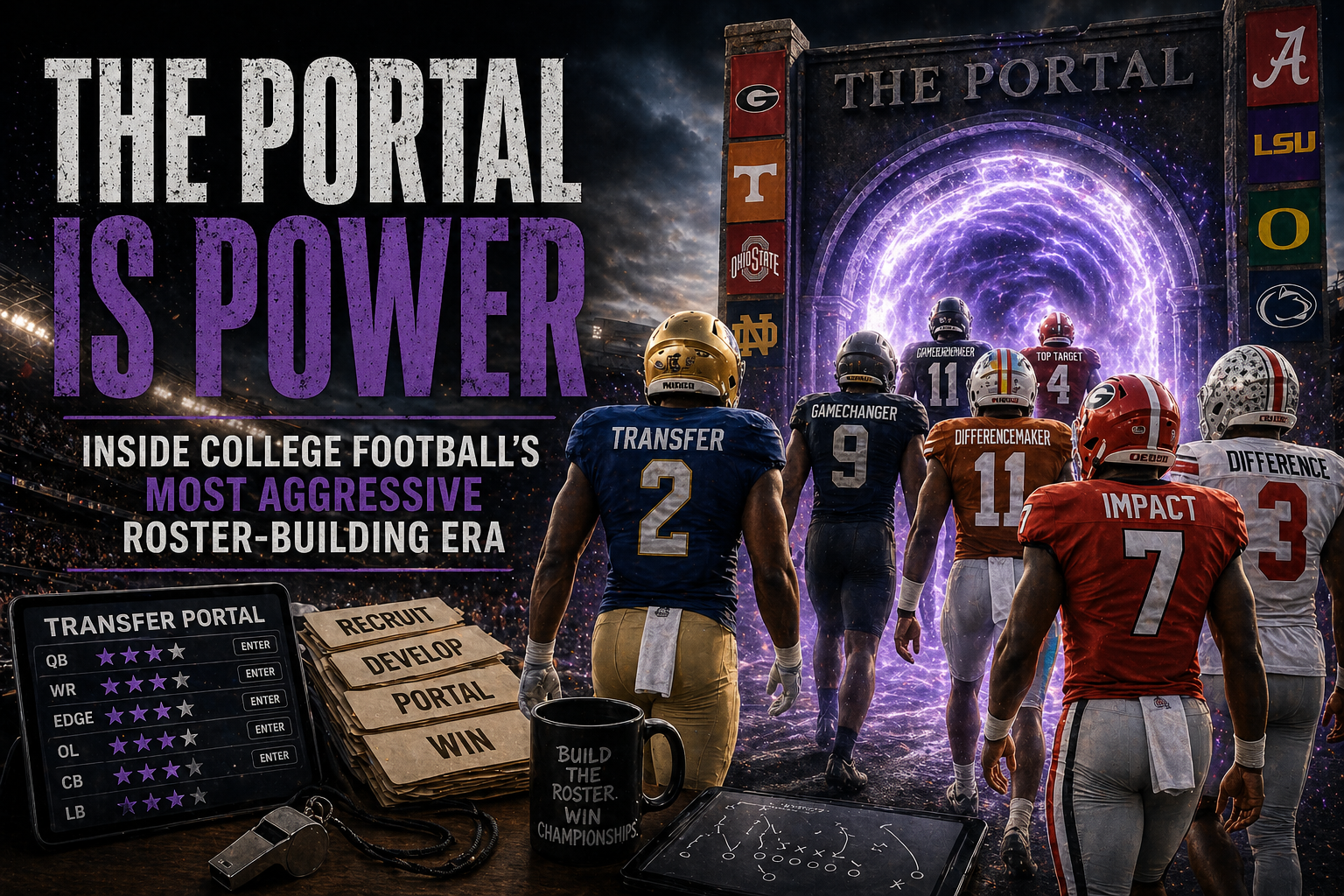
The Portal Is Power — Inside College Football's Most Aggressive Roster-Building Era
The window closed January 16. The deals were done in days. The dynasties were reshuffled overnight. And the teams that won the transfer portal war in 2026 will be the ones hoisting trophies in January.
The 2026 college football transfer portal cycle was, by almost every measure, the most aggressive and consequential single roster-movement period the sport has ever seen. Starting January 2, the new winter-only window ran for just 15 days — a compressed, frantic two-week sprint that functioned less like a traditional transfer portal and more like NFL free agency, with program-altering moves happening by the hour and NIL dollars defining who landed where. When the window closed on January 16, the college football landscape had been comprehensively reshuffled. Some programs added starters at every critical position group. Some lost pillars of their identity. And the teams that emerged from the cycle with the best new rosters — combined with elite traditional recruiting classes — now enter 2026 as genuine national championship contenders.
The Transfer That Changed the SEC: Sam Leavitt to LSU
No single transfer defined the 2026 cycle more than Sam Leavitt's move from Arizona State to LSU. Lane Kiffin, hired to replace the previous coaching staff in Baton Rouge, immediately proved his reputation as a portal dealmaker by landing the most coveted quarterback in the entire cycle. Leavitt went 16-4 as a starter over two seasons at Arizona State under Kenny Dillingham, completing north of 65% of his passes and demonstrating the creative playmaking ability and mobility that analysts described as ideal for Kiffin's offensive scheme. He was recovering from a Lisfranc injury suffered last September, but the consensus was that the talent and the system fit were too good for LSU to pass on.
Around Leavitt, Kiffin assembled one of the most aggressive portal classes in LSU history. Wide receivers Eugene Wilson III (from Florida), Jayce Brown (Kansas State), Tre' Brown III (Old Dominion), and Winston Watkins (Ole Miss) give the Tigers a rebuilt passing attack. Boise State defensive back Ty Benefield — who had the seventh-most tackles among defensive backs nationally in 2025 — adds immediate impact on the other side of the ball. Top-ranked edge rusher Princewill Umanmielen gives the defensive line a disruptive presence Kiffin's previous program always craved. LSU's 2026 roster, built almost entirely through the portal in a matter of days, is one of the most intriguing collections of talent in the SEC.
Penn State's Full Rebuild: Matt Campbell's Iowa State Pipeline
When Matt Campbell left Iowa State for Penn State after James Franklin's departure, he didn't rebuild the Nittany Lions' roster in the traditional sense. He essentially transplanted his Iowa State system — quarterback, scheme, coaching staff, and all — to State College. Quarterback Rocco Becht, who started 39 games for Campbell at Iowa State, arrives as Penn State's Day 1 starter. The top nine transfers in Campbell's class all came from Iowa State. Running back James Peoples came from Ohio State, where he averaged 5.6 yards per carry. Safety-linebacker hybrid Marcus Neal arrives as one of the most disruptive defensive players in the system.
The culture transplant is unprecedented in modern college football history. No head coach has ever moved to a new Power conference program and brought so much of his existing roster infrastructure with him. Whether it works — whether Big Ten defenses expose the limitations of a scheme built in the Big 12, and whether Becht can handle the pressure of playing in one of college football's most scrutinized markets — is the defining question of Penn State's 2026 season.
The Recruiting Classes: Texas, Tennessee, and the NIL Battle
On the traditional recruiting front, the 2026 class produced several programs that distinguished themselves in the battle for five-star talent. Texas landed five-star quarterback Dia Bell as the headline of a class that also included five-star edge rusher Richard Wesley and linebacker Tyler Atkinson, continuing the Longhorns' remarkable recruiting momentum under their current staff. Tennessee's class featured five-star quarterback Faizon Brandon and five-star wide receiver Tristen Keys — both of whom are expected to compete for immediate playing time under Josh Heupel's wide-open offensive system. Heupel's offense has consistently ranked among the most productive in the SEC, and adding that level of skill talent to an already explosive roster creates a legitimate national title threat.
Alabama's class, led by five-star running back Ezavier Crowell and defensive standouts Xavier Griffin and Jireh Edwards, continued Kalen DeBoer's argument that the Crimson Tide recruiting machine does not require Nick Saban to function at the highest level. Miami — runners-up in the national championship game — assembled another top ACC class led by five-star offensive tackle Jackson Cantwell, ranked as the No. 2 overall player in the country.
The Portal's Most Impactful Position: Quarterback
The quarterback movement in the 2026 portal cycle was historic in its volume and quality. Dylan Raiola — the former five-star from Buford, Georgia who threw for 4,819 yards and 31 touchdowns over two seasons at Nebraska before a broken fibula ended his 2025 — entered the portal and drew immediate interest from Georgia and multiple other programs. Josh Hoover, who completed north of 65% of his throws at TCU across multiple seasons, transferred to Indiana to replace Heisman winner Fernando Mendoza — arguably the single most seamless quarterback succession story in the portal's history. Duke's Darian Mensah entered the portal in the closing hours of the window, adding another high-profile name to a cycle already bursting with available starting-caliber passers.
The portal has permanently altered how college football programs are built. Indiana won a national championship not despite their portal-heavy roster construction but because of it. The sport has accepted this reality, and the programs that have mastered the combination of traditional recruiting and portal targeting — Texas, Georgia, Alabama, LSU, and now Penn State under Campbell — are the ones positioned to compete for titles in 2026 and beyond.