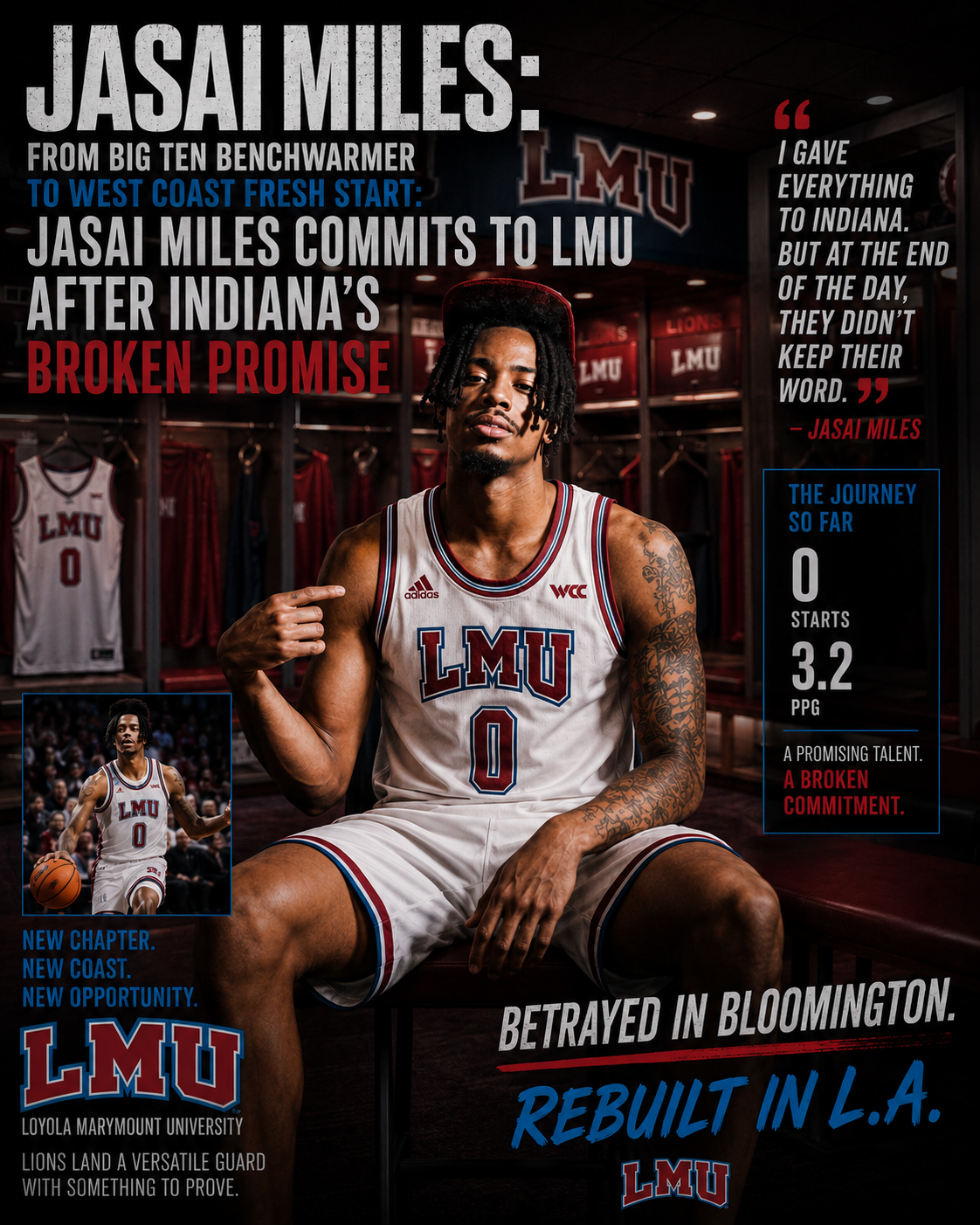
From Big Ten Benchwarmer to West Coast Fresh Start: Jasai Miles Commits to LMU After Indiana's Broken Promise
He averaged 15 points and nearly 7 rebounds a game at North Florida. He scored in double figures in 29 of 32 games his final season at UNF. Indiana brought him in promising opportunity, then gave him 9.5 minutes a game and a bench role he never escaped. Now he's starting over — and this time, he's going somewhere he'll actually play.
The story of Jasai Miles's one season at Indiana is a story the transfer portal era produces regularly, but rarely quite as starkly. Miles was not a roster filler or a depth piece brought in to practice against starters. He was a genuine mid-major star — an Atlantic Sun All-Conference Third Team selection who had spent his sophomore season at North Florida averaging 15.4 points per game on efficient shooting, 6.8 rebounds, and the kind of two-way versatility that made him exactly the type of player first-year Indiana head coach Darian DeVries was targeting in his initial transfer portal class. DeVries ranked that class 10th nationally. Miles was the fifth player committed to it. The pitch was clear: come to a Big Ten program, prove yourself at the highest level, and develop into the kind of player who makes noise on college basketball's biggest stage. What Miles actually received was 26 games, 9.5 minutes per game, and a single-digit scoring average against opponents who had never heard of him. On May 3, 2026, Miles committed to Loyola Marymount — and the full arc of what happened in between is worth understanding in detail.
Who Jasai Miles Is: The Player Indiana Recruited
Before the disappointment, there was a real reason Indiana wanted him. Miles's final season at North Florida — his sophomore year, 2024-25 — was one of the most productive individual campaigns in the Atlantic Sun Conference that year. His 15.4 points per game represented efficient, multi-faceted scoring: he could create off the bounce, use his 6-foot-6 frame to post up smaller guards, and make shots at a respectable clip from midrange and the three-point line. His 6.8 rebounds per game from the guard position represented elite board work that gave him a physical profile reminiscent of a classic NBA wing. He scored in double figures in 29 of 32 games that season — a mark of consistency that said he wasn't a flash-in-the-pan performer in blowouts but a player who competed and produced every single night regardless of the score.
The recruitment to Indiana was built around that profile. DeVries, in his first offseason as the Hoosiers' head coach following Mike Woodson's departure, was constructing a roster of high-minute mid-major producers — players who had proven they could score, rebound, and compete in real games rather than projects who needed years of development. Miles fit that blueprint precisely. He was not a freshman recruit. He was a college basketball player with real film, real statistics, and real experience. The expectation, reasonable on its face, was that his production would translate to meaningful minutes at Indiana.
What Actually Happened: A Season Lost to the Bench
The reality of Miles's season in Bloomington was the opposite of the promise. He appeared in 26 games and averaged 9.5 minutes per contest — less than a quarter of what a full player's allocation looks like in a 40-minute game. His averages dropped from 15.4 points at North Florida to 1.6 points in Bloomington, from 6.8 rebounds to 1.9. He scored in double figures zero times in his entire season at Indiana — a player who had done it 29 of 32 times the previous year, now unable to produce at any level in a division he had already proven he could dominate.
The statistical collapse was not a talent failure. It was a playing time failure. You cannot score 15 points per game in 9.5 minutes. You cannot grab 7 rebounds in under 10 minutes. The system that put him in Bloomington with a promise of opportunity simply did not deliver on that promise. Before teammate Tayton Conerway missed games with injury — which temporarily created a rotation opening — Miles was being faded from the rotation entirely, seeing under five minutes in four of Indiana's first five high-major games. The exception was a Marquette contest where he got 14 minutes and added four points, a brief window of genuine involvement that closed as quickly as it opened. He was placed on the injury report at various points — listed as questionable or out with undisclosed ailments — and missed stretches of the season entirely. His entire presence at Indiana felt like a player waiting for an opportunity that the coaching staff had already decided not to give him.
Indiana missed the NCAA Tournament for the second consecutive year under the program's previous and current regimes. DeVries's first season in Bloomington did not produce the results the program needed, and the portal cycle that followed saw Miles — along with several teammates — make the rational decision that a fresh start served everyone better. Miles entered the portal in early April. Only Nick Dorn, among the players who left, had produced at any meaningful level during the season. The Hoosiers lost six players total, and DeVries responded by switching his portal philosophy completely — now targeting proven high-major players rather than the mid-major producers he had brought in last spring. The irony is direct: the approach that brought Miles to Indiana has already been abandoned by the coach who used it.
Why LMU: The West Coast Conference and Playing Time That's Actually Real
Miles has committed to Loyola Marymount, entering the West Coast Conference under head coach Stan Johnson in his seventh season at the program. LMU finished 15-17 last season — not a glamour destination — but it offers what Indiana demonstrably did not: a realistic pathway to a starting role, genuine minutes, and an opportunity to rebuild professional value in a competitive mid-major environment where a 6-foot-6 wing who averaged 15 points and 7 rebounds two years ago will actually get the ball.
LMU is located in Los Angeles — a major market, close to family networks for players from the West Coast, and a program that under Johnson has been building toward WCC competitiveness. Miles arrives with three years of eligibility remaining after the redshirt year his Indiana stint effectively represented for his development. He is not a lottery prospect or a future first-round pick. He is a basketball player who was good enough to average 15 points against real competition and good enough to earn a scholarship at a Big Ten program. The only thing Indiana ever gave him that he couldn't use was time. At LMU, that finally changes. His story is one the transfer portal produces constantly but rarely examines closely — the mid-major star recruited to a Power conference, under-utilized, and left to find himself somewhere new. Miles is 22 years old. His best basketball is ahead of him.
Jasai Miles career stats — UNF (2024-25): 15.4 PPG, 6.8 RPG, 1.9 APG, Atlantic Sun All-Conference Third Team. Indiana (2025-26): 1.6 PPG, 1.9 RPG, 9.5 MPG across 26 games. Double-digit scoring games at UNF: 29 of 32. Double-digit scoring games at Indiana: 0. Transfer destination: Loyola Marymount (WCC). LMU head coach: Stan Johnson (7th season, 87-90 overall).