Napheesa Collier's NPR Interview Just Started the WNBA's Most Important Officiating Debate of the Year
The best defensive player of the modern era just said the game is too physical. A rookie No. 1 pick said she's confused because every touch is a foul. The league's commissioner has already spent the offseason retraining the referees. The WNBA is about to look fundamentally different. The question is whether everyone will agree that's a good thing.
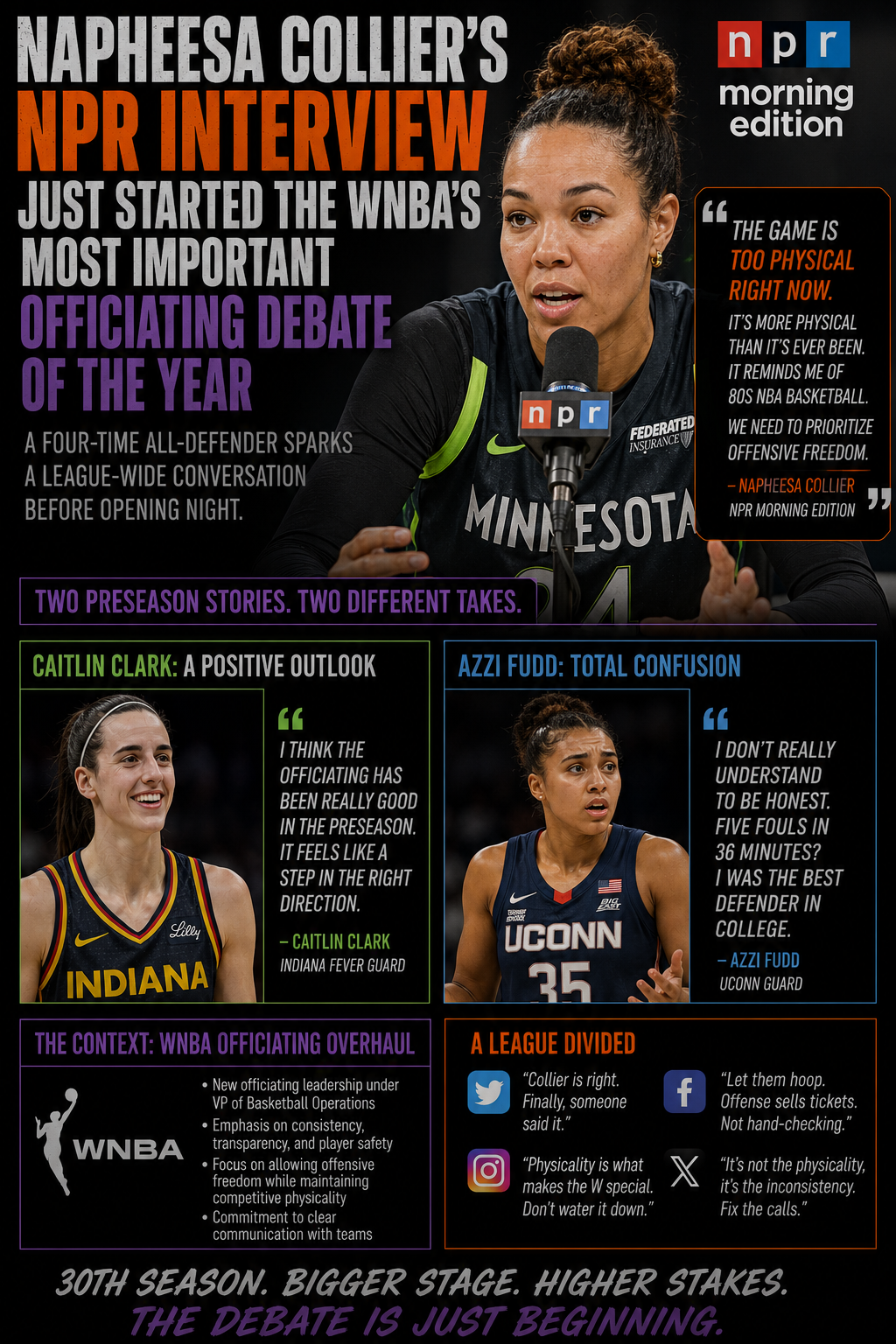
The most consequential sports media conversation involving women's basketball in recent days was not generated by a game result, a draft pick, or a contract signing. It happened on NPR's Morning Edition, when Minnesota Lynx star Napheesa Collier sat down for an interview published May 6 and said something that immediately lit up every basketball-adjacent social media platform in the country. "I do feel like the game is too physical right now," Collier said. "I think that's been a complaint of players and coaches alike for the past several years. We've been compared to the NBA of the '80s, in just our physicality. And I do think that hinders the players, obviously. Like, you come to watch players play offense and to score. When it's so physical, the game is not fun to watch and it's not fun to play." The basketball world stopped and argued about what she had just said. It is still arguing.
Why Collier Said It — and Why She's the Most Credible Possible Messenger
To understand the weight of these comments, you have to understand who Napheesa Collier is in the context of this argument. She is not an offensive-first perimeter player frustrated by physical coverage limiting her production. She is the WNBA's premier defensive force of the modern era — a four-time All-Defensive selection, the 2024 Defensive Player of the Year, a player whose entire competitive identity has been built on the physicality and intensity that she is now saying the league needs to reduce. When the best defensive player in the league says the game is too physical, it carries a specific kind of authority that no other voice in the sport can replicate.
Collier's motivations are also personal in ways that go beyond competitive preference. Last season, she missed multiple games in August with a right ankle sprain before tearing three ligaments in her ankle during the playoffs — an injury that ended her season prematurely and cost the Lynx their deepest possible postseason run. At the time, Collier publicly accused the WNBA of failing to protect its players. Her position on physicality is not a new development generated by this preseason. It is a conviction built over years of competing in a league she believes puts its players at unnecessary physical risk, compounded by the personal experience of losing significant portions of two consecutive seasons to injuries she believes resulted from exactly that risk.
She also carries institutional credibility beyond her playing credentials. Collier was a key figure in negotiating the WNBA's landmark new collective bargaining agreement as a prominent WNBPA representative — the deal that delivered the salary cap increase from $1.5 million to $7 million and dramatically improved player compensation across the board. Her position within the league's labor structure gives her comments on officiating and rule changes a weight that goes beyond a player simply complaining about how the game is called.
The League Is Already Moving
The most important context for Collier's NPR comments is that the WNBA has already effectively started implementing what she is asking for. WNBA Commissioner Cathy Engelbert went on record in April saying the league spent the offseason working closely with referees to improve foul consistency and create clearer standards around physical play heading into 2026. The preseason has already produced visible evidence of that shift, and two of the most compelling witnesses to it have come from opposite ends of the spectrum. Caitlin Clark — who has spent two professional seasons absorbing physical defensive coverage that produced the most controversial officiating debates in the league's modern history — praised the preseason officiating directly and without reservation. "I thought the refs did a really good job tonight, actually," she said after the Fever-Wings preseason matchup. A player who has had more reason than anyone to complain about the league's physicality is, in the opening days of the 2026 preseason, satisfied with what she is seeing.
On the other side: Azzi Fudd. The No. 1 overall pick in the 2026 draft — a player who had the best steals-and-blocks-to-personal-foul ratio in all of Division I women's basketball last season, recording 116 defensive plays against just 32 personal fouls — picked up five personal fouls across just 36 preseason minutes in her first two professional appearances. Her candid postgame comment after the second game captured the exact paradox the league is navigating: "Honestly, I feel more confused. I thought you could be physical in the W, and anytime you touch someone, it's a foul. I'm not really sure whether to be physical, I don't know. I'm still figuring that one out." A player whose entire defensive reputation was built on aggressive, high-contact defense is being penalized more in two preseason games than she typically was in several collegiate contests.
The Fan Debate: A League Divided
The social media response to Collier's comments was immediate, loud, and almost perfectly divided along the fault lines that have defined women's basketball discourse for the past two years. Fans who had criticized the league's physicality for years — particularly in the context of the hard fouls Clark received as a rookie — embraced Collier's position as validation. Fans who value the WNBA's physical, defense-first identity expressed concern that the league is fundamentally altering its product in response to pressure driven by one player's fanbase. "They keep going this way, they're going to lose all the viewers they gained over the past few years," one commenter predicted. "Idk I agree. Nobody wants to watch low scoring games. People like offense. It attracts eyes," countered another.
The debate is not resolvable through social media argument, and Commissioner Engelbert's approach — working with referees rather than changing rules, emphasizing consistency rather than enforcement overhaul — suggests the league is trying to thread a needle between competing visions of what women's basketball should look like. Whether the preseason's lighter whistle persists into the regular season, whether players adapt their defensive schemes accordingly, and whether the result produces the higher-scoring, more offensively entertaining product that Collier envisions — or the softer, foul-heavy game that her critics fear — will define the WNBA's 2026 identity as much as any individual player or any championship run.
Napheesa Collier NPR Morning Edition comments published: May 6, 2026. Collier's defensive accolades: 4x All-Defensive, 2024 DPOY. Azzi Fudd preseason fouls: 5 in 36 minutes across 2 games. Fudd's college foul rate: 32 personal fouls per 116 defensive plays (best ratio in Division I). WNBA Commissioner Cathy Engelbert: confirmed offseason referee retraining program. 2026 WNBA regular season begins: May 8.