Tuberville Draws a Line on College Sports Reform
The fight over how Washington should govern college sports got louder this week. Senator Tommy Tuberville of Alabama publicly opposed the Protect College Sports Act, telling the Senate floor that the bipartisan bill "goes too far" and risks adding confusion to an already chaotic college athletics landscape. The story was highlighted in the Winning Her Way newsletter and the core facts were confirmed by On3, ESPN, and Fox News.
Tuberville is not a random voice on this topic. He spent decades as a college football head coach before entering the Senate, which gives his position real weight inside the debate. His opposition matters because it shows that even people who broadly agree college sports need federal rules do not agree on what those rules should be.
What the Protect College Sports Act Tries to Do
The Protect College Sports Act is a bipartisan proposal built to bring order to a system that has been reshaped by court rulings, NIL, the transfer portal, and a patchwork of differing state laws. Supporters argue that without a national framework, schools and athletes are left guessing.
The bill's stated goals include creating national standards for athlete compensation, establishing transfer regulations, providing legal protections for athletic organizations, addressing competitive balance, protecting Olympic and non-revenue sports, and building clearer governance structures for college athletics. The argument from supporters is simple. One federal standard beats fifty different state approaches plus a steady stream of lawsuits.
The bill has picked up notable outside support. The NFL, the NFL Players Association, and the NBA Players Association have all told Congress they back the legislation. At the same time, the SEC and the Big Ten have raised concerns about the current version, which shows the disagreement is not just along party lines.
What Is Actually in the Bill
The Protect College Sports Act is not a short document. The roughly 111 page bill, introduced by Senators Maria Cantwell, Ted Cruz, Chris Coons, and Eric Schmitt, would write much of the recent House v. NCAA settlement into federal law. According to reporting from CBS Sports and Yahoo Sports and materials from the Senate Commerce Committee, that means codifying the revenue sharing framework at the center of the settlement and giving the new College Sports Commission the job of policing spending above the cap.
The numbers are concrete. Under the settlement framework the bill would lock in, each school can share roughly 21.3 million dollars with its athletes. The act would also extend that revenue sharing system after the House settlement is set to expire in 2035, which is part of why it reaches so far into the future of the sport.
On NIL, the bill would create a national standard and preempt the patchwork of state laws that schools have spent years navigating. Athletes would have to disclose NIL deals worth more than 600 dollars within 30 days, and the bill envisions a searchable database of anonymized deal data. It would set up an agent registry that caps fees at 5 percent, bar the creation of a breakaway super league, and stop coaches from leaving their teams before a season ends. On transfers, it guarantees one move without losing eligibility, with a second transfer generally requiring a year out except in specific cases such as a sport being discontinued.
Perhaps the most consequential piece is the antitrust protection. The bill would grant the NCAA and the College Sports Commission a limited antitrust exemption so they can enforce rules on eligibility, transfers, and compensation without the constant threat of litigation. That is exactly the kind of broad authority that Tuberville objects to.
Why Tuberville Says It Goes Too Far
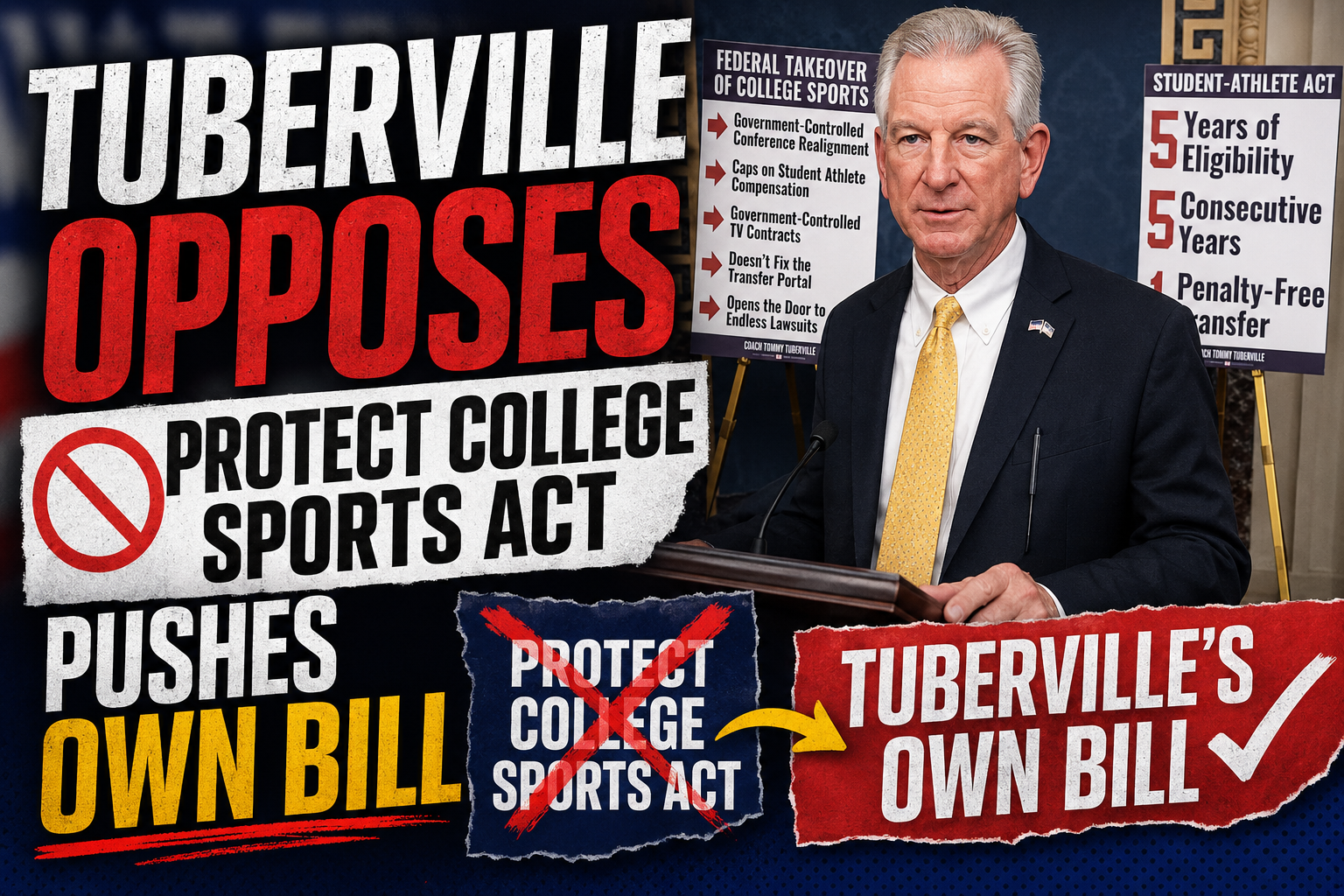
Tuberville's criticism centers on the scope of the bill. In a Senate floor speech that ran more than fifteen minutes, he described parts of the act as a "federal takeover of college sports," pointing specifically to caps on athlete compensation and what he called government-controlled television deals. His view is that Congress should not be in the business of deciding media rights agreements, conference alignments, and athletic department operations.
He also raised a legal warning. Tuberville argued that the bill contains loopholes and waivers around eligibility that could open the door to more lawsuits, which would defeat the purpose of a bill meant to create stability. That concern lands for many in the sport, since the NCAA has spent years fighting litigation over compensation, eligibility, and transfer rules. A new framework that is not airtight could simply become the next legal target.
The throughline of his argument is that the legislation focuses on controlling institutions rather than directly helping athletes. He believes lawmakers should prioritize clarity and stability for students over expanded federal oversight of the business of college sports.
Tuberville's Alternative: The Student-Athlete Act
Instead of backing the Protect College Sports Act, Tuberville is pushing his own bill, the Student-Athlete Act. It is built around three straightforward reforms: five years of eligibility, five consecutive years to use that eligibility, and one penalty-free transfer.
The pitch is simplicity. Rather than a sprawling regulatory structure, Tuberville's proposal sets clear rules that athletes, schools, and conferences can understand without a legal team. He argues that fixing eligibility and standardizing one clean transfer window would address the instability that coaches and administrators complain about most, without inserting the federal government into media and conference decisions.
Why Congress Keeps Circling This
It is worth remembering that this is not the first attempt to put federal rules around college sports. Earlier efforts, including the SCORE Act, stalled out before reaching the finish line, which is part of why the bipartisan Protect College Sports Act drew attention when its momentum emerged. Lawmakers have been trying for years to replace the patchwork with a single national standard, and each attempt has run into the same wall, a disagreement over how much power Washington and the NCAA should have. Tuberville's stand is the latest version of that recurring fight, not a one off objection. That history is also why few expect a fast resolution, even with prominent figures from football pushing for action.
The Transfer Portal and NIL Sit at the Center
Two issues keep driving this entire debate. The transfer portal has given athletes far more freedom to move, which creates opportunity for players but real headaches for coaches trying to build rosters across multiple seasons. Critics say unrestricted movement undermines continuity. Supporters counter that athletes deserve the same mobility coaches have always enjoyed.
NIL is the bigger and more complex piece. Since athletes gained the right to profit from their name, image, and likeness, spending has climbed sharply at the top programs. Supporters see NIL as an overdue correction that lets athletes share in the value they create. Critics worry about an arms race that strains competitive balance and squeezes smaller programs. Because states wrote different NIL rules and courts have repeatedly limited the NCAA's ability to regulate pay, many lawmakers believe only a federal standard can settle it.
What Happens Next in Congress
The path forward is not clear. When Tuberville moved to advance his Student-Athlete Act by unanimous consent, Senator Maria Cantwell objected, which stopped that effort. Senator Ted Cruz has signaled that any proposal will likely need bipartisan support to actually pass. That means negotiation, not a quick vote.
For athletes, coaches, schools, and fans, the stakes are high. Whichever framework gains traction could reshape eligibility, NIL, transfers, and college sports governance for years. The clearest message from this week is that both sides claim to be protecting student-athletes. They simply disagree on what that protection should look like and who should be in charge of it.
Sources: reporting confirmed by On3, ESPN, and Fox News. Bill details via CBS Sports, Yahoo Sports, and the U.S. Senate Commerce Committee.

Related Articles
Tuberville Opposes Protect College Sports Act, Pushes Own Bill