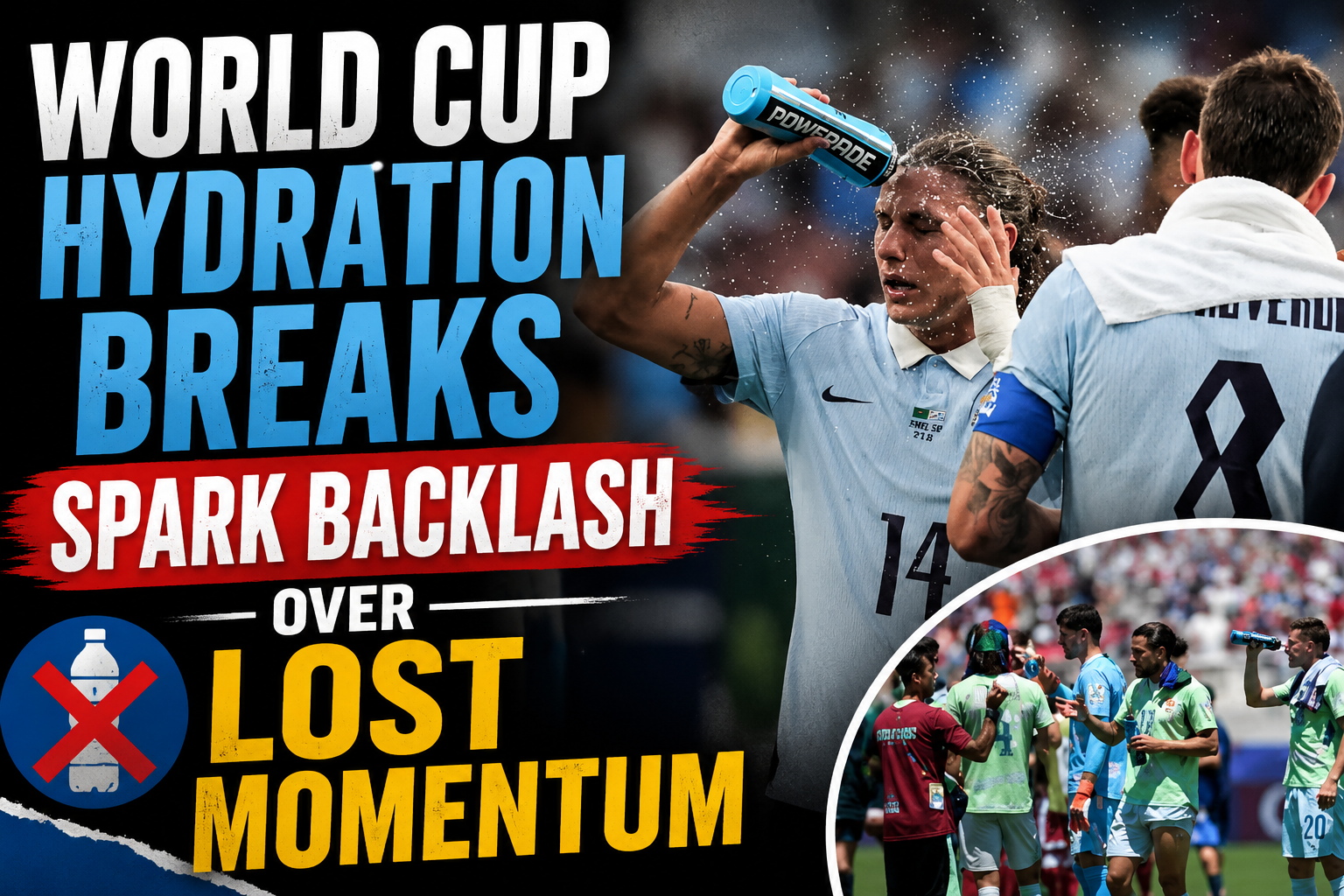
Hydration Breaks Become the Talk of the 2026 World Cup
A new wrinkle at the 2026 World Cup is drawing more attention than some of the goals. FIFA's hydration breaks, added to help players handle summer heat across the United States, Canada, and Mexico, have sparked a backlash and are being blamed for killing the momentum of games. The story moved on the Associated Press wire and the details were confirmed by ESPN and The Washington Post.
The concept is simple enough. Referees pause the match roughly 22 minutes into each half, giving players about three minutes to rehydrate. With many matches played in genuine heat, the health logic behind the breaks is easy to follow. The problem is what the breaks are doing to the flow of the games and to the spectacle the World Cup is supposed to deliver.
The Curacao Moment That Captured the Complaint
If you want one example that sums up the criticism, look at Curacao against Germany in Houston. Curacao, the smallest nation by population ever to qualify for a World Cup, had stunned the four time champions. Livano Comenencia scored to make it 1-1, and with the underdog carrying the run of play, a famous upset suddenly looked possible.
Then came the hydration break. Curacao lost the initiative during the stoppage and conceded two goals before halftime. The match eventually turned into a 7-1 win for Germany. Momentum maps shared after games like this one have shown how sharply the energy of a match can swing once play stops, and the Curacao collapse became the headline example.
Players and Coaches Weigh In
The pushback is not limited to fans. Netherlands captain Virgil van Dijk publicly criticized the breaks, lending a prominent player's voice to the complaint. Players who feel they are in rhythm do not want to stop, especially when they have the better of an opponent.
Coaches, on the other hand, have found a use for the pause. Several have seized the hydration break to deliver in-game tactical instructions that would normally be impossible without a substitution or halftime. That has created a fairness question of its own. A break designed for player welfare is doubling as a free coaching timeout, and the team that is struggling often benefits most from the reset.
The Television Question
A second line of criticism is about money and broadcasts. Some observers argue the breaks are a convenient excuse to send games to commercial in the middle of the action. In the United States, Fox has been going to commercials during the hydration breaks, which feeds the suspicion that the stoppages serve broadcasters as much as players.
For a sport that has long prided itself on two largely uninterrupted halves, that is a meaningful shift. Soccer's continuous flow is part of its identity, and fans are sensitive to anything that makes the game feel more like a stop and start broadcast product. The boos that greeted the first hydration break in the match between Iraq and Norway in Foxborough, Massachusetts, made the mood clear.
The Policy That Frustrates Critics
Part of what fuels the frustration is that the breaks are mandatory regardless of conditions. FIFA stipulated that the stoppages occur no matter the weather, the venue, or the location. That meant the Spain against Cape Verde match in Atlanta was interrupted even though it was played under a roof in an air conditioned stadium.
Critics point to that as the weak spot in the policy. If the breaks exist to protect players from heat, applying them in a climate controlled stadium undercuts the rationale and turns a safety measure into a blanket rule. Supporters of the policy would argue that consistency across all matches is the point, since selective breaks could create their own complaints about fairness. Either way, the one size fits all approach is now part of the debate.
The Heat Threat Behind the Rule
The backlash is loud, but the underlying problem is real. This is the first World Cup played across the United States, Canada, and Mexico in the heart of summer, and the heat has emerged as one of the tournament's defining challenges. Reporting from Time and others has noted that extreme heat is putting athletes at genuine risk, and the conditions are not evenly distributed across the 88 days and many venues.
The data explains FIFA's caution. In June and July, the same window the tournament occupies, afternoon temperatures in 14 of the 16 host cities frequently climb past 82 degrees Fahrenheit, and six of those cities often exceed roughly 90 degrees. Research cited by climate scientists and sports medicine experts has suggested that around a quarter of World Cup matches could face potentially dangerous heat. Against that backdrop, a three minute drink is not an unreasonable idea.
Where the experts and FIFA diverge is on the thresholds. The global players union FIFPRO has pushed for protections tied to the wet bulb globe temperature, recommending mandatory cooling breaks when that reading hits about 79 degrees Fahrenheit and advising that matches be postponed near 82 degrees. FIFA's own threshold for even considering postponement sits much higher, around 90 degrees. That gap is the real fault line. FIFPRO argues player welfare should outrank commercial concerns, while critics of the current setup say the mandatory, weather blind break splits the difference badly, applying a heat measure everywhere while ignoring the science on when heat is actually dangerous.
Balancing Safety and the Spectacle
None of the criticism erases the real reason the breaks exist. Player welfare in summer heat is a legitimate concern, and a tournament spread across North America in June and July faces conditions that can affect performance and health. The challenge for FIFA is that the current version of the solution is colliding with the very thing that makes the World Cup compelling, the uninterrupted drama of a match finding its rhythm.
The questions now are practical. Should the breaks be tied to actual temperature and humidity rather than applied everywhere? Should covered, air conditioned venues be exempt? Should the timing change so a break is less likely to interrupt a clear run of momentum? Those are the conversations the backlash is pushing to the front.
A Bigger Tournament Means More of It
The volume is part of why this matters. The 2026 World Cup is the first to feature an expanded 48 team field, which means more matches, more venues, and more chances for a hydration break to land at the wrong moment. Fans are not going to see this stoppage once or twice. They will see it twice in nearly every match across the entire tournament, which is why a rule that might have passed quietly is instead becoming a running storyline. When a format is brand new and the audience is the largest a World Cup has ever drawn, every novelty gets magnified, and the hydration break is the one everyone is talking about.
What to Watch
Expect the hydration break debate to follow this World Cup deep into the knockout rounds, especially if another underdog sees a promising spell snuffed out by a stoppage. FIFA has a balance to strike between protecting players and protecting the show. For now, a measure meant to keep athletes safe has become one of the defining storylines of the tournament, and not in the way organizers hoped.
Sources: Associated Press wire item; confirmed by ESPN and The Washington Post. Heat data via Time and FIFPRO.

Related Articles
World Cup Hydration Breaks Spark Backlash Over Lost Momentum