The Game That Never Happened: York Revolution Forfeits Pride Night After Players Refuse Rainbow Jerseys — and the Organization Fires Back
They had nine days of warning. They had a team meeting. They had a general manager who stood in front of them and asked them to reconsider. They still said no. And so the York Revolution forfeited a baseball game, wrote a $10,000 check to a local LGBTQ nonprofit, and told their own players — in public, in unmistakable language — that what they did was completely unacceptable.
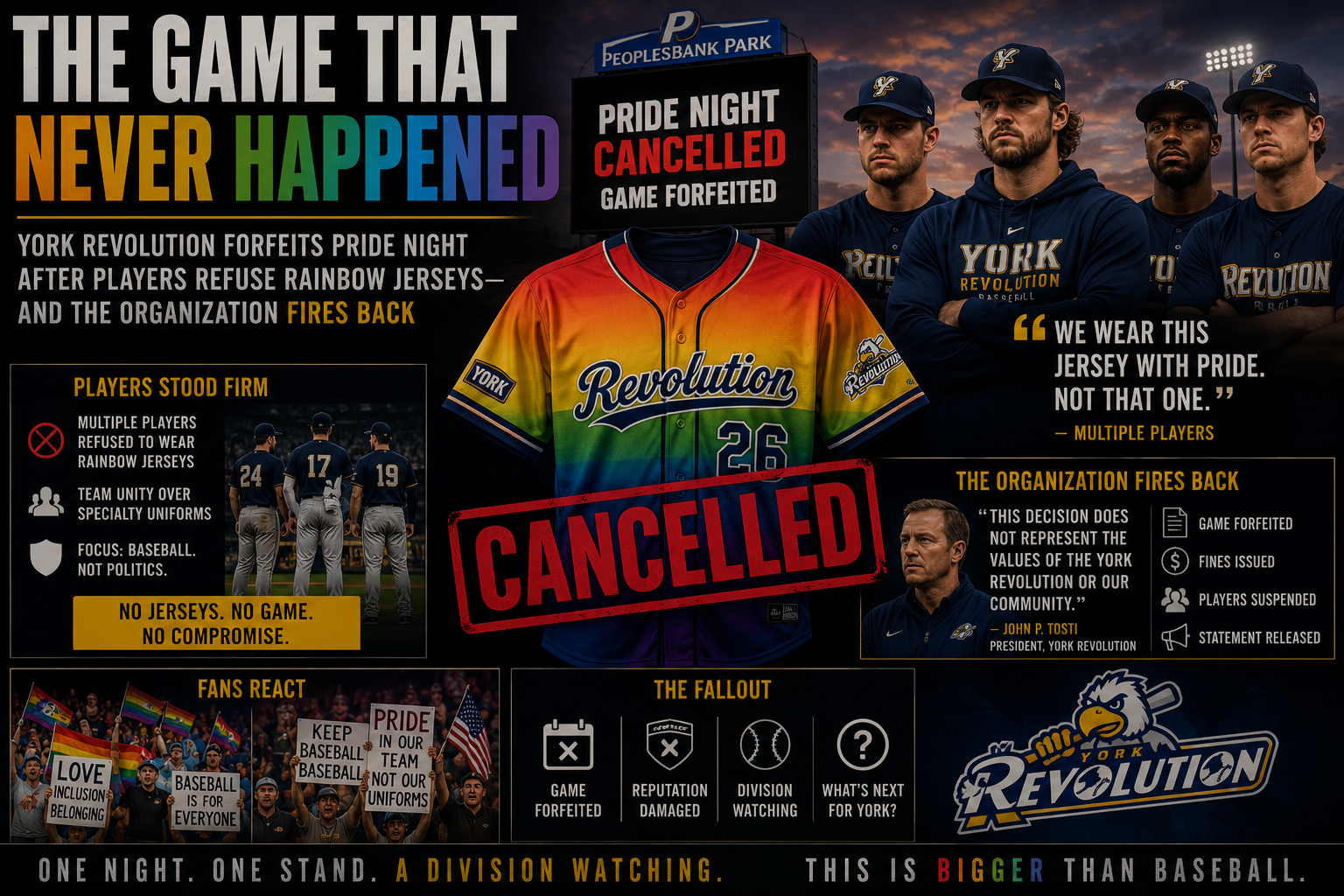
There was no game at WellSpan Park in York, Pennsylvania on Thursday night. The gates opened. The music played. Fans walked the warning track and took batting practice and toured the stadium in the June heat. The Rainbow Rose Center set up its tables. The lights came on. The scoreboard lit up. And there was no baseball — because fewer than nine of the York Revolution's 28 players were willing to wear a jersey with rainbow sleeves, and the team's management decided that if they could not have Pride Night with integrity, they would forfeit the game rather than compromise the event that had taken eleven years to build.
The decision, announced Wednesday and executed Thursday, was unprecedented in professional baseball and almost certainly in any professional sport in America. A team — willingly, deliberately, and with full financial consequence — chose to absorb a forfeit loss, donate ten thousand dollars out of its own pocket, and publicly condemn the behavior of its own roster rather than allow a group of players to dictate the terms of an event the organization had been hosting annually since 2015. In a statement, the York Revolution said it was with "great disappointment" that the team did not play the game and chose to forfeit. The word "disappointment" carried the specific weight of an organization that had done everything it could to prevent what ultimately happened.
What Happened in the Days Before
The story of Thursday's forfeit did not begin Thursday. President and GM Ben Shipley said his manager told him Tuesday that fewer than nine players on the 28-man roster — the minimum needed to fill out a lineup card — were willing to play in Thursday night's uniforms. Shipley said the discussion led to an unprecedented team meeting at which he was unable to talk players into wearing the rainbow sleeves.
That detail — the team meeting, the GM personally present, the inability to persuade even the minimum required number of players — is the most revealing element of the entire episode. Shipley did not send a memo. He did not issue a mandate through the coaching staff. He walked into the room himself and made the case directly: this event matters, this community matters, these jerseys represent who we are as an organization, and I am asking you to wear them. The players who refused did so after hearing that case in person from the man who runs the team. The refusal was not a miscommunication or a logistical failure. It was a decision, made consciously and deliberately, by enough players to make fielding a lineup impossible.
The Revolution's game against the Southern Maryland Blue Crabs was going to mark the Pennsylvania team's 11th Annual Pride Night, but players refused to don special jerseys that had rainbow sleeves. Eleven years of the event. Eleven years of the partnership with the Rainbow Rose Center. Eleven years of the organization building a reputation as, in its own words, the Most Welcoming Place in York. All of it brought to a halt by a group of professional athletes who would not put on a piece of clothing for three hours.
The Statement: An Organization That Did Not Mince Words
When a professional sports organization's players embarrass the team in a public and consequential way, the standard institutional response is carefully managed — measured language, emphasis on resolution, minimal direct criticism of the players involved. The York Revolution did not take that approach. "This action by the players is completely inconsistent with our vision as the Most Welcoming Place in York," the team wrote in its statement. There was no hedging in that sentence. There was no diplomatic softening of the accountability. The organization called the players' action what it was — a violation of the organization's values — in writing, for the record, in the public statement it distributed to media.
"This decision was not reached lightly," the team said, adding that "several of our players have refused to wear the scheduled Pride Night jersey and the club decided that hosting the event is more important than forcing players to wear jerseys they are not comfortable with and playing the game." The framing of that passage is careful and worth examining. The organization acknowledged the players' discomfort — it did not minimize or dismiss it — while simultaneously making clear that the discomfort did not override the obligation to the event and the community it represents. This was not a team that fired its players or demanded public apologies. It was a team that drew a line, accepted the consequence of where the line was drawn, and committed its own resources to demonstrating that commitment.
To mark its regret over the last-minute disruption, the club announced a $10,000 donation to the Rainbow Rose Center, a local LGBTQ nonprofit. The donation was not a legal settlement or a public relations calculation designed to manage the story. It was described explicitly as a "small token of our regret" — an acknowledgment that money cannot compensate for what the LGBTQ community of York was denied Thursday night, but that the organization would contribute something tangible rather than issue words alone. The players who refused the jersey lost the organization ten thousand dollars and a home game. The team paid the bill without putting it on the players. That restraint is, in its own way, as significant as the forfeit itself.
What the LGBTQ Community in York Said
The Rainbow Rose Center, which serves the LGBTQ community of York and Adams Counties and has been the Revolution's Pride Night partner since the event began, responded with a statement that captured the full complexity of what Thursday represented. The Rainbow Rose Center said it was "disappointed" in how events unfolded but expressed gratitude to the Revolution for ensuring Pride Night would still take place, calling the annual event "a celebration of visibility, belonging, and community."
That combination — disappointment and gratitude, existing simultaneously and honestly — reflects the reality that Thursday night was both a failure and an act of institutional integrity, depending on which element of it you examined. The failure was the refusal. The integrity was the forfeit. The game did not happen. The event did. The music played. The park was open. The fans who came for Pride Night had Pride Night — everything except the baseball, which the players made impossible. The community showed up anyway.
The Larger Context: This Has Happened Before
This turn of events marks the latest instance of baseball players not complying with Pride Night uniforms. San Francisco Giants pitchers faced criticism for writing Bible verses on their caps during the organization's annual Pride Night. In response, MLB warned those players that they could receive "future violations" for writing on their uniforms. The parallel is imperfect — writing on a cap is a passive act of individual expression, while refusing to wear a team uniform to the point of making a game impossible to play is something categorically different in its collective impact. But both incidents sit within the same ongoing reckoning in American professional sports about the relationship between players' personal beliefs, teams' institutional commitments, and the communities that both are supposed to serve.
The NHL navigated its own version of this debate across multiple seasons when players refused to wear Pride warmup jerseys, ultimately resulting in the league prohibiting special-themed jerseys during warmups entirely — a decision that avoided future controversy by eliminating the occasion for it, but was widely criticized for prioritizing institutional peace over institutional values. Minor league baseball, operating without the same league-level infrastructure and with rosters built on players who earn modest salaries and carry significant personal leverage relative to their professional vulnerability, has even less structural capacity to enforce compliance. The York Revolution could not make its players wear the jerseys. The only leverage it had was the threat of not playing — and it exercised that leverage completely.
The team did not identify which players refused to wear the jerseys, nor did it say whether disciplinary action was forthcoming. The silence on those two points is deliberate and appropriately so. The individual players who refused are not the story as the organization has framed it. The organization's response is the story. What happens next — whether the players who refused face any consequence within the team, whether the roster turns over, whether this Pride Night becomes the last one held under these circumstances — will define what the York Revolution's public statement actually meant beyond the week it was issued. The forfeit is over. The conversation is not.
York Revolution, WellSpan Park, York, Pennsylvania. June 18, 2026 — 11th Annual Pride Night. Game opponent: Southern Maryland Blue Crabs. Result: Forfeit (York Revolution). Reason: Fewer than 9 players willing to wear Pride Night jerseys with rainbow sleeves — below the minimum required to field a lineup. Team donation: $10,000 to Rainbow Rose Center. Pride Night events still held: Fan batting practice, park tours, music — free to public. Tickets: Exchangeable for any remaining 2026 regular-season home game. York Revolution Atlantic League record: Back-to-back champions (2024, 2025).