

It runs from September through April every year. It covers everything from football to korfball, tennis to table tennis, rugby union to American football. Over 4,800 student teams compete in its leagues. And the university that wins the most points in the standings earns a championship that most people outside the system have never heard of but that every university sports program in the country chases relentlessly.
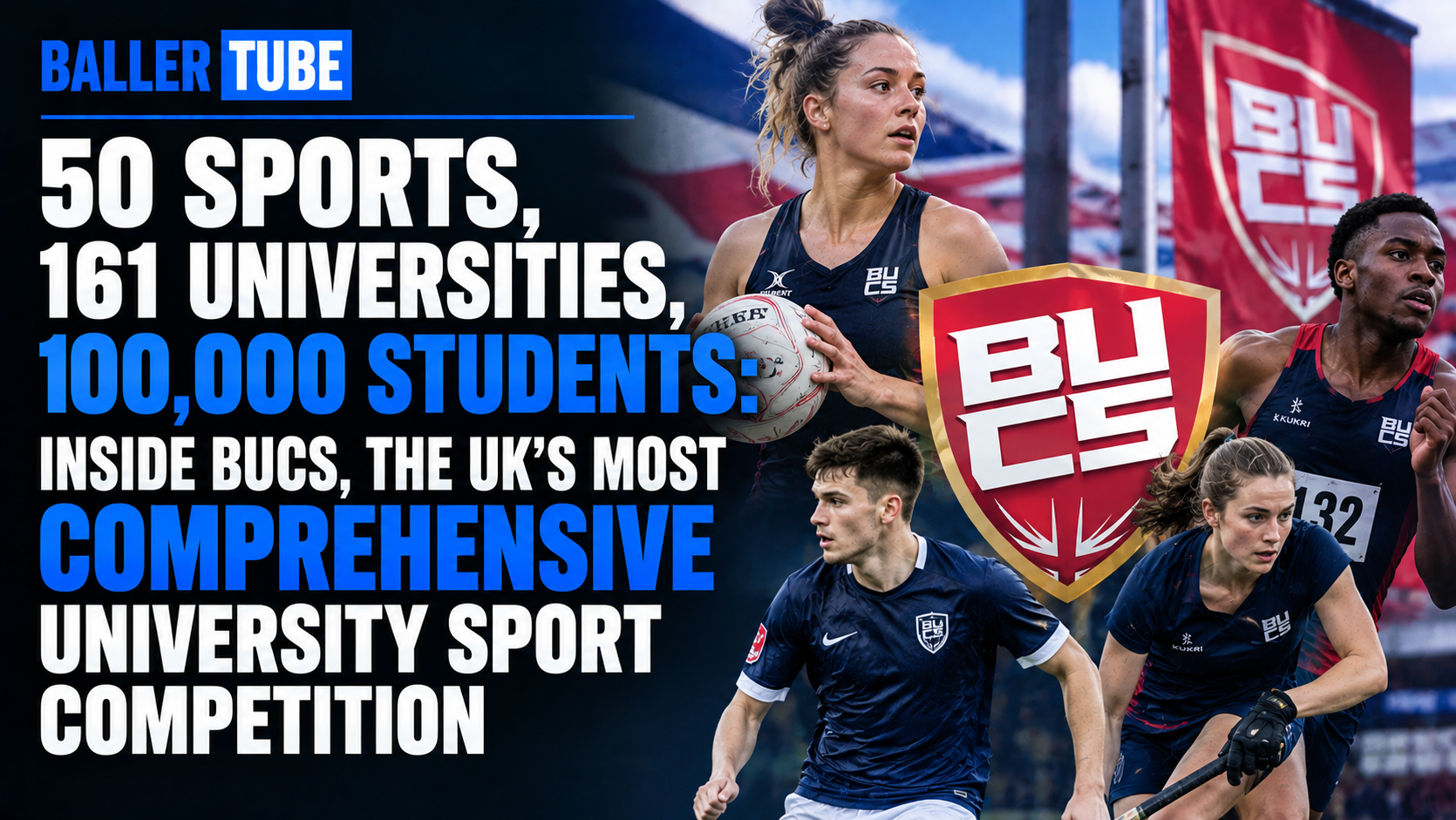
The acronym appears on kit, on fixtures lists, on training ground signage, and on the social media feeds of hundreds of thousands of student athletes across the United Kingdom every academic year. BUCS, which stands for British Universities and Colleges Sport, is the national governing body for higher education sport in the UK, and the competition structure it administers is the most comprehensive multi-sport university sports programme in the world by almost any available measure. Over 100,000 students regularly compete in BUCS competitions, leagues, and events across a programme covering 50 sports, 161 member institutions, and approximately 150 individual finals or championship events per year. It is the UK's equivalent of the NCAA, built on its own specific institutional history and operating on its own distinct competitive philosophy.
The History: From BUSB to BUSA to BUCS
The governance of university sport in the United Kingdom has a longer and more complicated institutional history than most of its participants realize. The British Universities Sports Board was formed in 1952 primarily to enable students to compete at an international level. It was replaced by the British Universities Sports Federation in 1962 and subsequently by the Universities Athletic Union, which ran inter-university sport for decades as the primary governing body for traditional university athletic competition in England.
Alongside the UAU, the British Polytechnics Sports Association formed in 1969 to represent polytechnics, and colleges of higher education were represented separately by the British Colleges Sports Association from 1970. The British Students Sports Federation formed in 1971 to represent students at polytechnics and colleges of higher education in international competitions. The fragmentation of governance across these multiple bodies reflected the fragmented structure of higher education itself, in which universities, polytechnics, and colleges of higher education operated as distinct institutional categories.
The structure of higher education in the United Kingdom changed fundamentally in 1992 when polytechnics and colleges of higher education received university status, eliminating the institutional distinction that had justified separate sports governance structures. By 1995, the UAU and the British Universities Sports Federation amalgamated to form the British Universities Sports Association, consolidating the governance of university sport into a single national body for the first time. BUCS was formed on June 16, 2008, through the merger of the British Universities Sports Association with University College Sport, creating the current organizational structure that governs the competition today. The merger brought together the competitive infrastructure of BUSA with the facilities and development programmes of UCS, producing an organization whose remit extends from elite athletic competition to grassroots participation and healthy campus development.
What BUCS Actually Does
BUCS works with student athletes, Sports Union staff and elected officers, professional sporting staff, coaches, and volunteers at its 161 member institutions to deliver a competition programme that operates across the full academic year. The core of that programme is a league system involving over 4,800 student teams competing in tiered divisional structures across every supported sport. League fixtures run through the academic year, with promotion and relegation between divisions providing the competitive stakes that make weekly fixtures meaningful rather than merely social.
Alongside the league programme, BUCS holds over 100 championship events throughout the year for individual students, covering both team sports at championship stage and individual disciplines across athletics, swimming, racket sports, gymnastics, and every other sport in which individual performance determines outcome. Students who compete in the Individuals programme win medals and BUCS points that contribute to their university's total in the overall standings, the cumulative measure of institutional athletic achievement that BUCS publishes throughout the year.
The BUCS points system is the framework through which university sports programmes are evaluated and ranked nationally. Points are earned for every result across every sport, with higher-tier league victories, championship wins, and individual medals contributing different point values. The university with the highest cumulative total across all sports at the end of the academic year holds a distinction that the most seriously athletic universities in the country pursue with genuine organizational commitment. Loughborough University has held the top position in the overall BUCS standings for an extended period, building a reputation as the UK's premier sporting university through sustained investment in facilities, coaching, and the recruitment of student athletes across multiple sports.
The Sports: From Football to Korfball
The range of sports covered by BUCS is broad enough to serve a genuinely diverse student athletic population. The programme includes association football, rugby union, rugby league, cricket, basketball, volleyball, netball, American football, lacrosse, hockey, tennis, badminton, squash, table tennis, swimming, athletics, cross-country running, rowing, sailing, equestrian sport, fencing, gymnastics, archery, boxing, judo, martial arts, and korfball, among others. The variety reflects both the diversity of British student athletic culture and BUCS's explicit organizational commitment to providing a competitive pathway for every student who wants one, regardless of which sport they play.
Football operates across a tiered national structure with divisional leagues organized by region and competitive tier. The top performing football universities compete in Premier tier fixtures against other institutions of comparable quality, with lower tiers providing appropriate competition for universities at every level of athletic investment. The promotion and relegation system means that improvement over time is rewarded with access to higher-quality competition, creating meaningful long-term stakes for programmes that are genuinely building towards competitive excellence.
Rugby union operates at its highest level through BUCS Super Rugby, the flagship competition of the entire programme. The eight-team national league features the best rugby-playing universities in the country, including Loughborough, Durham, Bath, Edinburgh, Exeter, Leeds, Cardiff Metropolitan, and Hartpury, competing in a full round-robin league with a knockout championship for the top eight finishers. The competition runs on Wednesdays during the academic year and has developed into one of the most competitive university sporting products in Europe, regularly producing players who go on to professional club rugby and international representation.
The women's equivalent, BUCS Super Rugby Women, operates on the same structural model. American football competes through the British Universities American Football League, which was absorbed into BUCS as an official sport in 2012 following its organisation by the British American Football Association. The integration of American football into the BUCS framework reflected both the sport's growing popularity at British universities and the organizational logic of consolidating competition governance under a single national body.
Wednesday: The Day British University Sport Exists
One of BUCS's most distinctive institutional features is the day on which most of its fixtures take place. Wednesday afternoons are the traditional slot for university sport in the United Kingdom, a scheduling convention that dates back to the earliest days of organized student athletic competition and that universities have maintained as a protected time in their academic timetables. Most BUCS league fixtures take place on Wednesday afternoons, with students travelling to away fixtures, hosting home games, and then returning to academic responsibilities for the Thursday lectures that follow.
The Wednesday scheduling creates a specific culture around BUCS sport that distinguishes it from recreational sport on one side and professional sport on the other. Students experience competitive sport as a genuine commitment that structures their week, requiring the kind of time management, physical preparation, and organizational discipline that participation in a league competition demands. The fixture card runs from October through April, meaning the commitment spans most of the academic year and involves dozens of games across different sports, levels, and locations.
Elite Performance Alongside Participation
BUCS operates across the full spectrum from elite athletic performance to healthy campus participation, and the organization's stated purpose encompasses both ends of that spectrum. At the elite end, BUCS works with universities that recruit student athletes, provide sports scholarships, operate professional-standard coaching and training facilities, and compete in competitions that regularly attract attention from professional clubs, national governing bodies, and international sporting organizations. The pathway from BUCS competition to national team selection is genuinely functional across multiple sports, with rugby union, swimming, athletics, and rowing all producing national team athletes through the university system in significant numbers.
At the participation end, BUCS supports universities in building the sports club infrastructure, facility quality, and programming breadth that keeps students physically active throughout their time in higher education. The relationship between elite competition and grassroots participation is not always easy to manage within a single organizational framework, but BUCS has navigated it by maintaining a points system that rewards excellence at the top while structuring leagues at every level to ensure that participation is accessible to students across the full range of sporting ability and ambition.
For the 100,000-plus students who compete in BUCS competitions each year, the programme is the primary competitive context that defines what sport means during their time in higher education. For the universities whose sports programmes those students represent, the BUCS standings are the measure of institutional achievement that drives investment, recruitment, and strategic planning. For the coaches, administrators, and volunteers who make the programme function across 161 institutions and 50 sports, BUCS is the governing framework that makes Wednesday afternoons in British university sport meaningful. It has been doing so, under various names and organizational forms, since 1952. It shows no sign of slowing down.
BUCS founded: June 16, 2008 (merger of BUSA and University College Sport). Member institutions: 161. Sports covered: 50+. Students competing annually: 100,000-plus. Student teams in league programme: 4,800-plus. Championship events per year: 150-plus. Longest-running overall standings leader: Loughborough University. BUCS Super Rugby teams: Loughborough, Durham, Bath, Edinburgh, Exeter, Leeds, Cardiff Metropolitan, Hartpury. Primary fixture day: Wednesday. Historical predecessors: BUSB (1952), BUSF (1962), UAU, BPSA (1969), BCSA (1970), BSSF (1971), BUSA (1995). Headquarters: London.