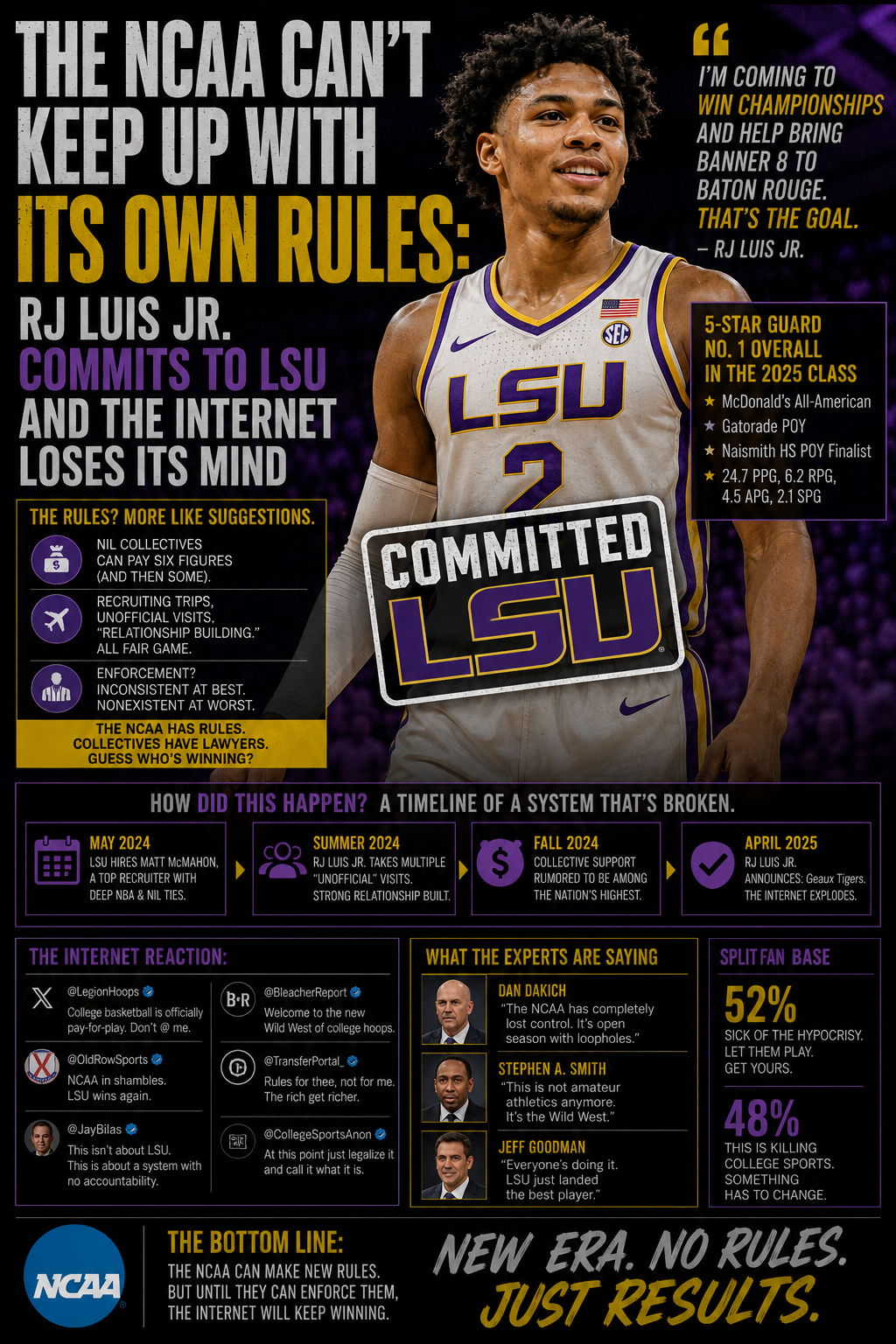
The NCAA Can't Keep Up With Its Own Rules: RJ Luis Jr. Commits to LSU and the Internet Loses Its Mind
He was the Big East Player of the Year. He told CBS Sports that going back to college would be a mistake. He went undrafted. He was traded to the Celtics. He was cut. He never played a single professional minute that counted. And now he wants to play for Will Wade at LSU — except the NCAA says he can't.
The college basketball transfer portal era has produced many situations that have tested the sport's rulebook, its credibility, and its fans' patience with the governing body that ostensibly runs it. But the story that broke on Tuesday — former St. John's star and 2025 Big East Player of the Year RJ Luis Jr. committing to LSU basketball under returning head coach Will Wade — may be the most brazen, most confusing, and most representative example of an NCAA system that cannot keep pace with the professional basketball landscape it is colliding with at full speed. Luis is not currently eligible to play college basketball. The NCAA has said he won't be. His representation is expected to file a lawsuit. Will Wade signed him anyway. And fans across the internet have had exactly one response: how is this even happening?
Who RJ Luis Jr. Is and How He Got Here
Luis grew up in Miami, enrolled at UMass as a 233rd-ranked recruit in the class of 2022, averaged 11.5 points per game in his freshman year, and transferred to St. John's — where everything changed. Under Rick Pitino's system at Queens, Luis developed into one of the most productive wings in the country. His junior season, 2024-25, was everything a mid-major-to-power-transfer could have dreamed of: 18.2 points and 7.2 rebounds per game, first-team All-Big East, unanimous consensus Big East Player of the Year, second-team AP All-American, a 31-5 record, an 18-2 Big East mark, and a No. 2 seed in the NCAA Tournament. He was 22 years old, 6 feet 7 inches tall, physically polished, and playing like a lottery pick.
He was not a lottery pick. He was not drafted at all. Despite entering both the transfer portal and the NBA Draft in the spring of 2025 — initially maintaining his college eligibility as he explored his options — Luis kept his name in the draft past the NCAA withdrawal deadline, a decision that ended his eligibility. He signed a two-way contract with the Utah Jazz. Then he was traded to the Boston Celtics organization as part of a salary dump alongside Georges Niang and two future second-round picks. The Celtics waived him on October 15, before the NBA season began. He signed an Exhibit 10 contract with the Maine Celtics, Boston's G League affiliate, but was waived again almost immediately due to a groin injury that required surgery. He never played in an NBA regular-season game. He never played in a G League game. He played in a handful of NBA preseason games — including one in Memphis against the Grizzlies — and then his professional career was over before it had genuinely begun.
The public record of how Luis talked about his NBA prospects makes his current situation particularly difficult to navigate without significant irony. At the 2025 NBA Draft Combine, asked point-blank by CBS Sports whether going back to college — where significant NIL money awaited him — would have been a smarter choice, Luis was definitive. "It's more than just the money," he said. "Say I go back to college, I get a large amount of money, but then what? I'm going to be a year older. Still going to have to do the process again. It's more about finding the right time to go into this. I think this is my moment." That quote now sits at the top of every article written about his LSU commitment. The moment he was looking for did not materialize. He now wants a do-over.
The Eligibility Problem: Why the NCAA Says No
The NCAA's position on Luis's eligibility is not ambiguous. NCAA president Charlie Baker reiterated in December that the organization will not reinstate eligibility to any player who has signed a two-way contract with an NBA team. The governing body doubled down on that standard last week in a memo distributed to member institutions — the same week Luis's commitment became public. The rule exists because the NCAA draws the line at professional contracts, not at professional performance: the moment a player signs on the dotted line with an NBA organization, regardless of whether they play a single second of professional basketball, their college eligibility is forfeited.
The precedent is directly applicable and recent. Former Alabama center Charles Bediako — who went undrafted in 2023, played five G League games, and attempted to return to the Crimson Tide — received a temporary restraining order that allowed him to play five games during the 2025-26 college season. When that order expired, an Alabama circuit judge denied his request for a preliminary injunction, ending his college comeback. The key distinction between Bediako's case and Luis's: Bediako actually played professional games before attempting to return. Luis did not play a single professional game at any level. His representation is expected to use that distinction as the centerpiece of a lawsuit arguing that the NCAA's rule is unjust as applied to a player who signed a contract but, due to injury, never actually played professional basketball. CBS Sports' reporting indicates the loophole that enabled former Baylor big man James Nnaji to regain eligibility — having been drafted but never having signed an NBA contract — does not apply to Luis because he did sign.
The looming 5-for-5 eligibility model expected to be adopted by the NCAA ahead of the 2026-27 season adds another layer. Under that framework, players would be granted five years of eligibility across five seasons — a change that would dramatically expand the window for players like Luis to compete at the college level. Whether that model arrives in time to help Luis, and whether a court will grant him the injunctive relief his representation is seeking before fall practice begins, remain entirely open questions.
Will Wade, LSU, and the Strategic Gamble
LSU's willingness to sign an ineligible player represents the specific kind of calculated gamble that Will Wade has made his career around. Wade, who returned to Baton Rouge after his dismissal from the LSU program in 2022 and subsequent tenure at VCU, is building his new LSU roster with exactly the kind of aggressive portal-and-lawsuit-adjacent strategy that the modern college basketball economy rewards. If Luis wins his court case and receives a year of eligibility, he becomes instantly one of the best players in the SEC — a 23-year-old consensus All-American with a year of NBA organizational experience who will arrive at LSU with more basketball maturity than almost anyone in college basketball. LSU's ceiling in 2026-27 with Luis eligible is categorically different from its ceiling without him.
If Luis loses his lawsuit, Wade has lost nothing except the time spent recruiting him. The signing costs no scholarship until eligibility is confirmed. The gamble has an asymmetric risk profile that Wade identified and moved on before any other SEC program could. Fans were not forgiving about the situation. "Gotta be illegal" was among the more restrained responses on social media. "How many times can the NCAA embarrass itself in one offseason?" read another widely shared post. The reality is that the NCAA's rules — written for a different era, before two-way contracts and G League signings and Exhibit 10 deals became the standard path for undrafted college stars — are genuinely struggling to keep pace with the professional basketball landscape. Luis's situation is not unique in its structure. It is unique in its visibility, because he was one of the five best players in college basketball the year he left.
RJ Luis Jr. college stats (St. John's, 2024-25): 18.2 PPG, 7.2 RPG, 2.0 APG, 1.4 SPG, 43.9% FG. Big East Player of the Year, 2025. Consensus second-team All-American. NBA career: 0 regular season games, 0 G League games. Teams: Utah Jazz (two-way), Boston Celtics (two-way, traded), Maine Celtics (Exhibit 10, waived due to injury). Current eligibility status: ineligible per NCAA rules. Legal path: expected lawsuit. Transfer destination: LSU under Will Wade.