HoopCode Basketball has become one of Arizona’s better-known basketball development programs. With year-round training, competitive club teams, and skill development opportunities, it has earned a reputation for helping athletes improve on the court.
Like any large basketball organization, however, HoopCode is not without criticism.
No program is perfect, and what works for one athlete may not work for another. While many families have had positive experiences, others have shared frustrations that are worth considering before making a financial and time commitment.
Here is a closer look at some of the concerns that have been raised.
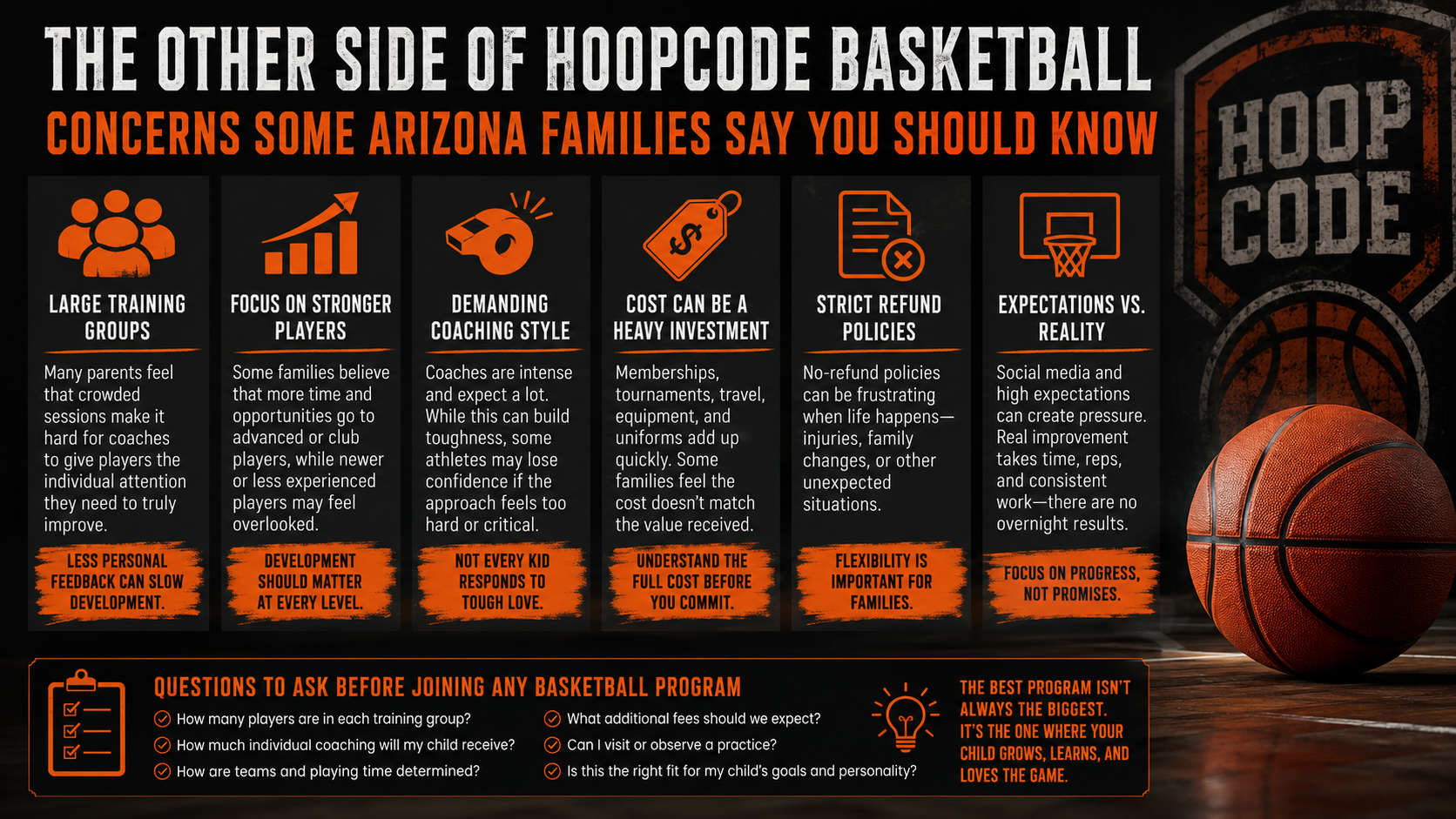
Large Training Groups Can Limit Individual Attention
One of the most common concerns revolves around class size.
Basketball training is most effective when coaches can spend meaningful time correcting a player’s shooting form, footwork, decision-making, and defensive habits. When sessions include a large number of athletes, that individual attention naturally becomes harder to provide.
Parents who have expressed disappointment often describe practices where players rotate quickly through drills without receiving much personalized coaching.
For beginners especially, feedback is critical.
A player learning proper mechanics may need repeated correction before a habit becomes permanent. If coaches are responsible for dozens of athletes during a session, some players may leave without hearing much individualized instruction.
That doesn’t necessarily mean the coaching is poor.
It simply means the experience can feel different from what families expect when they invest in private-style development.
Players who are naturally aggressive and confident often seek out coaches for extra help.
Quiet players may blend into the background.
That can create two very different experiences inside the exact same workout.
Advanced Players May Receive More Opportunities
Another criticism occasionally mentioned is the perception that stronger players receive more attention.
Competitive basketball is results-driven.
Coaches naturally spend time preparing the athletes who are expected to contribute during tournaments.
Because of this, families with newer or developing players sometimes feel their athlete receives fewer opportunities.
Whether that perception is accurate depends on the individual team and coaching staff.
Still, it is understandable why some parents feel frustrated if they believe their child is practicing hard but not receiving the same developmental investment as teammates.
This is a challenge faced by many club basketball organizations—not just HoopCode.
Programs that compete at high levels often prioritize winning while also attempting to develop players.
Balancing both goals isn’t easy.
https://www.cbssports.com/college-basketball/news/college-basketball-rankings-marcus-spears-jr-texas-top-25-1/
A Tough Coaching Style Isn’t for Every Athlete
Every coach has a different personality.
Some motivate through encouragement.
Others believe accountability and discipline produce better long-term results.
Several families have described HoopCode coaches as demanding.
For some athletes, this approach builds resilience and mental toughness.
Players learn to accept criticism, compete through adversity, and develop confidence under pressure.
Others, however, may struggle with that environment.
Young athletes respond differently to coaching styles.
A player who thrives on positive reinforcement may lose confidence if criticism outweighs encouragement.
Parents should remember that intensity alone does not define coaching quality.
The important question is whether athletes are learning, improving, and maintaining their love for basketball.
Different personalities require different coaching approaches.
Cost Can Be a Significant Investment
Competitive basketball is expensive.
Monthly memberships, tournament fees, travel expenses, uniforms, shoes, and equipment quickly add up.
Some families feel the overall investment becomes difficult to justify if they don’t believe their child is receiving enough individualized development.
This isn’t unique to HoopCode.
Elite youth sports across the country have become increasingly expensive.
Parents often expect measurable improvement when making that level of financial commitment.
If progress feels slow or opportunities become limited, disappointment naturally follows.
Before joining any basketball academy, families should understand exactly what is included in the cost.
Questions about practice frequency, tournament schedules, coaching access, and additional fees should be answered before registration.
Transparency helps prevent misunderstandings later.
Refund Policies Can Create Frustration
Another concern involves refund policies.
Life changes.
Players get injured.
Families relocate.
Schedules become overwhelming.
When organizations have firm cancellation or refund policies, parents can feel trapped if circumstances unexpectedly change.
From the business perspective, structured policies help programs budget staffing, facility rentals, and tournament planning.
From the customer’s perspective, flexibility is often appreciated during unexpected situations.
Neither viewpoint is necessarily wrong.
It simply becomes an important detail families should understand before committing.
Reading registration agreements carefully is one of the smartest things parents can do before joining any sports organization.
Expectations Versus Reality
Social media has changed youth sports.
Highlight videos, championship photos, and recruiting announcements often create high expectations.
Families sometimes expect dramatic improvement within a few months.
Basketball development rarely works that way.
Real improvement requires years of repetition.
Even excellent training cannot replace consistent work outside organized practices.
When expectations exceed reality, disappointment often follows.
Sometimes families blame the program.
Other times they realize their athlete simply needs more time.
The truth usually falls somewhere in between.
Not Every Player Learns the Same Way
One overlooked aspect of youth development is learning style.
Some athletes thrive in competitive environments with lots of players.
Others develop faster in smaller groups.
Some improve through repetition.
Others need constant coaching feedback.
Because HoopCode serves many athletes, its training model won’t perfectly match every player’s needs.
That doesn’t mean the program is ineffective.
It means parents should honestly evaluate whether their child’s personality matches the environment.
Finding the right fit is just as important as finding a well-known basketball academy.
https://www.ballertube.com/news/601/nikes-watch-list-the-players-vegas-was-built-to-show-off-this-weekend/?tag_ids=26378%2C31500%2C18%2C4240%2C722%2C32688%2C4075
Communication Matters
Parents consistently value communication from coaches and organizations.
Whether discussing playing time, tournament schedules, injuries, or expectations, clear communication builds trust.
When communication falls short, misunderstandings can grow quickly.
Families naturally want to understand how decisions are made.
Even when they disagree with a coach, honest explanations often reduce frustration.
Strong communication remains one of the biggest factors separating good youth programs from great ones.
Every Experience Is Different
It’s important to recognize that experiences vary.
One family may recommend HoopCode without hesitation.
Another may decide it wasn’t the right fit.
Both experiences can be genuine.
Factors such as coaching assignments, age groups, skill levels, and personal expectations all influence how families view a program.
That is why visiting practices, asking questions, and speaking with current participants can be valuable before making a commitment.
The Importance of Finding the Right Fit
One of the biggest mistakes families make is assuming that the most recognizable basketball program is automatically the best option for every player. In reality, every athlete develops differently, and the right environment can make all the difference.
Some players thrive in large, competitive settings where they are constantly challenged by talented teammates. They enjoy competing for playing time, learning from older athletes, and pushing themselves every practice.
Others need something different.
Younger or less experienced players often benefit from smaller groups where coaches have more time to explain drills, correct mistakes, and build confidence. Receiving consistent feedback can help them develop a stronger foundation before moving into a highly competitive environment.
Parents should honestly evaluate what their child needs instead of simply following the biggest name in youth basketball.
A player who enjoys basketball is much more likely to continue working on their game than one who feels discouraged after every practice.
That doesn’t mean athletes should avoid challenges. Instead, they should be challenged in a way that encourages growth rather than frustration.
Finding that balance is one of the most important parts of youth sports.
Questions Every Parent Should Ask
Before committing to any basketball academy, parents should take time to ask detailed questions.
How many athletes are usually in each practice?
How many coaches are working during those sessions?
How often do players receive individual feedback?
What happens if a player misses practices because of school, family obligations, or injuries?
How are teams selected?
How is playing time determined?
Are there additional tournament, travel, or uniform fees beyond the advertised membership?
These questions may seem simple, but the answers can help families avoid surprises later.
Parents should also attend a practice if possible.
Watching a session firsthand often provides a clearer picture than social media posts or promotional videos. It allows families to observe how coaches communicate, how players respond, and whether athletes appear engaged throughout practice.
Sometimes seeing the environment in person is the best way to determine if it’s the right fit.
Development Should Be the Priority
Winning tournaments is exciting.
Championship trophies, medals, and social media highlights can create memorable moments for players and families.
However, long-term development should always come before short-term success.
A young athlete who spends years improving shooting mechanics, decision-making, conditioning, and basketball IQ will usually be better prepared for high school and college basketball than someone whose role never expands because the focus is solely on winning.
Parents should pay attention to more than the scoreboard.
Is their child becoming more confident?
Are they making smarter decisions during games?
Do they understand the game better than they did six months ago?
Are they excited to continue improving?
Those questions often matter more than a tournament record.
Basketball is a long journey, and development rarely happens overnight.
Every practice, every game, and every season should move an athlete one step closer to becoming a more complete player.
Whether HoopCode or another Arizona basketball program is the right choice ultimately depends on the individual athlete, their goals, and the environment that allows them to enjoy the game while continuing to improve.
Final Thoughts
HoopCode Basketball has helped many Arizona athletes improve their skills and compete at higher levels. At the same time, some families have voiced concerns about large training groups, perceived differences in player attention, demanding coaching styles, overall costs, and strict policies.
These concerns don’t automatically make HoopCode a bad program. Instead, they highlight an important reality about youth sports: no organization is the perfect fit for every athlete.
Parents should evaluate programs based on their child’s goals, personality, and learning style rather than reputation alone.
The best basketball academy isn’t necessarily the biggest or most well-known.
It’s the one where a player continues to grow, enjoys the game, receives meaningful instruction, and leaves every practice excited to return.