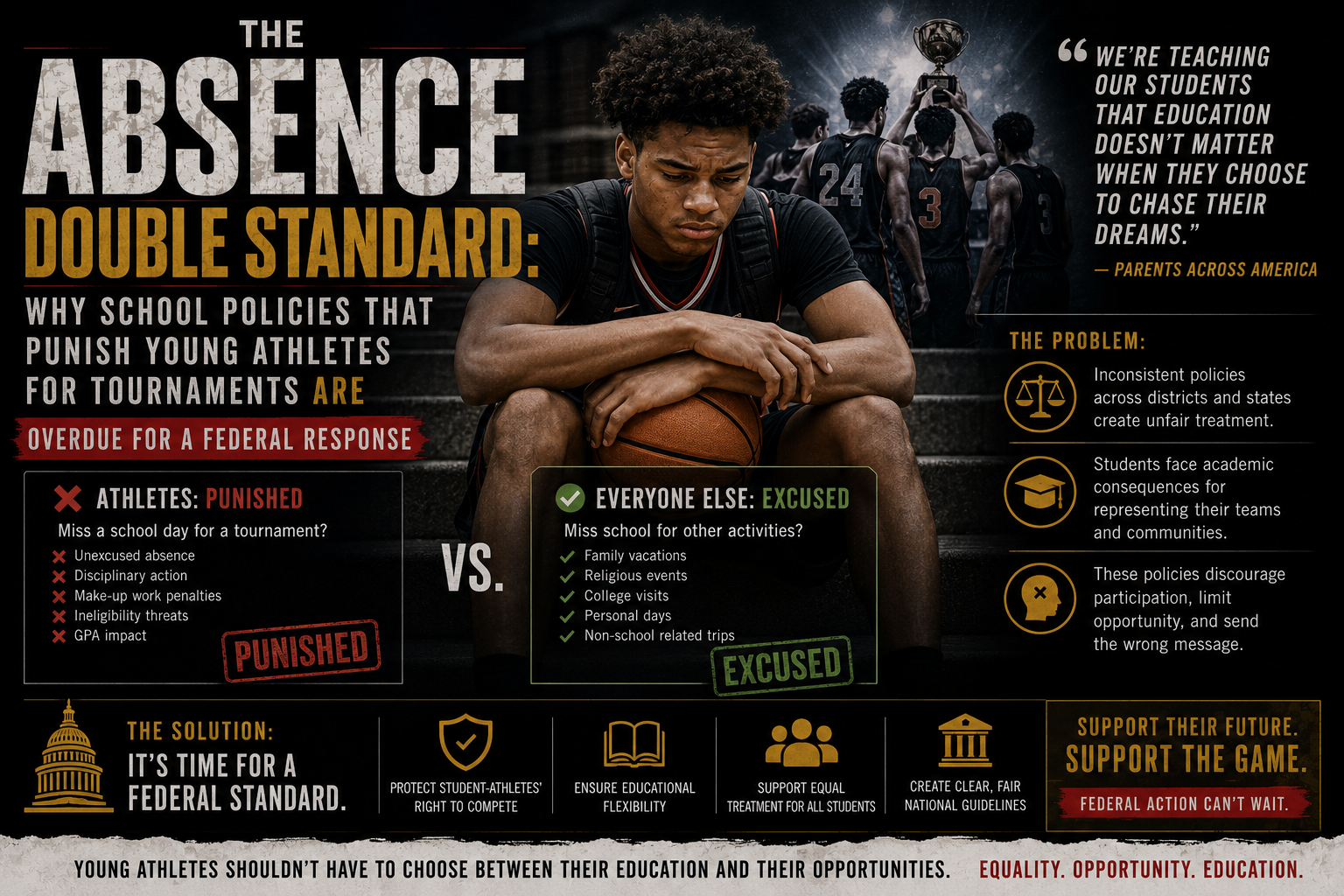
The Absence Double Standard: Why School Policies That Punish Young Athletes for Tournaments Are Overdue for a Federal Response
College athletes miss class for road games at Big Ten schools and the university sends a professor notification letter on athletic department letterhead before the trip even begins. A 15-year-old misses school for a basketball tournament that every college coach in the country attended — and comes back to an unexcused absence, a zero on the quiz, and a parent meeting about attendance policy.
This is not an editorial about whether sports are more important than school. They are not. Education is the foundation of every path forward for a young person, including the path through athletics, and anyone who has spent time in youth basketball knows that the players most likely to reach their potential are the ones who have families and coaches who refuse to allow basketball to crowd out academics. This is an editorial about something different: the fact that the educational system treats identical absences — school missed for athletic competition — in radically different ways depending on the age and institutional affiliation of the athlete, and that the inconsistency is not justifiable, not equitable, and not something that can be fixed by individual school districts making individual decisions. It requires a national standard.
The College Athlete Comparison
NCAA Division I student athletes miss class for athletic competition as a routine, institutionalized, federally recognized practice. The NCAA's own academic policies require member institutions to accommodate class absences for competition, to provide academic support services that account for travel schedules, and to ensure that athletes receive the same academic protections as any other enrolled student — including the right to make up missed work without academic penalty. The University of Michigan sends faculty notification letters before every road game. Florida State builds academic calendars that map the football schedule before the semester begins. Duke arranges tutorial sessions that travel with the basketball team during the NCAA Tournament. These accommodations are not gifts or privileges. They are recognized institutional obligations, built into the operating structure of every Division I university in America.
The 15-year-old who misses school for an AAU tournament is engaging in an activity that is functionally, competitively, and developmentally identical to what a 20-year-old college athlete does when he misses a Tuesday lecture for a Wednesday road game in the ACC. Both players are competing at the highest available level of their age group. Both are pursuing the same ultimate objective — a professional career or at minimum the scholarship pathway to higher education. Both have coaches, programs, and institutional frameworks surrounding their athletic development. The only difference is the jersey they wear and the age printed on their birth certificate. The educational system treats these two players as though they are doing fundamentally different things. They are not.
What Schools Currently Do — and Why It Varies So Dramatically
The absence landscape for youth athletes is one of the most inconsistently governed areas in American public education. Individual states have their own compulsory attendance laws with their own excused absence definitions. Within those states, individual school districts have their own policies. Within those districts, individual schools and individual principals have their own interpretations. The result is a system in which a student athlete in one county can miss Friday for a tournament and have it coded as an excused activity absence, while a student athlete in an adjacent county with identical circumstances receives an unexcused mark that triggers attendance thresholds, grade penalties, and parental notification requirements.
Some states — primarily those with strong legislative relationships between athletic associations and education departments — have formal frameworks for coding sports-related absences. California, Texas, and New York all have athletic activity absence provisions built into their education codes that provide partial protection for students competing in sanctioned athletic events. But "sanctioned" is the operative word: these provisions almost universally apply only to school-sponsored athletic programs. The AAU player missing school for an independent circuit event — the EYBL, the Under Armour Association, the 3SSB — receives none of these protections regardless of how elite the competition, how nationally significant the event, or how directly the tournament appearance is connected to the player's post-secondary educational pathway through the scholarship process.
Why This Needs Federal Attention
The argument for federal involvement in what has historically been treated as a purely local educational policy matter is built on three pillars: consistency, equity, and the documented economic significance of athletic scholarships as a pathway to higher education for economically disadvantaged students.
On consistency: the current system, in which the same activity produces different educational consequences based on geography, produces outcomes that are arbitrary and unjust. A student athlete whose family can afford to live in a district with favorable absence policies receives meaningful protection. A student athlete whose family cannot choose their school district receives penalties for identical behavior. This geographic arbitrariness is precisely the kind of inequity that federal education policy exists to address.
On equity: the families most harmed by punitive attendance policies for athletic absences are disproportionately low-income and minority families — the same families for whom the athletic scholarship pathway represents the most significant available route to higher education. Policies that penalize tournament attendance fall hardest on the students most dependent on athletics for college access and most vulnerable to grade penalties that undermine academic eligibility.
On economic significance: a Division I athletic scholarship is a federal financial aid-equivalent asset worth hundreds of thousands of dollars over four years. The federal government has a direct interest in ensuring that the competitive pipeline producing future scholarship athletes is not arbitrarily disrupted by inconsistent local attendance enforcement. The Department of Education already regulates academic eligibility standards for federal student aid programs. Extending that regulatory framework to include a minimum national standard for athletic activity absences — modeled on the accommodation structure already required of NCAA member institutions — is a logical extension of existing federal education policy authority.
The college athlete gets the professor notification letter. The high school player gets the unexcused absence. They are doing the same thing. It is time for the government to recognize that.
NCAA accommodation policy: Division I institutions are required to accommodate class absences for athletic competition and provide academic support for traveling athletes. State absence policies: California Education Code, Texas Education Code, and New York Education Law all include provisions for school-sponsored athletic activity absences. Federal jurisdiction: Department of Education regulates academic eligibility standards under Title IV of the Higher Education Act. Current federal standard for youth athletic absences at non-school-sponsored events: none.