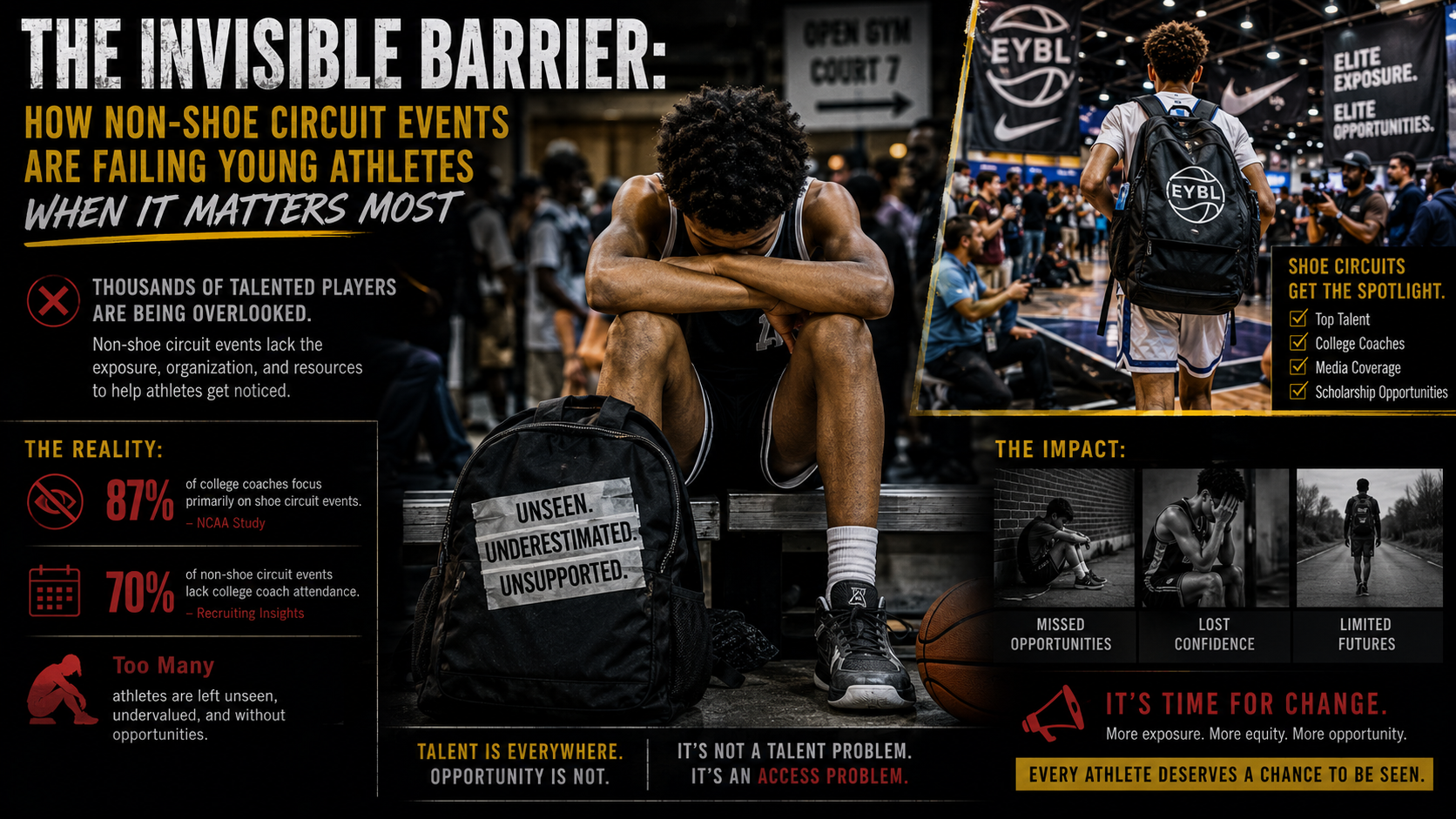
The Invisible Barrier: How Non-Shoe Circuit Events Are Failing Young Athletes When It Matters Most
The gyms look the same. The players are just as talented. The competition is just as real. But when the final whistle blows and the coaches file out, the players from the Nike circuit have fifteen business cards in their shorts pocket and the players from the independent tournament have none. That gap is not about basketball. It is about access.
There are two grassroots basketball worlds operating simultaneously in America, and most people who are not directly embedded in the recruiting industry do not know both of them exist. The first world is the shoe circuit — Nike's EYBL, the Adidas 3SSB, the Under Armour Association, the Puma Pro16 — prestigious, coach-attended, scholarship-producing events that run from April through July and represent the primary recruiting pipeline for Division I college basketball programs. The second world is everything else: the independent tournaments, the regional showcases, the non-affiliated circuits, the smaller events that operate outside the shoe brand sponsorship ecosystem and serve the majority of competitive youth basketball players in the country. The players in the second world are not less talented on average than the players in the first. They are less visible. And in college basketball recruiting, visibility is the entire game.
What College Coaches Actually Do During Recruiting Periods
To understand why the shoe circuit gap matters, you have to understand how college coaches allocate their limited recruiting time during NCAA-permitted live evaluation periods. Division I programs are permitted a specific number of days during which coaches can watch recruits in person — and those days, measured in dozens rather than hundreds across an entire spring and summer, must be used strategically. A head coach at a mid-major program might have 20 evaluation days available across the spring. An assistant coach at a power conference program might have 30. Every day spent at one event is a day not spent at another.
The decisions coaches make about where to spend those evaluation days are driven almost entirely by density — the concentration of scholarship-caliber talent in a single location. A single EYBL session in a major market might have 40 or 50 prospects ranked in the top 200 nationally competing across a single weekend in adjacent gyms. An independent tournament in the same city the same weekend might have three or four prospects of comparable caliber distributed across a bracket of 32 teams. The math is not complicated. The coach with 20 evaluation days goes where he can see the most prospects per day. That is the EYBL. That is the Under Armour Association. That is the 3SSB and the Pro16. The independent tournament gets nobody.
What This Actually Looks Like on the Ground
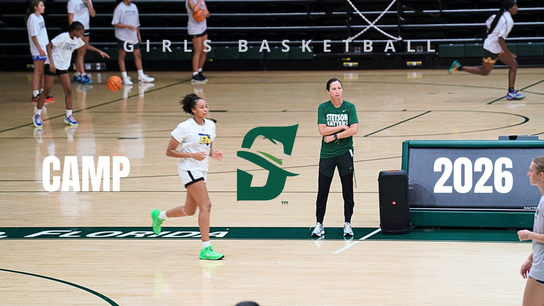
The difference between shoe circuit event environments and independent tournament environments is visible, physical, and impossible to miss if you have been to both. Walk into a gym at an EYBL session and the baselines are stacked two and three coaches deep — a sea of polo shirts and institution-branded pullovers representing programs from every level of Division I, all holding phones and notebooks, all there for the express purpose of watching specific players and updating their evaluations. The players know this. The coaches of the AAU teams know this. The parents who drove six hours to get there know this. The event is a job fair for basketball scholarships and everyone in the building is dressed for the interview.
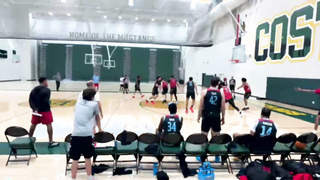
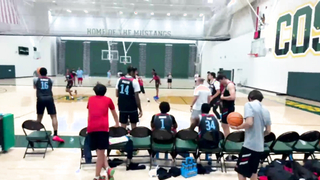
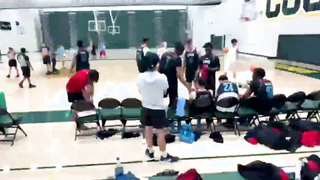
Walk into an independent tournament the same weekend and the baseline picture is different. There may be a few coaches from local Division II or Division III programs. There may be junior college scouts who work the independent circuit because it is the only environment they can afford to attend. There may be nobody — no coach at all beyond the team coaches already invested in the tournament's outcome. The players in that gym compete just as hard. They run the same drills, execute the same plays, make the same plays in transition and at the rim. And when the final buzzer sounds, they walk back to the sideline and collect no business cards, no scholarship offers, no coach contact information, and no evidence that the competition they just played in was witnessed by anyone with the authority to change their future.
Why Players End Up in the Non-Shoe World
The structural reasons that talented players end up on non-shoe circuits rather than EYBL programs are not complicated — they are financial, geographic, and relational, and they compound each other in ways that are difficult to escape.
Shoe circuit programs, particularly EYBL programs, operate at a significantly higher cost than independent circuit programs. The travel requirements are national — players fly to sessions in North Augusta, South Carolina, in the spring and Los Angeles in the summer, covering distances that require flights, hotels, and multi-day meal expenses. AAU programs that participate in the EYBL are typically sponsored by one of the shoe brands, which offsets a portion of costs, but the remaining family financial burden is substantial. For players from low-income families, the cost differential between a local independent tournament — where you drive two hours, pay a $25 entry fee, and sleep in your own bed — and an EYBL session — where the trip costs $800 per player in travel and housing before any event fee — is not a minor inconvenience. It is a barrier that effectively determines recruiting visibility before a single shot is taken.
Geographic concentration adds another layer. Shoe circuit programs cluster in major metropolitan areas — Los Angeles, Atlanta, Chicago, Dallas, New York, Washington D.C. — where population density supports the roster size and organizational infrastructure that elite programs require. Players from rural states, small cities, and underserved communities often have no access to shoe circuit programs simply because no program exists within a reasonable distance of where they live. Their only available option is the local or regional independent circuit — which is genuinely competitive basketball, often featuring players of legitimate Division I caliber, but which produces zero scholarship offers because zero college coaches are watching.
What Needs to Change
The recruiting inequality between shoe and non-shoe circuits is not a problem that individual programs or individual families can solve through effort alone. It is structural, and structural problems require structural responses.
The NCAA has the authority to expand evaluation periods specifically for non-affiliated circuit events — allowing college coaches additional evaluation days that can only be used at independent tournaments, creating the coach attendance incentive that currently does not exist. This proposal would cost nothing, require no financial commitment from programs, and directly expand scholarship access to the communities currently excluded from the pipeline.
Alternatively, the existing shoe brand sponsorship model could be challenged through an NCAA policy change that limits the advantages shoe-affiliated programs receive in evaluation access — requiring a percentage of evaluation activity to occur outside the shoe circuit ecosystem. Neither of these solutions is politically simple given the financial relationships between shoe brands and NCAA programs. Both are straightforward in their logic and their equity impact. The talent is already there in those independent gyms. The problem is that nobody with the power to offer a scholarship is watching. That is the gap. It is fixable. And until it is fixed, the same zip codes will keep producing the same scholarship offers, and the same zip codes will keep producing players whose talent never translated to opportunity because the gym they competed in was on the wrong side of a sponsorship agreement.
Nike EYBL: 5 sessions, major metro locations, estimated 200+ Division I coaches per session. Under Armour Association: regional locations, estimated 150+ Division I coaches per session. Adidas 3SSB: regional locations, estimated 100+ Division I coaches per session. Independent/non-affiliated tournaments: estimated 0-5 Division I coaches per event on average. NCAA live evaluation periods: limited number of days per calendar year. Scholarship value at Division I level: $200,000-$350,000 over four years.