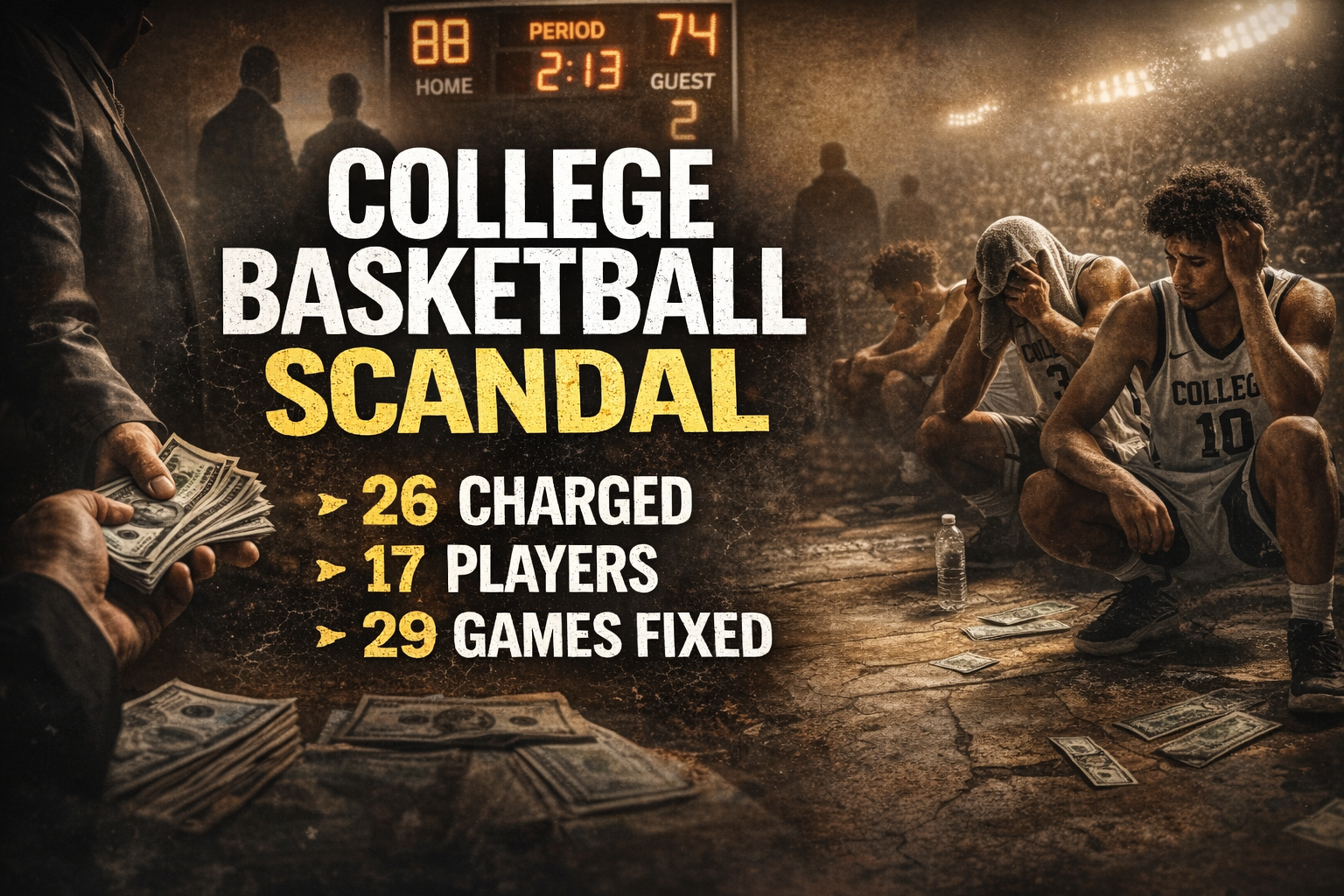
The FBI just dropped charges against 26 people in a massive college basketball point-shaving scheme that allegedly fixed 29 NCAA games between 2022 and 2025. Players were paid $10,000 to $30,000 per game to tank performances, shave points, and ensure specific betting outcomes.
Seventeen college basketball players are named. Multiple trainers, recruiters, and professional gamblers built an elaborate network to corrupt games and rake in profits from rigged bets.
But here's what nobody's talking about: look at the list of schools involved.
New Orleans. Mississippi Valley State. Nicholls State. Buffalo. Western Michigan. Robert Morris. Southern Miss. Kennesaw State. Tulane. Eastern Michigan. Alabama State. Abilene Christian.
Notice what's missing? Duke. Kentucky. Kansas. North Carolina. Any major Power 5 program.
With one exception—DePaul from the Big East—this entire scandal is mid-major and low-major programs. Players from schools that generate millions in revenue but see almost none of it. Athletes competing on national television who can't afford to eat off-campus without budgeting carefully.
And the federal prosecutor handling the case said the quiet part out loud: "Certain players were targeted because they were somewhat missing out on NIL money."
Translation: Players who aren't getting paid are vulnerable to schemes that pay them.
This isn't a scandal about individual bad actors. This is a scandal about a system that compensates Power 5 athletes while leaving mid-major players broke, desperate, and susceptible to exploitation.
College Basketball’s Silence Is Almost As Damning As the Crimes https://t.co/RxgNAFslwe
— BREAKING NEWZ Alert (@MustReadNewz) January 17, 2026
The Schools That Aren't on the List Tell the Story
Here's what's remarkable about this case: it's not who got caught. It's who didn't.
Where are the players from Duke, Kentucky, Kansas, North Carolina, Gonzaga, Villanova, or any other program with major NIL infrastructure? Where are the athletes from schools with million-dollar Name, Image, and Likeness collectives backing their rosters?
They're not on this list.
And it's not because Power 5 players are morally superior or less tempted by money. It's because they're already getting money—legally, through NIL deals that mid-major players don't have access to.
When a Kentucky guard is making $50,000-$100,000 in NIL money, the risk-reward calculation of taking $20,000 to shave points in a game looks completely different than it does for a Mississippi Valley State guard making zero NIL dollars while watching his school generate revenue from his play.
The pattern is undeniable:
- Players with NIL compensation: Not implicated in this scandal
- Players without NIL compensation: Vulnerable to bribes and point-shaving schemes
This isn't speculation. The prosecutor explicitly stated that players were targeted because they were missing out on NIL money.
The Economic Reality for Mid-Major Players
Let's talk about what life actually looks like for a Division I basketball player at a mid-major school.
You're generating revenue for your athletic department. Your games are streamed on ESPN+. Your conference tournament is broadcast nationally. Your school sells tickets, merchandise, and sponsorships based on your performance.
And you're getting:
- A scholarship covering tuition, room, and board (which is valuable, but doesn't put money in your pocket)
- A small stipend for cost of attendance (maybe $2,000-$5,000 per year depending on the school)
- Zero NIL opportunities because your school doesn't have a collective, local businesses aren't interested in mid-major athletes, and national brands only work with Power 5 stars
Meanwhile, you're watching Power 5 athletes with identical or worse statistics getting $50,000+ in NIL deals because they play for a school with resources and infrastructure.
You're broke. You can't afford to go out with friends without budgeting carefully. You can't help your family financially even though they've sacrificed to support your athletic career. You can't even afford the occasional nice meal off-campus.
Then someone approaches you and says: "I'll give you $15,000 to make sure your team doesn't cover the spread in the first half of Saturday's game. You don't even have to lose—just don't play as hard defensively for 20 minutes."
What do you do?
If you're a Power 5 player already making six figures in NIL, you laugh it off. The risk isn't worth it.
If you're a mid-major player making zero NIL dollars? The calculation gets a lot more complicated.
I think one of the people charged in the FBI College Basketball Gambling case is Rod Winkler who tried to fight Aaron Harrison
— Matt Jones (@KySportsRadio) January 16, 2026
“He a Man like I’m a man”
CRAZY!!!!https://t.co/s752j5A5Kn pic.twitter.com/AApfubUAkV
Why Power 5 Programs Aren't Implicated (Yet)
To be clear: this doesn't mean Power 5 players are morally superior or incapable of corruption.
What it means is they have less economic incentive to participate in point-shaving schemes because they're already compensated through legal channels.
NIL hasn't eliminated the temptation to cheat in college sports. What it's done is create a two-tier system:
- Tier 1: Power 5 athletes with access to significant NIL money, reducing their vulnerability to illegal schemes
- Tier 2: Mid-major and low-major athletes with little to no NIL money, making them prime targets for exploitation
The gamblers and fixers behind this scheme weren't stupid. They specifically targeted players at schools where NIL infrastructure doesn't exist. They knew these athletes were economically vulnerable.
According to the indictment, the scheme involved trainers, recruiters, and former players who had connections to mid-major programs. They built relationships with athletes who weren't getting paid, then offered them money to manipulate games.
It's not a coincidence that this happened at New Orleans, Mississippi Valley State, and Buffalo instead of at Duke, Kansas, and Kentucky.
The DePaul Exception (That Proves the Rule)
One Power 5-adjacent school does appear in the indictment: DePaul, a Big East program.
Three DePaul players—Jalen Terry, Da'Sean Nelson, and Micawber Etienne—are alleged to have taken bribes to underperform in games against Georgetown, Butler, and St. John's during the 2024 season.
But here's the thing: DePaul is in the Big East, but they're not a major NIL power. They're one of the weakest programs in a major conference. They went 3-29 last season. Their NIL infrastructure is nowhere near what Kansas, Duke, or Kentucky offers.
So even the one "Power 5" exception is actually a struggling program where players likely weren't receiving significant NIL compensation.
The pattern holds: players without NIL money are vulnerable. Players with NIL money aren't implicated.
What This Reveals About College Basketball's Economic Structure
This scandal exposes the fundamental inequality in college basketball's new NIL era.
NIL was supposed to allow all college athletes to profit from their name, image, and likeness. In reality, it's created a system where:
- Top-tier Power 5 athletes make seven figures through collectives, endorsements, and brand deals
- Mid-tier Power 5 athletes make modest NIL money ($150,000-$500,000)
- Mid-major athletes make less despite competing at the same Division I level
When you create that kind of economic disparity, you create vulnerability.
Athletes at mid-major schools are generating revenue. Their games are broadcast. Their jerseys are sold. Their performances drive ticket sales and media contracts. But they see almost none of that money because:
- Their schools don't have wealthy booster collectives funding NIL
- Local businesses don't see value in sponsoring mid-major athletes
- National brands only work with high-profile Power 5 stars
So you get a perverse situation where Division I athletes competing on national television can't afford basic expenses while their Power 5 counterparts are signing luxury car deals.
That economic pressure makes athletes susceptible to illegal schemes. Not because they're bad people, but because they're broke people being offered significant money to do something that doesn't even require them to lose games—just underperform slightly.
The Prosecutor Said It Out Loud
U.S. Attorney David Metcalf, when discussing the case, made a statement that should be front-page news but has been largely ignored:
"I will say that the evidence in this case shows that the monetization of college athletics and athletics generally furthered the enterprise in this case. But it's complicated, right? I mean, as we allege in the indictment, certain players were targeted because they were somewhat missing out on NIL money."
Read that again. Federal prosecutors believe players were specifically targeted because they weren't getting NIL compensation.
The gambling fixers didn't target Power 5 stars making $100,000 in NIL deals. They targeted mid-major players making zero dollars despite playing Division I basketball on national television.
That's not a gambling scandal. That's a systemic failure.
The False Narrative About "Bad Apples"
The easy narrative here is to focus on individual wrongdoing: "These players made bad choices. They violated NCAA rules. They deserve punishment."
And yes, they did make bad choices. They violated rules. There are consequences.
But focusing only on individual wrongdoing misses the forest for the trees.
When the pattern of corruption overwhelmingly involves players from schools without NIL infrastructure, that's not a character problem—it's a structural problem.
When federal prosecutors explicitly state that players were targeted because they were missing out on NIL money, that's not a gambling issue—it's an economic inequality issue.
When Power 5 athletes with significant NIL compensation aren't implicated while mid-major athletes with zero NIL compensation are at the center of the scandal, that tells you everything about the system.
What Needs to Change
If college basketball wants to prevent future point-shaving scandals, the solution isn't harsher penalties for athletes who get caught.
The solution is economic equity.
1. Revenue Sharing Must Include Mid-Majors The NCAA's proposed revenue-sharing model focuses on Power 5 conferences. Mid-major athletes need access to similar compensation structures. If you're generating broadcast revenue and ticket sales, you deserve a share.
2. NIL Infrastructure Can't Be Limited to Wealthy Programs The NCAA should create baseline NIL opportunities for all Division I athletes. National partnerships, baseline compensation structures, something that ensures a mid-major player isn't making zero dollars while a Power 5 player makes six figures.
3. Scholarship Athletes Need Meaningful Stipends Cost-of-attendance stipends need to be substantial enough that athletes can afford basic living expenses without financial stress. $2,000 per year isn't enough.
4. Transparency About Who's Getting Paid The current NIL system obscures who's making what. More transparency would reveal the massive inequity between Power 5 and mid-major athletes.
5. Acknowledge the Economic Incentives Driving Corruption Stop pretending this is about individual moral failures when the pattern clearly shows it's about economic desperation.
The Uncomfortable Truth
Here's what nobody in college basketball leadership wants to admit: this scandal was predictable.
When you create a system where some athletes make hundreds of thousands of dollars while others in the same division make nothing, you create vulnerability.
When you broadcast mid-major games on national television, sell tickets, generate revenue, and give athletes almost none of it while Power 5 athletes get massive NIL deals, you create resentment and desperation.
When you allow economic inequality to run rampant in a system that claims to value competitive integrity, you shouldn't be surprised when athletes without resources accept money from people offering it—even if it means compromising games.
The athletes who got caught in this scandal made poor choices. But the system that created the conditions for those choices is the bigger villain.
Power 5 athletes aren't more moral than mid-major athletes. They're just better compensated. And that compensation insulates them from the desperation that makes illegal schemes appealing.
What This Means for the Future
If college basketball doesn't address economic inequality, this won't be the last gambling scandal.
More mid-major athletes will be targeted because they're economically vulnerable. More games will be compromised. More federal investigations will expose corruption.
And the pattern will continue: mid-major athletes get caught while Power 5 athletes remain insulated by their NIL wealth.
The FBI just handed college basketball a roadmap showing exactly where the vulnerabilities are: athletes who aren't getting paid are susceptible to schemes that pay them.
The question is whether anyone in college basketball leadership is willing to address that structural problem, or if they'll continue focusing on punishing individual athletes while ignoring the system that set them up to fail.
Twenty-six people have been charged. Seventeen college basketball players' careers are over. Dozens of games were corrupted.
But the real scandal isn't what these athletes did. It's what the system failed to do for them.
When you don't pay athletes equitably, you create the conditions for corruption. This gambling probe didn't expose bad actors—it exposed a broken system.