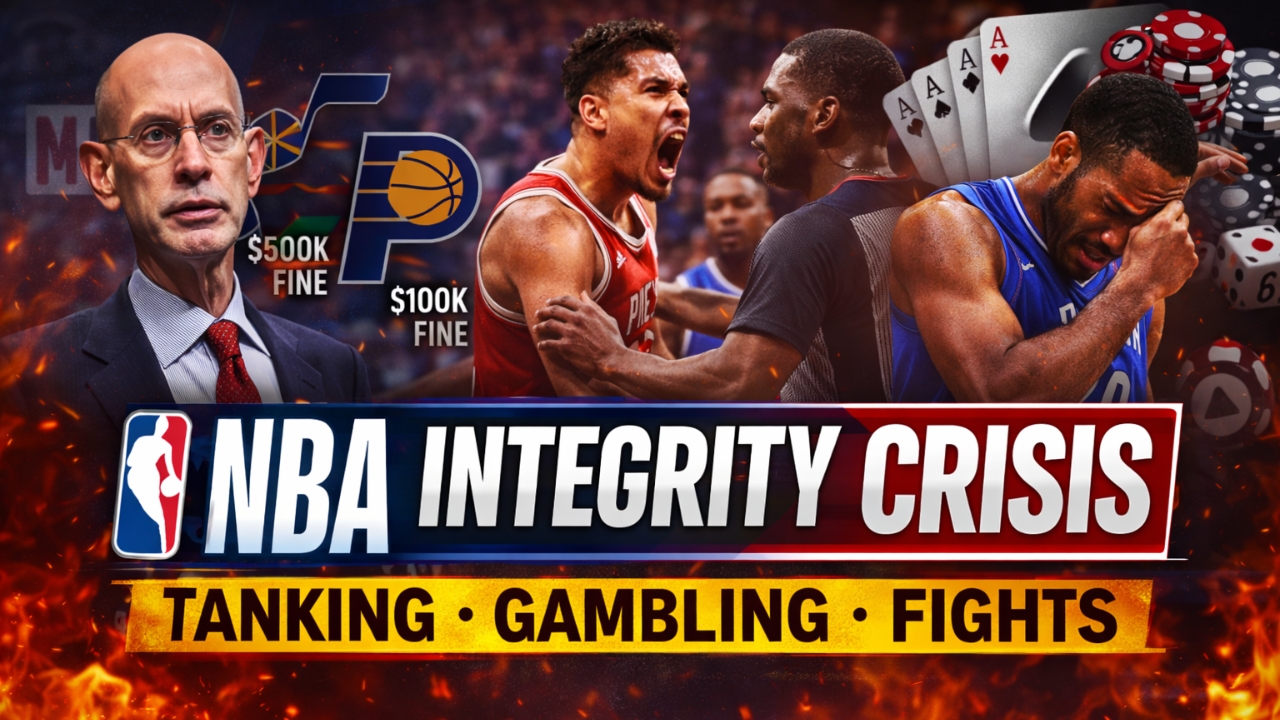
The NBA finds itself navigating the most turbulent period in decades, with a perfect storm of integrity issues threatening the league's credibility. On February 12, 2026, Commissioner Adam Silver levied a staggering $500,000 fine against the Utah Jazz and a $100,000 penalty against the Indiana Pacers for what he called "overt" tanking behavior—pulling healthy star players from close games to deliberately lose and improve draft positioning. Combined with an ongoing gambling scandal that has already ensnared a current All-Star, a head coach, and multiple former players, plus escalating on-court violence resulting in multi-game suspensions, the league faces a credibility crisis that raises fundamental questions: Has the proliferation of sports gambling corrupted professional basketball's competitive integrity? And is college basketball now offering a superior product?
The Fines: When Losing Becomes Strategy
The NBA's penalties against Utah and Indiana represent the league's most aggressive stance yet against tanking. The Jazz removed All-Stars Lauri Markkanen and Jaren Jackson Jr. from games against Orlando (Feb. 7) and Miami (Feb. 9) before the fourth quarter despite both being healthy and the outcomes still in doubt. Ironically, Utah actually won the Miami game 115-111 even after benching their stars—and still got fined.
"Overt behavior like this that prioritizes draft position over winning undermines the foundation of NBA competition and we will respond accordingly to any further actions that compromise the integrity of our games," Silver declared. "Additionally, we are working with our Competition Committee and Board of Governors to implement further measures to root out this type of conduct."
Jazz owner Ryan Smith clapped back on social media: "Agree to disagree... Also, we won the game in Miami and got fined? That makes sense..."
The Pacers violated the Player Participation Policy by sitting Pascal Siakam and two other starters against Utah on February 3. An NBA investigation, including review by an independent physician, determined all three could have played under the policy's medical standard.
These fines arrive amid the most blatant tanking epidemic in NBA history. At least five teams—Utah (18-38), Indiana (15-40), Washington Wizards, Sacramento Kings, and New Orleans Pelicans—possess 18 or fewer wins and appear locked in a race to the bottom. The prize? A guaranteed top-five pick in what many consider the strongest draft class in NBA history, with ESPN's Jay Williams predicting the first 13 picks will all be freshmen currently dominating college basketball.
The player participation policy was implemented in September 2023 specifically to discourage this behavior, but the fines represent mere costs of doing business for franchises prioritizing draft positioning over competitive integrity. When winning hurts your long-term prospects more than losing does, the incentive structure breaks down completely.
The Gambling Scandal: Darker Than We Knew
The tanking fines represent only the surface of the NBA's integrity crisis. On October 23, 2025, the league was rocked when federal authorities arrested 30 individuals including Miami Heat guard Terry Rozier, Portland Trail Blazers head coach Chauncey Billups, and former player and coach Damon Jones in connection with an illegal gambling and game-fixing operation.
According to federal indictments, Rozier allegedly sold insider information to bettors for $100,000 while with Charlotte in 2023, informing gamblers he would sit out a game against New Orleans due to "injury." Billups, a Basketball Hall of Famer, faces charges related to both an illegal poker ring with mafia connections and allegedly tipping off bettors that Portland would tank games. Jones faces charges in both schemes.
The scandal's tentacles extend throughout basketball. Federal prosecutors in January 2026 indicted 26 additional people—including current and former college players—for rigging NCAA Division I games and Chinese Basketball Association contests. The scheme involved point-shaving across at least 29 games with more than 39 players on 17 different Division I teams.
DePaul players allegedly accepted bribes to underperform in losses to Georgetown, Butler, and St. John's. Atlantic 10 schools including Saint Louis, LaSalle, and Fordham faced attempts to buy off players. One scheme targeting LaSalle failed when players
apparently ignored the bribe and won the first half despite gamblers betting $247,000 on St. Bonaventure.
Rozier, Billups, and Jones have all pleaded not guilty, with trials scheduled for 2026. Both Rozier and Billups remain on administrative leave, their careers in limbo while investigations continue.
This isn't the NBA's first gambling rodeo. Toronto's Jontay Porter received a lifetime ban in 2024 for similar conduct, and the investigation into his activities led to the current federal probe. The proliferation of legalized sports betting—now permitted in 40 states and Washington D.C.—has created an environment where Americans have wagered over $500 billion since the 2018 Supreme Court decision striking down federal betting prohibitions.
On-Court Violence: When Competition Turns Into Combat
Adding to the NBA's troubles, multiple violent altercations have resulted in severe suspensions undermining competitive balance. On February 9, 2026, a brawl between Detroit and Charlotte resulted in four player ejections and significant discipline:
- Isaiah Stewart (Detroit): 7-game suspension for leaving the bench area, aggressively entering the altercation, and fighting—with the league citing his "repeated history of unsportsmanlike acts" (including his infamous 2021 incident with LeBron James)
- Miles Bridges (Charlotte): 4-game suspension for fighting and escalating the situation
- Moussa Diabate (Charlotte): 4-game suspension for fighting and escalating
- Jalen Duren (Detroit): 2-game suspension for initiating the altercation
The fight lasted over 30 seconds, moved from the lane toward the benches, and required police presence on the floor. The suspensions will cost the players a combined $1.57 million in salary.
Stewart's seven-game penalty reflects his troubling pattern—he was suspended three games in February 2024 for punching Phoenix's Drew Eubanks in a pregame altercation, and two games in April 2024 during a Pistons-Timberwolves melee.
For Charlotte, the timing couldn't be worse. The Hornets entered the Detroit game on a nine-game winning streak—one shy of the franchise record—and fighting for playoff positioning. Losing Bridges and Diabate for four games each severely damages their postseason hopes.
Gambling's Role: Follow the Money
The gambling crisis extends beyond individual bad actors—it reveals systemic vulnerabilities in a league now inextricably linked to betting operators. The NBA has partnered with multiple sportsbooks, integrating betting content into broadcasts and embracing gambling revenue as a growth engine. When the league profits from betting while simultaneously investigating game-fixing scandals involving its players and coaches, the conflict of interest becomes glaring.
Sports gambling revenue increased 22% from 2023 to 2024, jumping from $11 billion to $13.7 billion. Platforms like FanDuel, DraftKings, and ESPN Bet make wagering accessible through smartphone apps, creating unprecedented temptation for players, coaches, and team personnel with insider information.
The FBI began investigating NBA-connected individuals for illegal gambling in 2023 after detecting unusual betting patterns involving Rozier. The league conducted its own investigation, meeting with Rozier multiple times, but ultimately cleared him before federal authorities arrested him months later.
Congressional members have now sent letters to Commissioner Silver demanding answers about regulatory oversight and the league's gambling partnerships. The question becomes unavoidable: When billions in gambling revenue flow through league-approved partnerships while game-fixing scandals multiply, can competitive integrity coexist with gambling interests?
College Basketball: The Superior Product?
Amid the NBA's troubles, college basketball is experiencing a renaissance. ESPN's Jay Williams declared on "Get Up" that "the college basketball product is better than the NBA product right now. Each night in college basketball, you're having top-15 matchups, and the best players are actually playing in the games and competing every night."
The numbers support Williams' assessment. College basketball viewership is soaring, with Fox reporting a 69% increase this season, averaging 1.37 million viewers for men's games. ESPN networks show a 21% increase year-over-year. The February 1 Illinois-Nebraska game on FS1 became the most-watched college basketball game ever on that network with nearly 1.4 million viewers.
Women's college basketball continues its explosive growth with ESPN reporting a 39% viewership increase. Major matchups routinely draw over 2 million viewers, with Kentucky-Arkansas pulling 2.39 million and BYU-Kansas attracting 2.1 million.
The 2026 draft class—featuring BYU's AJ Dybantsa, Duke's Cameron Boozer, Kansas' Darryn Peterson, and North Carolina's Caleb Wilson—represents generational talent choosing to play college basketball rather than alternative paths. The recent Duke-UNC rivalry game drew the highest ratings since Mike Krzyzewski's final home game in 2022.
Compare that to NBA teams deliberately losing to draft these same players. The contrast couldn't be starker: college basketball features elite talent competing desperately to win every night, while NBA teams manipulate rosters to maximize lottery odds.
Different Challenges, Better Product?
College basketball faces its own integrity challenges—the January 2026 indictments prove gambling corruption extends to amateur ranks. NIL deals, transfer portal chaos, and questions about amateurism create complexity around the college game.
But here's the fundamental difference: college players compete to win. Every game matters for tournament seeding, conference championships, and legacy. March Madness' single-elimination format creates genuine stakes where one loss ends seasons.
The NBA's 82-game regular season increasingly feels meaningless when a third of the league actively tries to lose. Fans paying hundreds of dollars for tickets watch teams bench healthy All-Stars in close games. Television networks broadcasting nationally struggle to promote competitive integrity when outcomes are predetermined by draft positioning rather than competitive merit.
The College Football Playoff's success—with Indiana's championship run averaging 30.1 million viewers, a 36% increase year-over-year—demonstrates amateur sports can deliver premium entertainment when participants compete authentically. The Rose Bowl's 23.9 million viewers beat most NBA regular season games, proving college sports can rival professional leagues in viewership when the product delivers genuine competition.
The Larger Question: Can the NBA Fix This?
Commissioner Silver's stern fines represent acknowledgment that tanking has spiraled out of control. But $500,000 penalties for franchises worth billions barely qualify as speed bumps on the road to high draft picks. Utah owner Ryan Smith's defiant social media response suggests teams view fines as acceptable costs.
Silver promised to work with the Competition Committee and Board of Governors to "implement further measures to root out this type of conduct." But what measures can actually work? Eliminating the draft lottery entirely? Implementing European-style relegation? Creating harsher competitive penalties for teams that fall below minimum win thresholds?
The gambling crisis requires even more urgent attention. With federal prosecutions ongoing and congressional scrutiny intensifying, the league must demonstrate it can police its own personnel while maintaining billions in gambling partnerships. The conflict between gambling revenue and competitive integrity may prove impossible to resolve without structural changes to how the league engages with betting operators.
The violence issue, while troubling, represents the most manageable problem. Suspensions work. Players losing $1.57 million combined sends clear messages. Enforcing rules against fighting isn't complicated—the challenge is consistent application.
The Verdict: Helpful or Hurtful?
Is all this chaos helpful or hurtful for the NBA? The answer depends on the league's response.
The damage is severe:
- Competitive integrity compromised by systematic tanking
- Federal gambling prosecutions involving current players and coaches
- Congressional scrutiny of league gambling partnerships
- Violent on-court incidents damaging the product
- College basketball offering demonstrably more competitive, entertaining games
But opportunity exists:
- Aggressive fines signal Silver won't tolerate obvious tanking
- Federal prosecutions could deter future gambling violations
- Increased enforcement of violence penalties
- Growing viewership for competitive games shows fans reward authenticity
The NBA retains advantages college basketball can't match: established superstars, global reach, guaranteed long-term player development narratives, and playoff series creating extended storylines. When NBA teams actually try to win, the product remains elite.
But right now, in February 2026, with a third of the league tanking, gambling scandals unfolding, and fights erupting, Jay Williams' assessment rings true: college basketball delivers a superior product because the participants actually compete to win every night.
For the NBA to reclaim its position, Silver must implement structural changes that make losing more painful than missing high draft picks. Until tanking becomes competitively catastrophic rather than strategically beneficial, fans will continue gravitating toward college basketball, where the games still matter and the outcomes aren't predetermined by draft positioning.
The NBA's integrity crisis represents a crossroads. The league can either implement revolutionary reforms that restore competitive balance and separate gambling interests from operational control, or it can watch its product erode while college basketball captures viewers seeking authentic competition.
For young athletes building careers through platforms like BallerTube, the message is clear: wherever you play, compete to win. Authenticity matters. Fans recognize the difference between athletes giving maximum effort and organizations manipulating outcomes for draft positioning.
The NBA's 2025-26 season will be remembered as the year the league's integrity was tested like never before. How Commissioner Silver and the owners respond will determine whether professional basketball remains must-watch television or becomes secondary to college basketball's increasingly superior product.