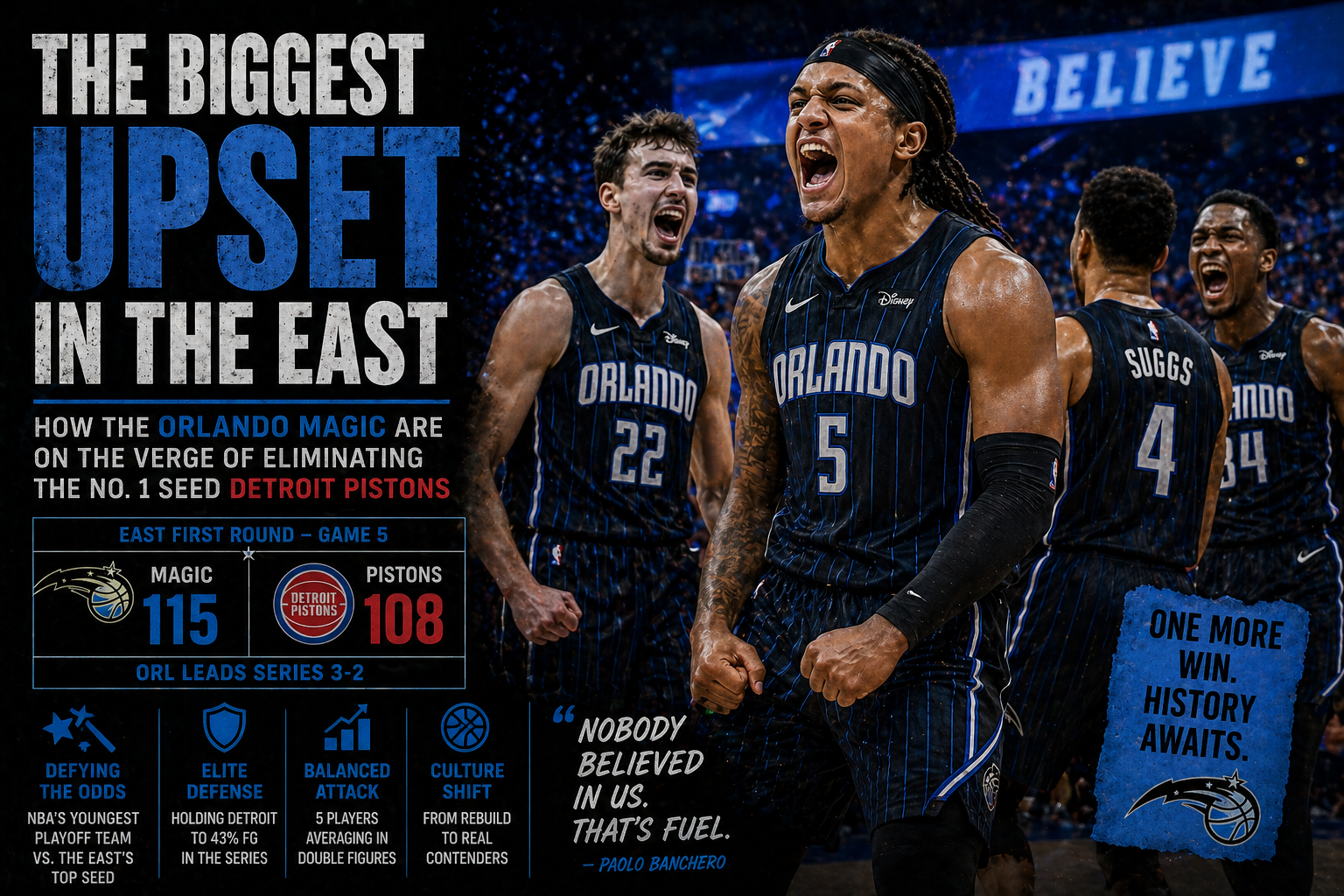
The Biggest Upset in the East: How the Orlando Magic Are on the Verge of Eliminating the No. 1 Seed Detroit Pistons
They survived injuries all year. They spent most of the season outside the top six. They had to claw through the play-in just to get here. And now the Orlando Magic, the No. 8 seed in the Eastern Conference, are one win away from one of the most stunning first-round upsets in NBA playoff history.
As of Tuesday April 28, 2026, the Orlando Magic lead the Detroit Pistons 3-1 in the first-round playoff series. Game 5 is Wednesday night. The Pistons — who finished 60-22, won the Eastern Conference's top seed for the first time in franchise history since the Bad Boys era, and were installed as one of the most defensively dominant teams in the league — are one loss away from the earliest exit a No. 1 seed has suffered in years. And the team doing this to them entered the series having barely scraped into the bracket through the play-in tournament on a Friday night, after an embarrassing Game 82 loss that had left their entire season in question. The Magic's story is improbable in every chapter. The Pistons' collapse is the story nobody planned for but everyone is watching.
The Magic's Season: A Story of Survival
To understand what Orlando is doing right now, you have to understand what they survived to get here. The Magic entered 2025-26 with genuine ambitions for a top-four seed in the East. They had traded for Desmond Bane in the offseason — sending Cole Anthony, Kentavious Caldwell-Pope, and multiple first-round picks to Memphis — to give Paolo Banchero and Franz Wagner the spacing partner their offense desperately needed. The preseason projection was a team that could challenge for the Eastern Conference's upper tier. The reality was almost entirely different.
Injuries dismantled Orlando's season from the opening months. Franz Wagner — the team's leading scorer at 23.4 points per game — played just four games after December 7, missing most of three months with a high ankle sprain. The Magic's starting five of Suggs, Bane, Wagner, Banchero, and Wendell Carter Jr. had a combined net rating of plus-14.0 per 100 possessions in the minutes they shared together — a number that projects to one of the best lineups in the Eastern Conference. They played just 126 minutes together all season. Banchero, meanwhile, was battling his own inconsistency issues. His shooting efficiency through the first half of the season was a genuine concern — the team was not consistently better with him on the floor — and the conversation around whether he was living up to his max contract became one of the central narratives of Orlando's difficult stretch.
Then the All-Star break arrived, and something shifted. Banchero returned from his time in the Bahamas as a visibly different player. After the break, he averaged 23.4 points, 8.4 rebounds, and 5.2 assists per game with shooting splits of 46.5/35.4/79.6 — a complete reversal of his early-season struggles. Orlando's net rating with Banchero on the floor went from negative territory to plus-12.0 per 100 possessions after the break. Wagner's imminent return brought renewed energy. Bane — who had emerged throughout the season as the team's steadiest contributor at 19.0 points and 4.5 assists per game on 56.1% true shooting — provided the professional glue the roster needed around its two young stars through every difficult stretch.
The team still only scratched into the play-in through that final-week grind — finishing in the bracket's lower tier and needing to win Friday night's play-in game to advance. Then, on that Friday, they destroyed the Charlotte Hornets 121-90. Kon Knueppel and LaMelo Ball were neutralized. Orlando's defense, which had always been the team's identity even through its worst offensive stretches, showed up at the exact moment it was needed. The turnaround in 72 hours — from embarrassing Game 82 loss to dominant play-in destruction of the Hornets — was staggering. And it was only the beginning.
Game 1: The Upset That Announced the Series
The Magic walked into Little Caesars Arena on Saturday as 12-point underdogs and left with a 112-101 wire-to-wire victory that sent a shockwave through the entire Eastern Conference bracket. All five Orlando starters scored 16 points or more. Paolo Banchero led with 23 points, 9 rebounds, 4 assists, and 1 steal. Franz Wagner — returning from his calf injury, limited but present — contributed 19 points. Wendell Carter Jr. added 17 points, 7 rebounds, and 5 assists. Desmond Bane and Jalen Suggs each scored 16 and 17 points respectively. It was the most balanced collective scoring performance any team had delivered in the first round of the playoffs that weekend.
Detroit's Cade Cunningham scored 39 points. He was the only Piston to score in double figures. The Magic had identified Jalen Duren — the All-Star center who had averaged 12.4 shots per game after the All-Star break — as the key to unlocking the Pistons' half-court offense, and they crowded him in the paint so aggressively that he finished with just four shots the entire game. Without Duren as a functional second option, Cunningham became a solo act, and the Magic's defense knew it. It was the most disciplined game plan execution the Magic had produced all season. The Pistons, playing their first playoff home game in nearly 18 years, ended the night with their fans filing out with three minutes remaining in the fourth quarter.
The Series: Four Games of Chaos, Turnarounds, and History
Detroit answered in Game 2 with a physical third-quarter explosion that gave the Pistons their first playoff home win since 2008, ending an 11-game postseason losing streak at Little Caesars Arena that had become the longest in NBA history. Cunningham averaged 31 points through the first two games combined. The Pistons' identity asserted itself and the series was tied.
Games 3 and 4 in Orlando were where the Magic pulled away. Game 3, at the Kia Center, was a physical contest that went back and forth — Banchero scoring 25, Wagner adding 25 of his own, Carter Jr. delivering a playoff career-best 17 rebounds, and all five Orlando starters scoring in double figures again. The Pistons rallied late, cutting a 17-point deficit to four points in the final two minutes, but couldn't complete the comeback as Banchero hit the dagger pull-up three with 38 seconds remaining. Magic 113, Pistons 105. Series lead: 2-1.
Game 4 was the defensive masterpiece. Orlando shot just 32.8% from the field — and still won 94-88. They forced 20 Detroit turnovers, won the rebounding battle 69-63, and generated ten more field goal attempts than the Pistons on a night where neither team could consistently convert. Cunningham had 25 points and fought hard, but committed 6.3 turnovers per game in the series — a number that encapsulates the defensive pressure Orlando's collective effort has applied to him throughout. The Pistons shot 20% from three-point range in Game 4. Jamal Cain's thunderous putback slam over Jalen Duren in the fourth quarter became the moment of the game — one of the physical exclamation points that has defined Orlando's postseason identity.
What Detroit Is Going Through
The Pistons' collapse is not a simple story, and it deserves more than a line about the No. 1 seed being embarrassed. Detroit's season was built on a remarkable combination of defensive identity, team cohesion, and depth — a 60-win organization that nobody predicted entering the year. Cade Cunningham, the franchise cornerstone, missed significant time down the stretch with a collapsed lung that kept him out for extended stretches and disrupted his rhythm. He returned for the playoffs but has been fighting through Duren's ineffectiveness and the complete absence of secondary scoring. Tobias Harris and Duren are the only other Pistons averaging double figures in the series. The team that won 60 games by distributing the ball and sharing the load is now dependent on Cunningham to create everything, while Orlando's five-man collective effort suffocates every passing lane.
Magic Johnson — yes, that Magic Johnson — urged the Pistons publicly to "get their swagger back." Coach J.B. Bickerstaff has called for cleaner execution inside to get Duren more involved. The team rallied in Game 4's final moments, closing a gap but ultimately scoring just one point in the game's final 2.5 minutes when the game was on the line. Fundamentals — free throw shooting, three-point conversion, ball security against Orlando's pressure — have all broken down in the series' pivotal moments.
The Magic, for their part, have a chance on Wednesday to become just the seventh No. 8 seed in NBA history to eliminate a No. 1 seed in a first-round series. The last team to do it was the 2022-23 Miami Heat, who beat the Milwaukee Bucks before reaching the NBA Finals. Orlando — battered by injuries all season, forced into the play-in, written off entering this series — is now one win away from joining that company.
The basketball world didn't see this coming. Orlando did.
2026 NBA Playoffs, Eastern Conference First Round: Orlando Magic vs. Detroit Pistons. Current series: Magic lead 3-1. Game 5: Wednesday, April 29. Magic playoff scoring leaders: Paolo Banchero (20.5 PPG), Desmond Bane (17+ PPG), Franz Wagner (19+ PPG). Pistons: Cade Cunningham (31 PPG), Tobias Harris (16.5 PPG). Cunningham turnovers per game in series: 6.3. Pistons' 3-point percentage in Game 4: 20%.