The Most Direct Route: Flau'jae Johnson, the Seattle Storm, and the 2026 WNBA Rookie of the Year Race
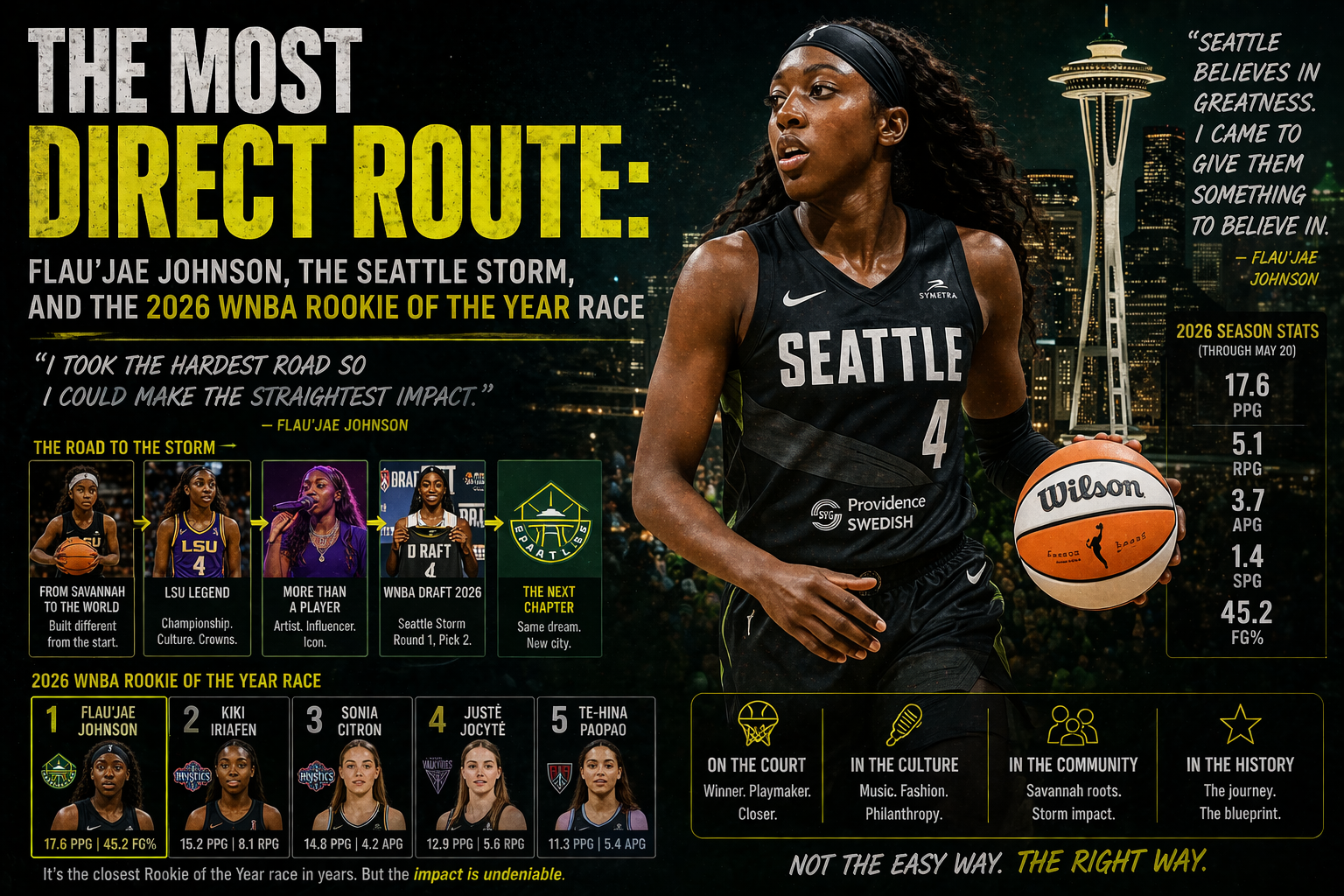
She was drafted eighth. She was traded within the hour. She scored a preseason team-high on the first night she wore a Storm jersey. And before the regular season has even started, Flau'jae Johnson has the most compelling Rookie of the Year argument in the 2026 class.
The 2026 WNBA Draft delivered one of the most stunning individual storylines of any draft night in the league's history — not in the selection of Azzi Fudd at No. 1, not in the Olivia Miles landing in Minnesota at No. 2, and not in UCLA's historic six-player draft night. The story that reverberated longest happened after the podium had gone quiet, after the television coverage had shifted, and after most of the basketball world had already begun digesting the night's results. The Golden State Valkyries, who had selected Flau'jae Johnson with the eighth overall pick, announced they were trading her rights to the Seattle Storm in exchange for Marta Suarez — the No. 16 pick — and a 2028 second-round selection. The reaction was immediate and almost unanimous: Golden State had given away a star, and Seattle had stolen one.
Who Flau'jae Johnson Is
Before the trade, the controversy, or the Rookie of the Year conversation, there is the player — and the player is extraordinary in ways that transcend the basketball court. Johnson is 22 years old, a native of Baton Rouge, Louisiana, the daughter of late rapper Camoflauge, and a signed recording artist on Jay-Z's Roc Nation label who has 266,000 YouTube subscribers, 167,000 monthly Spotify listeners, and a partnership with e.l.f. Cosmetics that has generated national advertising campaigns built around her story. She performed original songs on America's Got Talent at 14 years old. She has recorded tracks with Lil Wayne and Waka Flocka Flame. She was given the key to the city of Baton Rouge on April 4, 2026 — two weeks before the start of WNBA training camp.
The basketball résumé matches the biography. Johnson spent four seasons at LSU under head coach Kim Mulkey, amassing 2,063 career points — one of the most productive four-year totals in Tigers program history. She averaged 14.6 points, 5.3 rebounds, 2.3 assists, and 1.6 steals per game across 141 career games and 139 starts, shooting 37.3% from three-point range over her career and winning a national championship with the Tigers. Her final season produced 14.2 points and 4.2 rebounds per game on 46.5% shooting from the field, with 27 double-digit scoring games including nine outings with 20 or more points. She earned First-Team All-SEC and Third-Team All-American honors as a senior. She was the program's most decorated player in the post-championship era and one of the most athletically gifted and defensively disruptive guards available in the entire 2026 draft class.
ESPN's preseason assessment of her professional projection was direct: "She's a stellar defender with solid scoring capabilities, and she should have ample opportunities to earn playing time as a rookie." The trade simply accelerated every element of that opportunity from "ample" to "complete."
Why the Trade Was a Gift
Understanding Flau'jae Johnson's Rookie of the Year case requires understanding the structure of the award at its foundation. Winning ROTY in the WNBA is, at its core, about opportunity — the opportunity to play, to lead, to accumulate statistics in meaningful minutes on a team that needs what you provide. In 2024, Caitlin Clark won the award because Indiana gave her the entire offense and let her run it. In 2025, Paige Bueckers won because Dallas gave her the same freedom. Both were No. 1 overall picks on teams that had finished near the bottom of the standings, which meant no veteran competition and maximum playing time from Day 1.
Azzi Fudd — this year's No. 1 pick — goes to Dallas and joins Bueckers and Arike Ogunbowale. She enters as the team's third scoring option. The Rookie of the Year path is significantly more complicated. The same calculus applies to Lauren Betts and Gabriela Jaquez in Washington, to Kiki Rice in Toronto, to Olivia Miles in Minnesota — all talented players who will compete for minutes and touches with established veterans on structured rosters. Johnson, by contrast, goes to a Seattle Storm team that lost its top five scorers from last season, is in active rebuild mode, and genuinely needs a primary ball-handling guard to run the offense. She is not the third option in Seattle. She is, for practical purposes, the first.
The financial framework confirms it. Under the new collective bargaining agreement, Johnson will earn more than $300,000 as a rookie — nearly four times what Bueckers earned last season as the top overall pick. The market has caught up to what these players are worth, and Johnson's contract reflects both the new economic reality and the specific value her combination of scoring, defense, and star power brings to a rebuilding franchise.
The Preseason Preview
The first real evidence arrived on the opening night of WNBA preseason play. In the Storm's first exhibition against the Golden State Valkyries — the team that drafted and immediately traded her, in what qualified as one of sports' more unusual first reunions — Johnson scored a team-high 12 points in 23 minutes on 5-for-10 shooting, adding three rebounds and demonstrating the kind of confident, instinct-driven play that doesn't require familiarity with a system to produce. The Storm lost 78-76. Johnson was the best player on her team.
Storm head coach's assessment afterward was telling: "The more she knows where she needs to be, the more those instincts take over, the more the intangibles take over, the athleticism, the feel. It's really hard to teach feel. She has it." Johnson's own framing of her approach to professional basketball was even more revealing: "In practice, you've got to be very vulnerable, because that's how you learn. You have to mess up. But in the game, I'm super confident. You've got to play at the end of the day. There's plays and all that, but ultimately I was just like, 'Put the ball in the basket.'" That mentality — professional humility in practice, complete confidence in games — is exactly the psychological profile that ROTY winners have demonstrated in the modern era. Johnson has it naturally.
She arrives in Seattle alongside 19-year-old Spanish center Awa Fam Thiam — the No. 3 overall pick, a generational talent whose combination with Johnson gives the Storm two of the most exciting young players in the league on the same roster — and Duke's Taina Mair at No. 14. The Storm are building something deliberately and patiently. Johnson is the face of that build, the name on the marquee, the player the franchise is counting on to announce the era while developing toward the player they believe she can become. The regular season begins May 8. The Rookie of the Year race is already underway. And Flau'jae Johnson, who was traded within an hour of being drafted and responded by putting up a team-high in her preseason debut, is ahead.
Flau'jae Johnson: LSU, 4 seasons, 2,063 career points, 14.6 PPG, 5.3 RPG, 37.3% from three. Drafted No. 8 (Golden State Valkyries), traded to Seattle Storm for Marta Suarez (No. 16) and 2028 second-round pick. 2026 rookie salary: $300,000-plus. Preseason debut: 12 points, 5-for-10 shooting, 23 minutes. Storm 2026 season begins May 8.