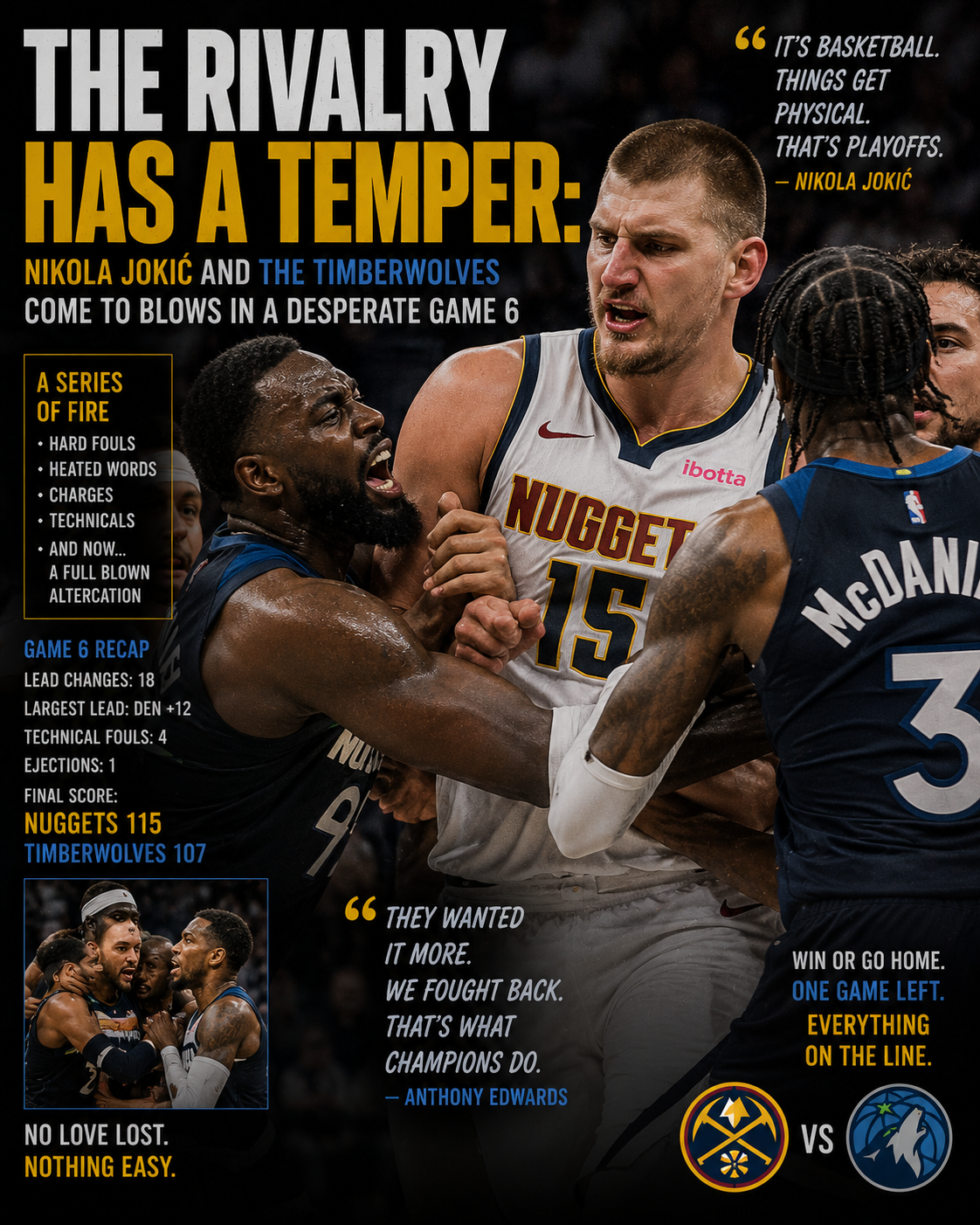
The Rivalry Has a Temper: Nikola Jokić and the Timberwolves Come to Blows in a Desperate Game 6
This is the third time in four years these two teams have met in the playoffs. The bad blood is real, the emotions are volcanic, and Nikola Jokić — one of the most composed players in basketball — has now been in two shoving matches in this series alone. The Timberwolves won anyway.
There are playoff rivalries and then there are playoff grudges. The Denver Nuggets and Minnesota Timberwolves have spent four years building something that qualifies fully as the latter — a relationship forged in three postseason series, two enormous Nuggets wins, one historic Timberwolves comeback, and an accumulation of hard fouls, physical confrontations, and end-of-blowout grievances that has made every game between these teams feel like it is being played at a temperature several degrees above normal. By the time Game 6 arrived at Target Center on April 30, with the Nuggets facing elimination and Nikola Jokić carrying an already-simmering frustration from earlier in the series, the conditions were set for exactly what happened. The fourth quarter boiled over. The benches emptied toward the court. Jokić was in the middle of it. And when the final buzzer sounded, it was Minnesota — shorthanded, undermanned, and absolutely unwilling to lose — who advanced.
The Series That Built to This
To understand what happened in Game 6, you have to understand the series it concluded. Minnesota and Denver entered this first-round matchup as two of the most physically imposing teams in the Western Conference, with a three-year history of playoff confrontations that had left both rosters with very long memories. The Timberwolves took a 3-1 series lead — a position of comfort that the Nuggets, three-time playoff survivors and a team built for exactly these moments, refused to accept. Denver clawed back to force Game 6 at Target Center, arriving in Minnesota knowing the Wolves would be without three players averaging 10-plus points in the series: Anthony Edwards (18.5 PPG), Donte DiVincenzo (10.8 PPG), and Dosunmu (21.8 PPG) — a level of injury attrition that, in virtually any other context, would have made the Nuggets heavy favorites to win on the road and force Game 7.
Denver was also shorthanded, missing both Aaron Gordon and Peyton Watson. But Minnesota's absences were on a categorically different level. Coach Chris Finch responded by making one of his most creative lineup decisions of the postseason — starting Terrence Shannon Jr., a 6-foot-6 second-year guard from Illinois who had spent most of the season in a reserve role, and playing veteran Mike Conley for 26 minutes in his most significant postseason contribution in years. Shannon Jr. responded with 24 points in 35 minutes. Rudy Gobert played like a different version of Jokić himself — finishing with 10 points, 13 rebounds, and eight assists. The shorthanded Wolves didn't just survive. They played some of their best basketball of the series.
The Confrontation: Fourth Quarter, Rising Temperature
The shoving match came late in the fourth quarter of a close game — Minnesota maintaining a lead that felt more comfortable than it actually was, Denver pushing back with the desperation of a team that could see its season ending. Jaylen Clark — the reserve guard who had been one of Finch's most trusted defensive options throughout the series — gave Jokić a small shove after a play in the paint. The shove was not violent or aggressive in isolation. But Jokić, who had been physical and contested throughout the game and whose patience with Minnesota's physical approach had been depleting since Game 4, retaliated immediately and emphatically, turning on Clark and engaging in a shoving exchange that brought both benches toward the court.
Naz Reid — normally one of the more even-keeled presences in the Timberwolves' rotation — got involved from behind, shoving Jokić in the back as players swarmed from both directions. The officials moved quickly and successfully kept the situation from escalating further. When the dust settled, technical fouls were assessed to Clark, Reid, and Jokić — no ejections, a free throw for Denver, and a game that resumed with both teams intact but running on pure emotional fuel. The crowd at Target Center, which had been generating playoff-series-level noise all night, reached a different decibel level entirely.
This was not the first time this series that the two sides had come to this moment. At the end of Game 4 — a Minnesota blowout in which the Wolves were winning by a comfortable margin in the closing seconds — Jokić had confronted Jalen McDaniels for continuing to score in garbage time rather than simply dribbling out the clock. "It's a lack of respect," Jokić said afterward, a comment that landed in the Timberwolves' locker room and apparently stayed there. The Game 6 shoving match was, in part, a sequel to that conversation — the accumulated friction of three playoff series and dozens of high-contact possessions finally expressing itself in the only way it had left.
Minnesota Advances, Denver Reflects
The final score was 110-98 — Timberwolves. Minnesota became the first team in NBA playoff history to win a game while missing three players who had been averaging 10 or more points in the series. The victory gave them a 4-2 series win and a second-round date with the San Antonio Spurs and Victor Wembanyama. Jokić finished with his customary statistical brilliance — but was characteristically unwilling to blame anyone other than himself and his teammates for the series result. Asked about head coach David Adelman's decisions, Jokić was as generous as ever: "It's not his fault that we couldn't rebound. It's not his fault that we could not catch the ball. There is nothing to blame David Adelman for. It was all us."
The most telling measure of Denver's collapse is this: the team that averaged 122.1 points per game during the regular season — the highest-scoring offense in the NBA — failed to reach 100 points in three of the six games in Minnesota. All three sub-100 performances came in Target Center. Minnesota's defense, anchored by Gobert's ability to shadow Jokić and allow the rest of the Wolves to defend Denver's perimeter players straight up, neutralized the most prolific offensive system in basketball three separate times across one series. That is not bad luck or variance. That is a defensive blueprint — and it will inform how Wembanyama and the Spurs approach their second-round preparation over the next several days.
Denver goes home. Minnesota, battered and undermanned and still winning, goes to face the future of basketball. The rivalry is not over. It has the feel of something that will continue for years, whenever both teams are healthy and whole and meeting again in April or May. The bad blood accumulated across three playoff matchups doesn't disappear in an offseason. It waits.
Game 6 final: Minnesota Timberwolves 110, Denver Nuggets 98. Series: Timberwolves win 4-2. Technical fouls assessed in Q4 scuffle: Nikola Jokić, Jaylen Clark, Naz Reid. No ejections. Minnesota's injured players absent: Anthony Edwards (18.5 PPG), Donte DiVincenzo (10.8 PPG), Dosunmu (21.8 PPG). Jokić's series: averages not released, but posted triple-double range numbers across multiple games. Timberwolves advance to face San Antonio Spurs in Round 2.