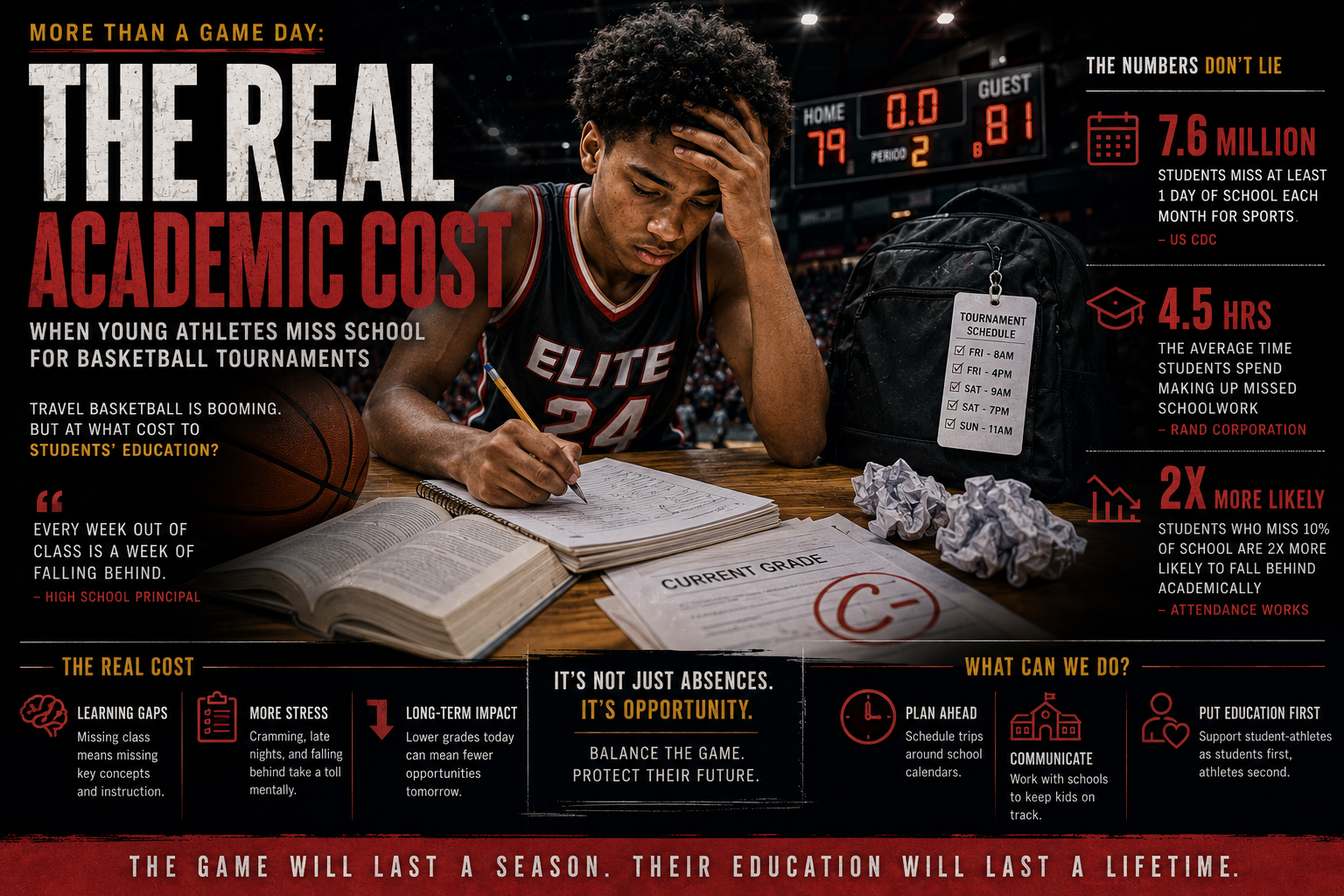

More Than a Game Day: The Real Academic Cost When Young Athletes Miss School for Basketball Tournaments
The alarm goes off at 4 a.m. The drive is three states away. The tournament runs Friday through Sunday. And Monday morning, there is a quiz nobody prepared for, a teacher who marks the absence unexcused, and a grade that starts sliding before the season is even halfway over.
Every weekend from March through July, hundreds of thousands of young basketball players across the United States load into minivans and SUVs for drives that range from two hours to twelve, heading toward gyms in cities they have never visited to play in tournaments that matter more to their futures than most adults fully understand. The AAU circuit, the independent tournaments, the shoe-sponsored showcases, the regional qualifiers — the grassroots basketball calendar runs almost continuously, and for the players in it, especially the ones with legitimate college prospects, missing a tournament is rarely an option. Missing school to attend one, on the other hand, has costs that the basketball world has never adequately calculated or addressed.
What the Research Actually Shows
The academic impact of repeated school absences is one of the most consistently documented findings in educational research, and it applies regardless of why a student misses class. The National Center for Education Statistics has established that students who miss more than 10% of the school year — approximately 18 days in a standard 180-day calendar — experience measurable declines in academic performance, lower test scores, and higher rates of course failure. For many competitive AAU players who participate in a full spring and summer circuit, 18 absent school days is not a worst-case scenario. It is a routine one.
The academic effect is not distributed equally across all students. Research from Johns Hopkins Center for Summer Learning has demonstrated that the achievement gap between high-performing and struggling students widens most significantly when instruction time is inconsistently received — and instructional time lost to tournaments falls disproportionately on students who were already managing below-grade-level content before the season began. For the student who is excelling academically, a missed Friday and the follow-up makeup work is a manageable inconvenience. For the student who is already struggling with algebra or reading comprehension, the same three-day absence can be the event that pushes their grade past the point where recovery is realistic within a single semester.
The social dimension compounds the academic one. Adolescent educational research consistently finds that school attendance is not merely about content delivery — it is about the social and relational environment that keeps young people engaged with learning. Students who miss repeated school days report feeling disconnected from classroom relationships, falling behind on group projects, losing the thread of ongoing discussions, and — critically — beginning to identify themselves as someone who is not fully present in the academic environment. That identity shift is among the most difficult to reverse, and it often begins not with a single catastrophic event but with the gradual accumulation of absences that each, individually, seemed justified.
What Coaches, Parents, and Players Navigate
The families who navigate elite youth basketball understand this tension better than anyone observing from the outside. The cost-benefit calculation they make every time a tournament conflicts with a school day is not made casually or without awareness of the trade-offs involved. College coaches do not watch players at regional tournaments they have never heard of. The exposure that leads to scholarship offers happens at specific events, in specific cities, in front of specific programs — and those events do not arrange their schedules around middle school finals week. A family that decides the academic cost of a tournament absence is too high to accept may be making the right educational decision. They may also be closing the door on the scholarship conversation entirely.
The most experienced youth basketball coaches and program directors are acutely aware of this dynamic and many attempt to mitigate it through advance communication with schools, structured study time during travel, and deliberate scheduling of tournaments to minimize conflicts with high-stakes academic moments like finals, standardized testing periods, and project deadlines. The reality is that these mitigations are imperfect and unevenly applied. A coach who runs a program in an affluent suburb, where parent communication infrastructure is robust and school administrators are accustomed to athletic accommodations, operates in a fundamentally different environment from a coach whose players attend under-resourced schools with high teacher turnover, minimal administrative flexibility, and no formal process for managing competitive athlete absences.
The Long Game: What's Actually at Stake
The argument for tolerating academic disruption in service of elite youth basketball is, at its core, an argument about long-term return on investment. A full athletic scholarship to a Division I university is worth, at current four-year estimates, between $200,000 and $350,000 in tuition, room, board, and fees. For families with limited financial resources, the scholarship pathway represents one of the most direct available routes to higher education and the economic mobility that follows. When a missed Friday at school is the price of being seen by a college coach who might offer that scholarship, the calculation is not as straightforward as critics who have never had to make it often suggest.
The counter-argument is equally real: the scholarship path requires the player to remain academically eligible, and academic eligibility requires grades, test scores, and transcripts that tournament-driven absences actively undermine. NCAA academic eligibility standards are not forgiving, and the student who arrives at a Division I program with genuine academic deficits — created or compounded by years of tournament absences — is statistically less likely to graduate, less likely to successfully navigate the college academic environment, and less likely to benefit from the education the scholarship was supposed to provide. The most honest assessment is that tournament absences and academic outcomes are not independent variables. They are connected, and the connection runs in the wrong direction for the students least equipped to absorb the cost.
The EYBL spring season runs April through July, with 5 annual sessions. The Under Armour Association, Adidas 3SSB, and Puma Pro16 circuits run parallel schedules. Most sessions run Thursday through Sunday, conflicting with standard school attendance 3-4 days per session for players who travel significant distances. NCAA academic eligibility requires a minimum 2.3 GPA in 16 core courses and a qualifying SAT/ACT score for Division I programs.