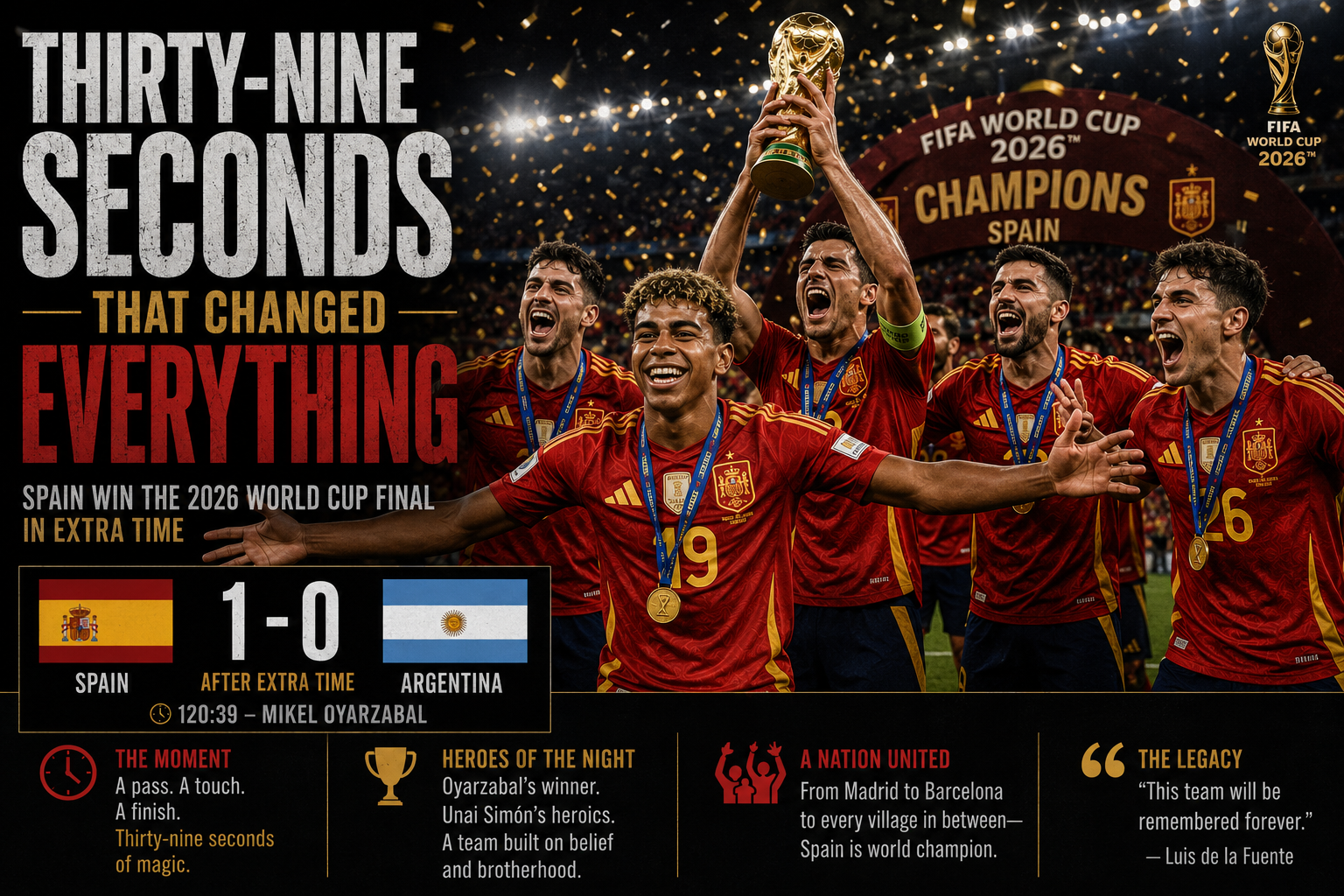
Thirty-Nine Seconds That Changed Everything: Spain Win the 2026 World Cup Final in Extra Time
Argentina had the best goalkeeper in the world. He made 10 saves, a World Cup final record, and kept them level for 105 minutes without recording a single shot on target. Then Enzo Fernandez got a second yellow card. Thirty-nine seconds later, Ferran Torres ended the match and handed Spain their second world title.
EAST RUTHERFORD, NEW JERSEY — Shadows had crept across MetLife Stadium when Ferran Torres finally ended the tension. The 2026 FIFA World Cup Final between Spain and Argentina had run 105 minutes and 21 seconds without a goal. In that time, Spain had taken 20 shots, put 12 on target, and exercised a possession grip of 60 to 32 percent that left their opponents gasping for any foothold from which to launch a coherent attack. Argentina had taken two shots in 105 minutes, neither on target. They had scored 19 goals across six previous matches to reach this final. Against Spain, they managed nothing. And they had still not lost — because Emiliano Martinez was having the greatest goalkeeping performance in the history of the World Cup final.
Then Enzo Fernandez went in on Pau Cubarsi with a reckless challenge in the third minute of second-half stoppage time. The referee, who had shown restraint throughout, had no choice. Second yellow card, red card, Argentina reduced to ten men as the match entered extra time. The moment everyone at MetLife Stadium had quietly suspected for the entire second half had arrived. Spain would now get the goal they had earned all afternoon.
How the Final Unfolded
The tactical picture was established within the opening ten minutes and never changed. Luis de la Fuente set his Spain side up in their customary 4-3-3, with Rodri anchoring the midfield as he had done through every game of the tournament, and Lamine Yamal and Nico Williams providing the wide width that created every meaningful Spanish attack. Argentina, under the guidance of Lionel Scaloni, set their defensive block with ten outfield players behind the ball from the moment they lost possession, surrendering territory in exchange for a compact defensive structure that attempted to deny Spain the central angles they needed to create shooting opportunities.
For the first 45 minutes, Martinez made it work through sheer brilliance. He saved a Yamal drive in the eighth minute. He palmed a Pedri volley over the bar in the 23rd minute. He spread himself to deny a Torres close-range header in the 31st minute. He made his 10th save of the match in the 78th minute from a Williams cutback that appeared certain to produce a goal. Each save was louder than the one before in the Spanish areas of the crowd. Each was a sentence in a story that was building toward an impossible punchline: Argentina, defending world champions, who had scored more goals than any other team at this tournament, unable to manage a single attempt on target against a team that had outshot them by a ratio of 20 to two.
Messi's influence was contained throughout. Rodri's positioning in the midfield denied Messi the space he needed to receive the ball in dangerous areas and turn forward. When Messi did receive the ball, he was immediately surrounded by two Spanish outfield players who did not foul but stayed close enough to prevent the kind of solo creation that had defined his tournament. His final assist in the semifinal against England had sent a nation dreaming of back-to-back titles. In the final, he was rendered a peripheral figure by the most disciplined defensive team performance a Spanish side has managed in a major final.
The disallowed goal summed up Argentina's afternoon. When Nico Williams fired into the net in the 89th minute, the Spanish supporters inside MetLife Stadium erupted before the flag went up and the video review confirmed a Merino foul on Otamendi in the build-up. The goal was ruled out. The Argentine players and supporters celebrated the reprieve with the energy of a team that understood, at that moment, that their goalkeeper had kept them in a match they had no right to still be drawing.
The Moment: Ferran Torres in the 106th Minute
The first period of extra time ran without a decisive moment. Spain pressed forward, Argentina's ten men absorbed pressure with organized compactness, and the shootout that would have represented the most unjust possible outcome was beginning to feel inevitable. Then came the second period of extra time and the 37 seconds that ended the tournament.
Nico Williams, brought on as a substitute in the second half, collected the ball on the right side of the Argentine penalty area and delivered a header — not a pass, a header flick — that found Torres in the central channel with time and space to take one touch and shoot. Torres did not take one touch. He took none. He received the header on his chest, let it drop, and thumped an 8-yard shot past Martinez before the goalkeeper, who had made ten saves in 105 minutes, could set his feet. The ball hit the net. Torres ran toward the Spanish supporters' end. The stadium reacted with the volcanic release that 105 minutes of scoreless pressure produces when it finally breaks.
Spain 1, Argentina 0. Full time after extra time.
What It Means: Records, Farewells, and History Written in Real Time
Spain are world champions for the second time, following their 1-0 win over the Netherlands in Johannesburg in 2010. They are the first nation in history to simultaneously hold both the men's and women's World Cup titles. The squad that de la Fuente has assembled represents the fullest expression of La Masia's development philosophy over 15 years: a generation of technically immaculate players who can execute a suffocating possession style at every level of competition, from youth football through to the final of the largest tournament in the sport's history.
Kylian Mbappe finished as the tournament's top scorer with eight goals, earning the Golden Boot in what he described as his greatest individual performance at a World Cup. The Golden Ball went to Lamine Yamal, 18 years old and the tournament's most dazzling individual personality, who dribbled past defenders on both sides of his body as though the world stage were a playground he had been playing on his entire life. The first halftime show in World Cup history, staged between the first and second halves of the final, delivered a spectacle that will be replicated at every future tournament. United States President Donald Trump attended the final and was photographed with Spain's players and the trophy.
For Messi, the final image is not the one he wanted. He sat on the MetLife turf as Spain's celebrations began around him, taking in what appeared to be the last moment of his World Cup career. He had provided the assist that sent Argentina to the final. He had played every minute he could. He could not prevent what Spain's tactical structure made inevitable. The greatest player in the sport's history leaves the World Cup stage without the back-to-back title he came to New Jersey to claim. Spain would not let him have it. Torres made sure of that in the 106th minute, on a suburban New Jersey football field, in front of 82,500 people and hundreds of millions watching around the world.
Spain won. The world cup was over. The greatest sporting event on earth closed exactly the way it should: with a goal that arrived at the last possible moment, from a player who had waited all game for his chance, against a goalkeeper who had done everything humanly possible to prevent it.
2026 FIFA World Cup Final: Spain 1-0 Argentina (AET). July 19, 2026, MetLife Stadium, East Rutherford, New Jersey. Goal: Ferran Torres, 106 minutes. Assist: Nico Williams. Red card: Enzo Fernandez (90+3', second yellow). Spain stats: 20 shots, 12 on target, 60% possession. Argentina stats: 2 shots, 0 on target, 32% possession. Emiliano Martinez saves: 10 (World Cup final record). Golden Boot: Kylian Mbappe (France), 8 goals. Golden Ball: Lamine Yamal (Spain). Golden Glove: Emiliano Martinez (Argentina). Attendance: 82,500. Spain's second World Cup title: 2010, 2026. First nation to hold both men's and women's World Cups simultaneously.