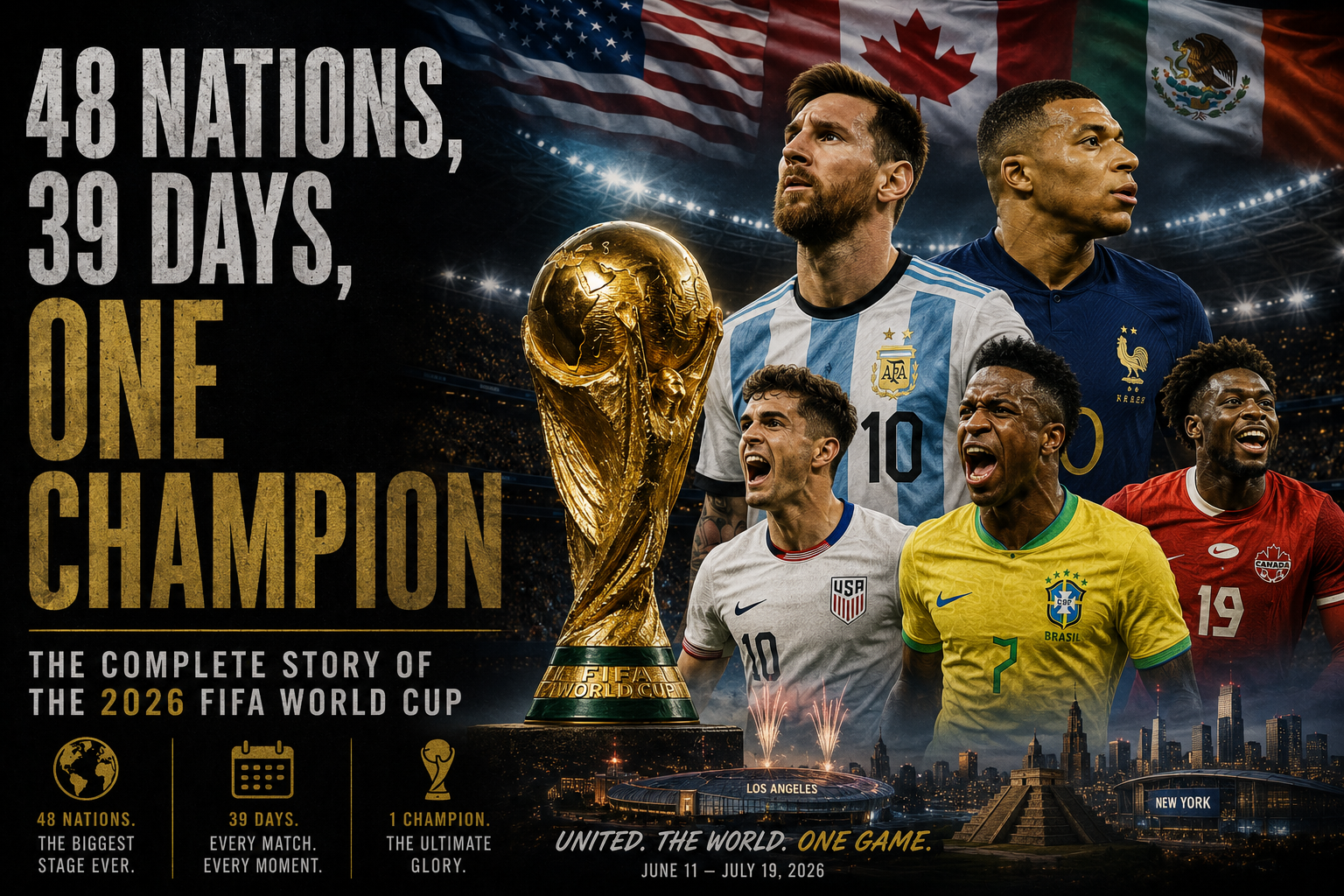
48 Nations, 39 Days, One Champion: The Complete Story of the 2026 FIFA World Cup
Spain started with a draw against Cape Verde. Argentina nearly went out against Egypt. Brazil fell to Norway. The United States lost to Belgium. And when it was over, Ferran Torres scored in the 106th minute and the sport's greatest prize went to La Roja for the second time in history. The 2026 World Cup was the biggest in the sport's history and, in many ways, the most unpredictable.
The 23rd FIFA World Cup began on June 11, 2026, in the Estadio Azteca in Mexico City with the host nation defeating South Africa 2-0 in front of a roaring crowd of over 87,000 people. It ended 39 days later at MetLife Stadium in East Rutherford, New Jersey, when Ferran Torres controlled a header from Nico Williams and thundered a shot past Emiliano Martinez in the 106th minute of extra time, handing Spain a 1-0 victory over Argentina and completing one of the most dominant individual tournament performances in World Cup history. Between those two moments, 104 games were played across 16 host cities in the United States, Canada, and Mexico. Records fell at every stage. Upsets multiplied across the bracket. And the 2026 World Cup delivered on the promise of the biggest, most ambitious expansion of the tournament's format in the sport's history.
The Group Stage: Chaos From the Opening Weekend
The expanded 48-team format divided nations into 12 groups of four, with each team playing three group stage games and the top two from each group advancing, alongside the eight best third-place finishers. The structure was new. The chaos it produced was immediate.
Spain, the tournament's top-ranked entrant and eventual champions, began their campaign with a draw against Cape Verde, the West African tournament debutants who had never previously qualified for a World Cup. The result sent a wave of panic through the Spanish camp and provided the tournament's first indication that the expanded format had produced a field with genuine competitive depth at every level. La Roja recovered, winning their remaining group games and advancing as group winners, but the stumble against Cape Verde set an early narrative tone: no team, regardless of ranking or history, was safe from the opening round's unpredictability.
The United States opened Group D with the weight of host nation expectation and the 32 years of anticipation since the 1994 tournament had helped establish soccer's mainstream foothold in American culture. They beat Paraguay and advanced to the Round of 32, then the Round of 16, before meeting Belgium in Seattle on July 6. The USMNT lost 3-2 in what USA Today called another humbling result in a tournament where the Americans had won just one match in the Round of 16 or beyond across nine World Cup appearances since 1990. The only exception was 2002, when a controversial 1-0 loss to Germany ended a quarterfinal run. Belgium's three-goal explosion extinguished American hopes on home soil in one of the tournament's most emotionally charged results.
Brazil, the five-time champions and one of the tournament's most anticipated participants, survived a nervy group stage before falling to Norway in the Round of 16. Erling Haaland did not score in that game but dominated the buildup phases in ways that allowed teammates to convert. The result eliminated South America's most decorated footballing nation and handed the Nordic countries their greatest result in the sport's modern history. Brazil's elimination at the last-16 stage was the tournament's most significant upset before the quarterfinals.
The Knockout Rounds: The Path to the Final
The Round of 32 and Round of 16 produced the bracket that the knockout stages deserved. All three host nations were eliminated: Canada lost to Morocco, Mexico fell to England after Thomas Tuchel's side edged past them at the Azteca, and the United States fell to Belgium. The quarterfinals brought France versus Morocco in a rematch of the 2022 semifinal. Kylian Mbappe led France to a 2-0 win, scoring his seventh tournament goal and establishing himself as the tournament's most electrifying individual performer across the full six weeks. Belgium, fresh off defeating the United States, then fell to Spain in a 2-1 quarterfinal as La Roja's combination play proved too structured and relentless for Belgium's direct approach to disrupt for a full 90 minutes.
On the other side of the bracket, Norway's fairy tale run ended against England in a 2-1 quarterfinal in which Jude Bellingham scored twice, keeping the Three Lions on course for their first World Cup final since 1966. Argentina survived the most dramatic path to the semifinals of any contender. They needed extra time to beat Cape Verde in the group stage, scraped past Egypt on penalties in the Round of 16, and then required an extra-time goal from Julian Alvarez in the quarterfinal to eliminate Switzerland, who had themselves beaten Germany on penalties to reach that stage.
The semifinals produced the matches the bracket had been setting up since the group draw in December 2025. France against Spain in Dallas saw Luis de la Fuente's side dominate Didier Deschamps' team in a way that reflected the full quality gap between the tournament's best team and a France side that had produced individual brilliance without collective cohesion. Spain's win set up the final everyone had been hoping for since the seedings were announced. Argentina against England in Atlanta was a different kind of game. Anthony Gordon gave England the lead in the 55th minute before Tuchel switched to five defenders. Then Lionel Messi provided the assist for Enzo Fernandez's equalizer in the 86th minute, followed by a Lautaro Martinez winner in the second minute of stoppage time. Argentina 2, England 1. The final was set.
The Final: Spain Suffocates Messi's Last Stand
The 2026 FIFA World Cup Final between Spain and Argentina was played at MetLife Stadium in East Rutherford, New Jersey, on July 19, 2026, in front of 82,500 fans in an atmosphere that, as multiple correspondents noted, was undermined only by the NFL stadium's gray concourse and suburban character. The football more than compensated for the venue's limitations.
Spain dominated the match so completely that their statistical superiority reached historic proportions. They finished with 20 shots to Argentina's two. Twelve on target to zero. A possession share of 60 to 32 percent. Argentina, who had scored 19 goals in seven matches en route to the final, did not register a single attempt on target across 120 minutes of football. The defending champions were suffocated by Spain's midfield press in a way that left Messi effectively isolated from dangerous areas for almost the entire match.
Argentina's salvation, for as long as it lasted, was Emiliano Martinez. The goalkeeper made 10 saves in the final, breaking the record for saves in a World Cup final, including multiple world-class stops in the first half that kept the score level when Spain's sustained pressure appeared certain to produce a breakthrough. With Martinez performing at a level beyond almost any goalkeeper in tournament history, the final lurched toward extra time despite Argentina's near-total inability to create anything of their own.
Then came Enzo Fernandez. With 93 minutes played, the Argentina midfielder recklessly challenged Pau Cubarsi and received a second yellow card, reducing Argentina to ten men at the worst possible moment. Spain had been the better team for 90 minutes. With a numerical advantage in extra time, the result became inevitable, though even then, a disallowed goal for a foul on Otamendi in the build-up kept the score level longer than Spain deserved. Thirty-nine seconds into the second half of extra time, substitute Ferran Torres thumped an 8-yard shot past Martinez and the match was over.
Spain 1, Argentina 0. La Roja are world champions for the second time, following their 2010 triumph in South Africa. They are now the first nation in history to hold both the men's and women's World Cups simultaneously. Messi sat on the MetLife turf at full time, alone with the weight of what had just happened, in what appeared to be his final appearance at a World Cup. He had provided an assist in the semifinal. He had carried Argentina through a brutal knockout run. He could not quite carry them past a Spanish team that was simply, in this tournament and in this final, the best team in the world.
2026 FIFA World Cup: June 11 to July 19, USA, Canada, Mexico. 48 nations, 104 matches, 16 host cities. Final score: Spain 1-0 Argentina (AET). Goal: Ferran Torres, 106 minutes. Assist: Nico Williams. Red card: Enzo Fernandez (90+3'). Spain shots: 20. Argentina shots: 2 (0 on target). Emiliano Martinez saves: 10 (World Cup final record). Tournament top scorer: Kylian Mbappe, 8 goals. Golden Ball: Lamine Yamal (Spain). Host nation eliminations: USA (Round of 16, lost to Belgium 3-2), Mexico (Round of 16, lost to England), Canada (Round of 16, lost to Morocco). Spain's second World Cup title: first was 2010.