
Every recruiting cycle in college basketball comes with noise, hype, and instant judgment. Fans refresh ranking boards, celebrate commitments, and argue over which program “won the class.” Five-star signings are treated like guarantees. Top-10 classes are labeled automatic contenders before a single practice is played.
But college basketball doesn’t work that cleanly.
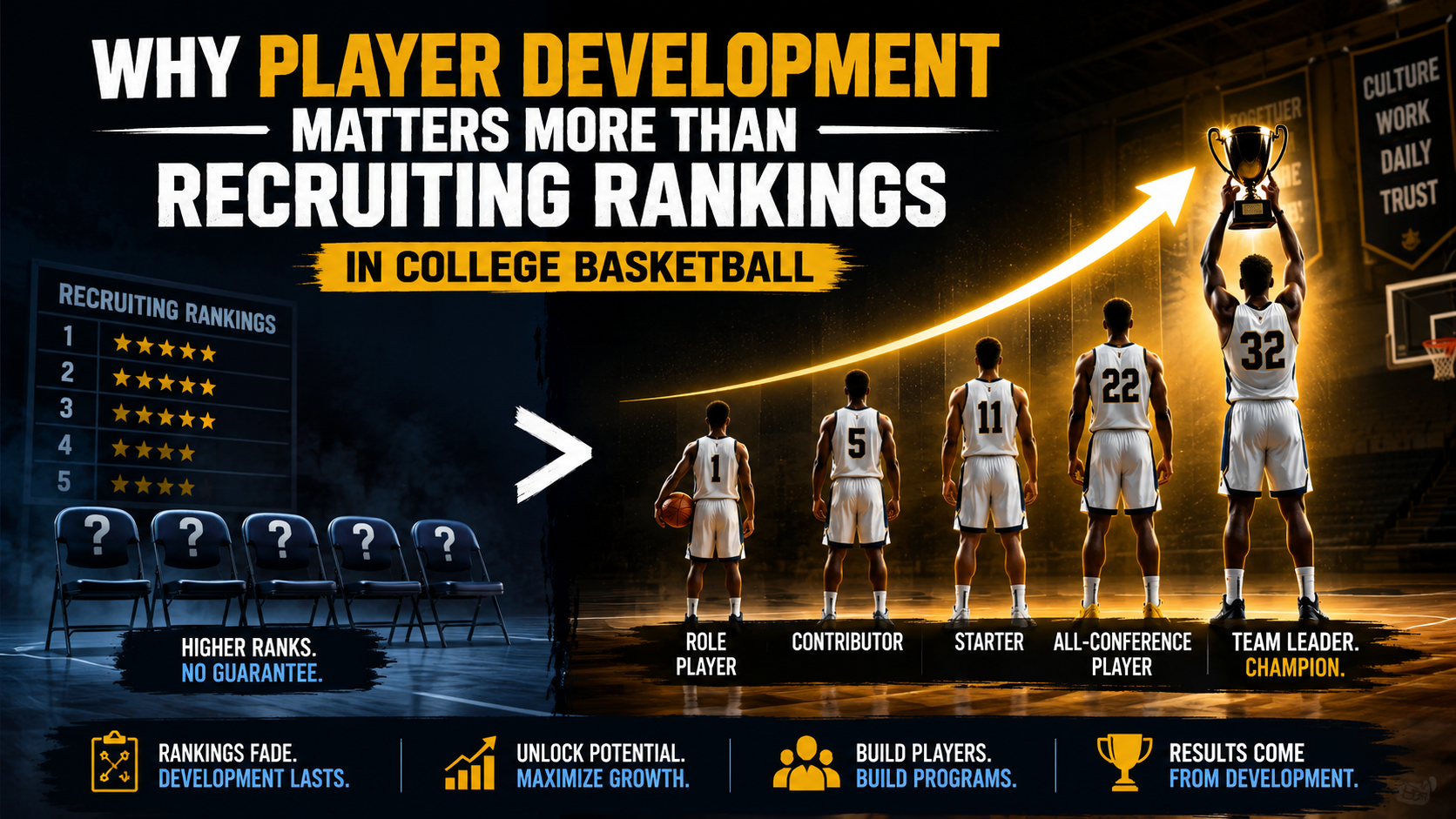
Year after year, the sport proves something that front offices and great coaches already know: recruiting rankings create expectations, but player development determines outcomes.
Talent matters. No championship team is built without it. But talent alone is never the final answer. What separates good programs from great ones is not just who they recruit—it’s what they build after the recruit arrives.
Player development is the real engine of sustained success.
The Recruiting Rankings Obsession
Recruiting rankings have become one of the loudest parts of college basketball culture. Websites evaluate prospects as early as middle school. High school juniors already carry labels that follow them into college. Social media amplifies every commitment, transfer, and ranking update.
It creates the illusion of certainty.
A five-star prospect is expected to dominate immediately. A top-25 class is expected to translate into wins. Anything less is labeled disappointment.
But rankings are not predictions of success. They are snapshots of potential based on limited information—high school production, physical tools, exposure, and projection.
What they cannot measure well:
- how a player responds to coaching
- how hard a player works in private
- how a body develops in a college strength program
- how quickly decision-making improves
- how consistency holds up under pressure
- how mental toughness evolves through adversity
In other words, rankings measure what a player is today, not what he will become.
And college basketball is a “become” sport.
What Player Development Actually Means
Player development is often misunderstood as just “getting shots up” or improving individual skills in workouts. In reality, it is a full transformation process that touches every part of a player’s game and life.
True development includes:
Skill refinement
Shooting mechanics, finishing ability, ball handling under pressure, passing reads, and footwork are sharpened daily. Small adjustments create long-term efficiency.
Physical development
Strength, explosiveness, conditioning, durability, and injury prevention are built through structured training programs. Many players arrive talented but physically unprepared for the college level.
Basketball IQ
Understanding spacing, timing, defensive rotations, pick-and-roll reads, and game flow separates contributors from stars.
Mental development
Confidence, composure, resilience, and focus determine performance in close games and high-pressure environments.
https://www.ballertube.com/news/145/aau-coaches-and-nil-a-conflict-of-interest-or-a-new-opportunity/
Role acceptance and expansion
Players learn how to contribute in specific roles before expanding into larger responsibilities. Not everyone is a star on day one—but many grow into it.
Professional habits
Film study, nutrition, recovery, time management, and consistency build the foundation for long-term success.
Development is not one moment. It is a system.
And programs that invest in that system consistently outperform expectations.
Why Recruiting Rankings Miss the Real Timeline of Growth
One of the biggest flaws in recruiting evaluation is timing.
High school basketball rewards dominance. College basketball rewards adaptation.
A player can be the best athlete on the floor in high school simply because of early physical development. That same advantage can shrink or disappear in college, where everyone is bigger, faster, and more skilled.
At the same time, a player who looked average in high school may explode in college once he:
- gains 15–25 pounds of muscle
- improves shooting consistency
- adjusts to structured offensive systems
- learns defensive positioning
- develops confidence through repetition
Recruiting rankings rarely capture that trajectory.
They often reward:
- immediate production over long-term projection
- highlight performance over skill sustainability
- exposure over environment
- physical advantage over skill depth
That is why recruiting misses are not rare—they are normal.
And that is exactly where development becomes the separator.
The Programs That Consistently Win Understand This
When you study programs that consistently win deep into March, a pattern appears. They are rarely just “talent accumulation” teams. They are development systems.
They take players who may not be finished products and turn them into complete ones.
What they consistently do well:
1. Player growth over time
Freshmen become sophomores who look completely different. Juniors become leaders. Seniors become polished decision-makers.
2. Skill maximization
Players do not just improve—they become efficient. Turnovers drop. Shooting percentages rise. Defensive discipline improves.
3. Defined roles early
Instead of forcing players into star expectations immediately, roles are clear. That clarity speeds up development.
4. Internal competition
Practices are structured to push improvement daily, not just maintain status.
5. Long-term identity
Programs are built on habits, not hype. Development becomes part of the culture, not an occasional focus.
These programs don’t ignore recruiting rankings—but they don’t depend on them either.
They trust their system to elevate players beyond their original projection.
Development Creates Competitive Advantage
In modern college basketball, almost every program can access talent. The difference is what happens once that talent arrives.
Development creates a multiplier effect:
- A three-star recruit becomes a four-year starter.
- A role player becomes an all-conference performer.
- A bench player becomes a breakout star.
- A transfer becomes a system fit who elevates team performance.
Programs that develop well do more with less. Programs that don’t develop well often do less with more.
That difference shows up most clearly in February and March, when depth, consistency, and player improvement matter more than preseason rankings.
Development is not just about improving individuals. It is about increasing the ceiling of the entire roster.
Culture Is the Foundation of Development
No development system works without culture.
Culture determines whether players:
- accept coaching or resist it
- embrace repetition or avoid it
- compete daily or selectively
- stay patient or transfer quickly
In strong cultures, development is expected. Players understand that growth is part of the process, not an optional extra.
Coaching staffs in these environments do not just teach—they build standards.
Those standards create accountability:
- Effort is non-negotiable
- Improvement is tracked
- Film does not lie
- Consistency is rewarded more than flashes
In weaker cultures, talent can stall. Players may not be pushed, challenged, or developed properly. In those environments, recruiting rankings become misleading because they don’t translate into progress.
Culture determines whether potential becomes production.
https://www.cbssports.com/college-basketball/news/pac-12-mid-major-basketball-conference/
The Transfer Portal Makes Development Even More Important
Modern college basketball has changed dramatically with the transfer portal. Rosters are fluid. Continuity is harder. Immediate impact is expected.
This shift increases the value of development in two ways.
1. Faster player growth is required
Coaches have less time to wait. Players must improve quickly or risk losing roles or transferring.
2. Retention depends on development
Players leave programs when they feel stagnant. If a player believes he is not improving, he looks elsewhere.
Programs that develop well:
- retain more players
- attract transfers who want growth
- build more cohesive rosters
- adapt faster to roster changes
In this environment, development is not just an advantage—it is survival.
NBA Success Is Built Through Development, Not Just Recruiting Labels
Another misconception in basketball is that professional success is obvious early. In reality, many of the best players in professional basketball were not immediate stars in college.
What often separates those who reach the highest level is development over time:
- improving shooting efficiency
- expanding offensive skill sets
- learning defensive versatility
- increasing physical readiness
- building confidence in bigger roles
Players who develop consistently show something scouts value deeply: upward trajectory.
A player who improves every season signals potential that has not yet been fully unlocked.
College programs that specialize in development not only win more games—they also produce more professional-ready athletes. That reputation then feeds back into recruiting, creating a cycle of sustained success.
Why Fans and Media Misinterpret Recruiting Rankings
Recruiting rankings dominate attention because they are simple and immediate.
Development is slow and less visible.
A recruiting class can be graded instantly. Development requires time, patience, and context.
Fans often see:
- a five-star recruit sitting on the bench early
- a lower-ranked player outperforming expectations
- inconsistent freshman performances
And assume something is wrong.
But in reality, nothing is wrong. It is just development happening at different speeds.
Growth is not linear. Some players leap early. Others take two or three seasons to fully emerge.
Programs that understand this are less reactive and more stable. They do not panic over early struggles or overhype early success. They focus on long-term improvement.
The Future of College Basketball Belongs to Development Programs
College basketball is becoming more dynamic than ever. Between NIL, the transfer portal, expanded scouting, and increased player movement, roster construction is no longer static.
In this environment, recruiting rankings alone cannot guarantee success.
The programs that will consistently thrive are the ones that:
- identify undervalued talent
- develop players faster than opponents
- adapt players to multiple roles
- build systems, not just rosters
- prioritize growth over hype
The gap between programs is no longer just recruiting—it is development infrastructure.
Conclusion
Recruiting rankings will always matter. They help identify talent and generate excitement. But they are only the beginning of the story.
Player development is the story.
It is the process that transforms potential into performance, recruits into contributors, and rosters into winning teams.
The best programs understand a simple truth:
You don’t win because of who you sign. You win because of who you develop.
Rankings predict possibilities.
Development produces reality.
And in college basketball, reality is what wins games.