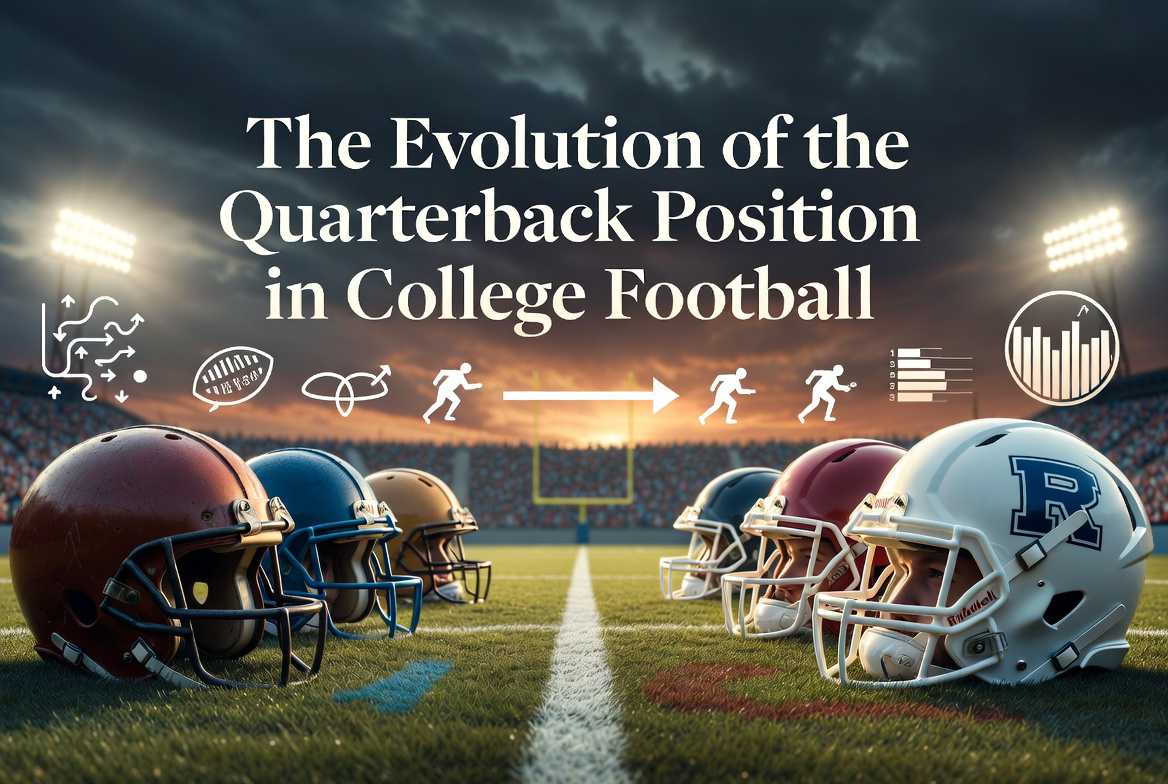
Few positions in sports have changed more dramatically than the quarterback in college football. What was once a role centered on handing off the football and managing the offense has become the most visible, scrutinized, and influential position on the field.
Today’s quarterbacks are expected to throw with precision, read complex defenses, manage social media attention, lead locker rooms, understand advanced analytics, and often serve as the face of entire athletic programs. They are not simply players. They are leaders, marketers, decision-makers, and, in many cases, the driving force behind a team’s success.
The journey from the quarterbacks of the early twentieth century to the stars of today’s game reveals how college football itself has evolved. Changes in rules, coaching philosophies, technology, recruiting, and athlete development have transformed what it means to play the position.
Understanding that evolution helps explain why the quarterback remains the most important player in college football.
The Early Days: A Different Kind of Quarterback
In the earliest years of college football, the quarterback position looked nothing like it does today.
Offenses relied heavily on running the football. Forward passes were either illegal or rarely used. The quarterback’s primary responsibility was organizing formations, calling signals, and distributing the ball to running backs.
Physical toughness often mattered more than passing ability. Many quarterbacks were essentially extra runners on the field. Coaches valued leadership and intelligence, but throwing accuracy was not viewed as a critical skill because passing played such a small role in offensive strategy.
The game was built around controlling possession, winning field position, and overpowering opponents at the line of scrimmage.
As a result, quarterbacks were important but not necessarily the stars of their teams.
That would eventually change.
The Birth of the Passing Game
One of the most significant turning points in football history came when the forward pass became a legitimate offensive weapon.
Initially, coaches viewed passing as risky. Incomplete passes often carried severe consequences under early rules, making many teams reluctant to throw the football.
Over time, however, innovative coaches recognized the potential advantages of attacking defenses through the air.
As passing became more effective, quarterbacks needed a new set of skills.
They had to:
- Throw accurately
- Read defensive coverages
- Anticipate receiver movements
- Make quick decisions under pressure
The position began shifting from a facilitator role to a playmaker role.
Quarterbacks who could consistently complete passes gained tremendous value, and offenses gradually expanded their passing concepts.
The seeds of the modern quarterback had been planted.
The Quarterback Becomes the Field General
As offenses became more sophisticated, quarterbacks were required to think faster and process more information.
The position evolved into the role of a field general.
Instead of merely receiving instructions from the sideline, quarterbacks became responsible for:
- Reading defenses before the snap
- Identifying blitzes
- Adjusting protections
- Changing plays at the line of scrimmage
- Managing game situations
Mental preparation became just as important as physical ability.
Great quarterbacks developed reputations for understanding defenses as well as defensive coordinators themselves.
Leadership also became a defining characteristic.
Players naturally looked toward the quarterback during critical moments because the position touched every aspect of the game.
The best quarterbacks combined confidence with composure and earned the trust of their teammates.
The Era of Traditional Pocket Passers
For decades, many successful college programs relied on quarterbacks who operated primarily from the pocket.
These players were known for:
- Strong arms
- Accuracy
- Timing
- Decision-making
Mobility was helpful but not essential.
The ideal quarterback was often viewed as someone who could stand tall in the pocket and deliver passes to all areas of the field.
Offensive systems became increasingly complex, featuring:
- Multiple receiver routes
- Timing-based concepts
- Sophisticated passing trees
Quarterbacks spent countless hours studying defenses and learning offensive schemes.
This period produced many legendary passers who demonstrated that precision and intelligence could dominate college football.
The quarterback was no longer just another player in the offense.
He had become the centerpiece.
The Option Football Influence
While passing offenses gained popularity, another style of football shaped quarterback development.
Option offenses required quarterbacks to make split-second decisions after the snap.
Rather than predetermined handoffs, quarterbacks read defenders and chose whether to:
- Hand the ball off
- Keep the ball
- Pitch it to another runner
This approach placed enormous responsibility on the quarterback.
Decision-making speed became crucial.
Athleticism also gained greater importance because quarterbacks frequently carried the football themselves.
Programs that embraced option football showed that quarterbacks did not need elite passing numbers to impact games.
Instead, versatility became a valuable trait.
The concept of the dual-threat quarterback began gaining momentum.
https://www.ballertube.com/news/195/sacramento-state-charts-risky-new-course-withdraws-from-big-sky-after-fbs-hopes-dashed/
Television Changes Everything
The expansion of television transformed college football in countless ways.
Quarterbacks became highly visible public figures.
Fans could watch games from across the country, creating national recognition for elite players.
Recruiting changed dramatically.
Young athletes watched successful quarterbacks on television and dreamed of following similar paths.
Coaches also gained greater exposure to offensive innovations from around the country.
Ideas spread faster than ever before.
As television audiences grew, exciting offenses became increasingly attractive.
Programs that featured dynamic quarterbacks often received more attention and generated greater excitement among fans.
The quarterback became not only the leader of the offense but also the face of the program.
The Spread Offense Revolution
Few developments altered quarterback play more than the rise of the spread offense.
Spread systems fundamentally changed how offenses attacked defenses.
By placing receivers across the field, offenses created more space and forced defenses to cover larger areas.
Quarterbacks suddenly had:
- More passing options
- Faster reads
- Increased opportunities to exploit mismatches
The spread offense also accelerated the pace of games.
Quarterbacks had to process information quickly while maintaining accuracy.
Many spread systems emphasized efficiency over arm strength.
A quarterback who could consistently make the correct decision often succeeded regardless of physical measurements.
This shift expanded opportunities for players who might have been overlooked in previous eras.
The position became more accessible to different types of athletes.
The Rise of the Dual-Threat Quarterback
As spread offenses expanded, dual-threat quarterbacks became increasingly valuable.
These players could hurt defenses with both their arms and their legs.
Defenses faced a difficult challenge.
When quarterbacks could run effectively, defenders had to account for an additional rushing threat on every play.
This often created numerical advantages for offenses.
Dual-threat quarterbacks brought several benefits:
- Extended plays
- Escaped pressure
- Created explosive runs
- Forced defensive adjustments
- Increased offensive flexibility
Many of the most successful college offenses in recent decades have been built around quarterbacks capable of making plays both inside and outside the pocket.
The traditional distinction between quarterback and athlete began disappearing.
The modern quarterback became both.
Quarterbacks as Athletes
The physical profile of quarterbacks has evolved dramatically.
Today’s quarterbacks train year-round using advanced strength and conditioning programs.
Many arrive on campus:
- Faster
- Stronger
- More explosive
- Better prepared physically
Quarterbacks now work extensively on mobility, agility, and overall athletic performance.
Even quarterbacks known primarily for passing understand the importance of movement.
Defensive players are bigger and faster than ever.
The ability to avoid pressure and create outside structure has become a major advantage.
Mobility is no longer considered a bonus.
In many systems, it is an expectation.
Technology Changes Development
Technology has revolutionized quarterback training.
Film study remains essential, but today’s players have access to tools previous generations could never imagine.
Modern quarterbacks use:
- Digital playbooks
- Video analysis software
- Virtual training platforms
- Performance tracking systems
- Motion analysis technology
Coaches can break down mechanics frame by frame.
Players can study opponents from virtually anywhere.
Practice efficiency has improved dramatically.
Quarterbacks now enter college with far more knowledge and experience than many players from previous generations.
The learning curve has shortened significantly.
The Recruiting Evolution
Quarterback recruiting has become one of the most competitive aspects of college football.
Elite prospects often receive attention years before graduating high school.
Recruiting evaluations now consider:
- Physical tools
- Leadership ability
- Football IQ
- Character
- Long-term development potential
Quarterback camps and specialized training programs have expanded opportunities for young athletes to improve their skills.
Many prospects enter college having already thrown thousands of passes in organized settings.
The development process begins earlier than ever before.
As a result, expectations for incoming quarterbacks continue to rise.
The Transfer Portal Era
The transfer portal has transformed quarterback movement across college football.
In previous eras, quarterbacks often spent years waiting for opportunities.
Today, players can seek better situations if playing time is limited.
This has created a more dynamic landscape.
Quarterbacks now evaluate programs based on:
- Playing opportunities
- Offensive systems
- Coaching staffs
- Development pathways
Coaches also use the portal to address immediate roster needs.
Experienced quarterbacks can dramatically change a program’s outlook in a short period of time.
Competition has increased at every level.
The position has become more fluid than ever before.
NIL and the Quarterback Spotlight
Name, Image, and Likeness opportunities have further elevated the quarterback position.
Because quarterbacks receive significant media attention, they often become some of the most recognizable athletes on campus.
This visibility creates opportunities beyond football.
Modern quarterbacks must learn to manage:
- Public expectations
- Media responsibilities
- Personal branding
- Financial opportunities
While performance remains the primary focus, the role now includes responsibilities that extend beyond the field.
The spotlight has never been brighter.
https://www.cbssports.com/college-football/news/ryan-coleman-williams-alabama-2026-bounceback/
Leadership Remains the Constant
Despite all the changes, one aspect of the position has remained remarkably consistent.
Leadership still matters.
Whether operating a wishbone offense decades ago or leading a fast-paced spread attack today, quarterbacks are expected to inspire confidence.
Teammates look to them during:
- Adversity
- Pressure situations
- Close games
- Championship runs
Statistics can measure production, but leadership often determines how teams respond when facing challenges.
The best quarterbacks combine talent with accountability, preparation, and resilience.
That has never changed.
What the Future Holds
The quarterback position will continue evolving.
Offenses will become more creative.
Technology will continue advancing.
Player development methods will improve.
Artificial intelligence, data analytics, and enhanced training tools may further reshape preparation and decision-making.
Quarterbacks of the future may process information faster and arrive at the college level more prepared than ever before.
Yet some fundamentals will remain timeless.
Accuracy will matter.
Decision-making will matter.
Leadership will matter.
The ability to perform under pressure will matter.
No matter how much football changes, quarterbacks will still be judged by their ability to help their teams win.
Conclusion
The evolution of the quarterback position mirrors the evolution of college football itself. What began as a role focused primarily on organizing the offense has become the most influential position in the sport. Today’s quarterbacks are athletes, leaders, decision-makers, and public faces of their programs.
Rule changes, offensive innovation, technology, recruiting, NIL, and the transfer portal have all contributed to this transformation. The modern quarterback must possess a unique combination of physical talent, mental toughness, and leadership ability.
As college football continues to evolve, the quarterback position will evolve with it. New strategies and technologies will shape future generations, but the responsibility at the heart of the role will remain unchanged.
When the game is on the line, the quarterback still holds the ball, carries the expectations of teammates and fans, and ultimately helps determine the outcome. That reality has connected every generation of quarterbacks, from the earliest days of college football to the stars of today.