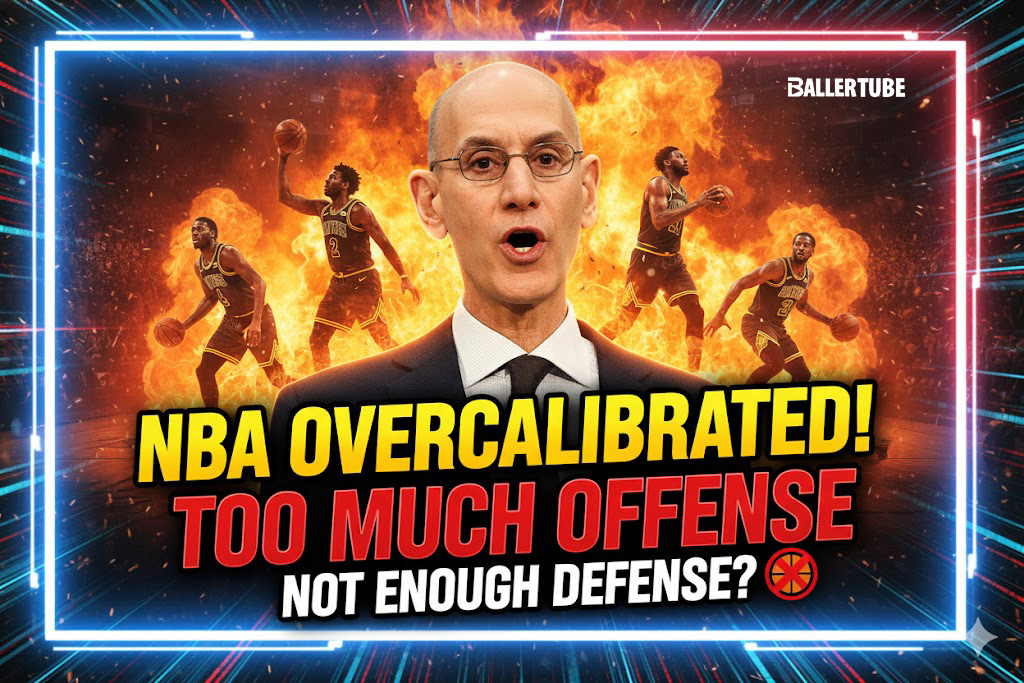
The Commissioner's Candid Admission During Pacers-Nuggets Broadcast
In a moment of striking transparency, NBA Commissioner Adam Silver acknowledged what many fans and coaches have been saying for years: the league may have pushed too far toward offense at the expense of defensive intensity. During Wednesday's broadcast of the Indiana Pacers versus Denver Nuggets game at Gainbridge Fieldhouse, Silver made a confession that could signal a major philosophical shift for the league.
"People love scoring, but the one thing I think maybe the league overcalibrated in terms of offense at times, because what fans clearly love too is defense," Silver said during his in-game interview. He continued, emphasizing what spectators truly want to see: "They want to see physical defense. They don't want to see things that are unsportsmanlike, but they want to see guys body up and stuff."
The timing of Silver's comments couldn't be more telling. The NBA is in the midst of a historic scoring explosion, and the numbers tell a story of a league that may have swung too far in one direction.
The Numbers Don't Lie: A League Drowning in Points
The 2024-25 season has seen offensive output reach unprecedented levels. Teams are averaging around 115 points per game this season, with several franchises pushing past 120 points per contest. The Denver Nuggets, who were playing when Silver made his comments, lead the league at 125.1 points per game, joined by the Miami Heat, Oklahoma City Thunder, Houston Rockets, New York Knicks, and Chicago Bulls—all averaging at least 120 points.
To put this in historical context, the league is approaching scoring levels not seen since the early 1960s. The current pace represents a dramatic escalation from just two decades ago, when teams averaged barely over 90 points per game in the 2003-04 season—the NBA's modern low point that prompted the league to begin favoring offensive play.
But here's the critical question: Has the pendulum swung too far?
Adam Silver:
— Legion Hoops (@LegionHoops) December 6, 2025
“People love scoring, the one thing I think maybe that the league over-calibrated in terms of offense at times, because what fans clearly love too, is defense... They wanna see physical defense.”
(h/t @MrBuckBuckNBA) pic.twitter.com/b373blyNYk
The Rule Changes That Built an Offensive Paradise
The NBA didn't stumble into this high-scoring era by accident. It was engineered through a systematic series of rule changes designed to unleash offensive talent and create a more "entertaining" product.
After the defensive slugfest of the early 2000s, the league cracked down on hand-checking in 2004, giving ball handlers more freedom to operate. The offensive player gradually received more and more protection, with rules evolving to penalize defenders for even the slightest contact on jump shots. Touch fouls became commonplace. Driving lanes opened up as defenders were stripped of the physicality that once defined elite defense.
The results were predictable: scoring exploded, stars put up video-game numbers, and highlight reels became longer. But something else happened too—defense became almost irrelevant in regular season games. The tactical chess match between offense and defense devolved into a track meet where the winner was simply whoever could score fastest.
Silver's admission that the league "overcalibrated" suggests an awareness that this experiment may have gone too far.
What Coaches and Players Have Been Saying All Along
Silver's comments validate what coaches have been arguing for years. Steve Kerr, Mike Brown, and others have suggested that defense is being legislated out of the game, not because players aren't trying, but because the rules make it nearly impossible to play effective defense without drawing a whistle.
The challenge for defenders has become exponential. They must navigate screens without making contact, contest shots without touching the shooter's body, and somehow prevent drives to the basket while avoiding any physicality. Meanwhile, offensive players have perfected the art of drawing fouls, knowing that the rules heavily favor them.
Even Anthony Edwards, one of the league's rising young stars, has voiced frustration with the state of defense in today's NBA. When your own players are acknowledging the imbalance, you know the problem is real.
The Ironic Timing: Defense Penalized During Silver's Comments
In a moment of almost comedic irony, Pacers coach Rick Carlisle received a technical foul for arguing that Bruce Brown had fouled Jarace Walker during a physical sequence—occurring at the exact same time Silver was discussing the need for more physical defense.
This perfectly encapsulates the league's current contradiction: officials are calling games so tightly that coaches can't even argue for physical play without being penalized, even as the commissioner publicly acknowledges that fans want to see more defensive intensity.
The Fan Perspective: Scoring Isn't Everything
Here's the truth that Silver seems to finally understand: fans don't just want scoring. They want drama, competition, and meaningful basketball. They want to see a defensive stop in crunch time matter as much as a clutch three-pointer. They want to feel tension when a game is on the line, not watch another team rattle off an 8-0 run in 90 seconds because nobody can guard anyone.
The most memorable playoff series in recent memory haven't been shootouts—they've been defensive battles where every possession carries weight. Think about the intensity of playoff basketball versus regular season games. The difference isn't just effort; it's that officials allow more physical play, and suddenly defense matters again.
Casual fans might be drawn in by highlight dunks and logo three-pointers, but hardcore basketball fans—the ones who drive league engagement year-round—crave the complete game. They want to see elite defenders lock down superstar scorers. They want to watch a team's defensive scheme dismantle an opponent's offensive flow. They want basketball to be chess, not checkers.
What Changes Should We Expect?
Silver's acknowledgment is significant because it suggests the league is genuinely reconsidering its approach. The NBA's Competition Committee has already begun reviewing the offense-defense balance, according to reports from earlier this year.
Potential adjustments could include:
Allowing more physical play on the perimeter: Giving defenders more leeway to hand-check and body up ball handlers without immediately drawing fouls. This doesn't mean returning to 1990s brutality, but rather finding a middle ground that allows genuine defensive pressure.
Redefining shooting fouls: The current interpretation heavily penalizes any contact on a shooter, even if that contact is minimal and doesn't affect the shot. Allowing defenders to contest shots more aggressively—without touching the shooter's arms or body—could restore some balance.
Eliminating defensive three-second violations: This rule forces big men to abandon the paint, creating wide-open driving lanes. Removing it would allow teams to protect the rim more effectively and force offenses to actually execute rather than simply attacking downhill.
Adjusting hand-checking rules: The 2004 crackdown on hand-checking was necessary, but the pendulum may have swung too far. Allowing defenders to place a hand on a ball handler—without impeding their progress—could slow down the pace and create more tactical possessions.
The key, as Silver himself noted, is finding the balance. The league doesn't want to return to the 80-point slugfests of 2004, but it also can't continue with the current system where defense is an afterthought and every game feels like an All-Star exhibition.
The Broader Question: What Is Good Basketball?
Silver's comments raise a fundamental question about what the NBA wants to be. Is it entertainment first, sport second? Or can it be both?
The league's growth over the past decade has been undeniable, fueled largely by international expansion, star power, and yes, offensive fireworks. But sustainable growth requires more than highlights—it requires compelling competition. Fans need to believe that games matter, that teams are genuinely competing, and that excellence on both ends of the floor is valued.
Right now, the NBA rewards offensive talent almost exclusively. MVP races are dominated by scoring averages. All-NBA teams favor offensive production. Defensive Player of the Year has become a consolation prize rather than a marquee award. This sends a clear message to players: if you want to get paid and achieve stardom, focus on scoring.
But the greatest teams in NBA history—the Bulls, Lakers, Spurs, and recent iterations of the Warriors and Bucks—were built on defense. Championship teams don't just outscore opponents; they prevent them from scoring. That fundamental truth hasn't changed, even if regular season basketball has forgotten it.
Silver's Challenge: Turning Words Into Action
The easy part was acknowledging the problem. The hard part will be actually fixing it without alienating the offensive stars who drive the league's popularity or the casual fans who might prefer high-scoring affairs.
Silver must navigate competing interests: coaches who want more defensive tools, players who've built their games around current rules, referees who've been trained to protect offensive players, and fans who have different preferences. It's a delicate balance, and any changes will be met with criticism from some quarter.
But the commissioner deserves credit for publicly acknowledging what many have known privately: the NBA overcalibrated. The question now is whether the league has the courage to recalibrate back toward the middle, restoring the balance that makes basketball great.
Conclusion: A Potential Turning Point
Adam Silver's comments during the Pacers-Nuggets broadcast may be remembered as a turning point—the moment the NBA acknowledged that bigger numbers don't always mean better basketball.
The league now faces the challenge of striking a delicate balance between offensive excitement and defensive integrity. If Silver follows through on this acknowledgment with meaningful rule changes, we could see a renaissance of defense in the NBA. Games could become more tactical, more competitive, and ultimately more compelling.
The fans have spoken, and now the commissioner has listened. The question is: will the league act?
For now, we're left with Silver's candid assessment and a hint of what might come next. One thing is certain—people love scoring, but they also love defense. And perhaps the NBA is finally ready to give them both.