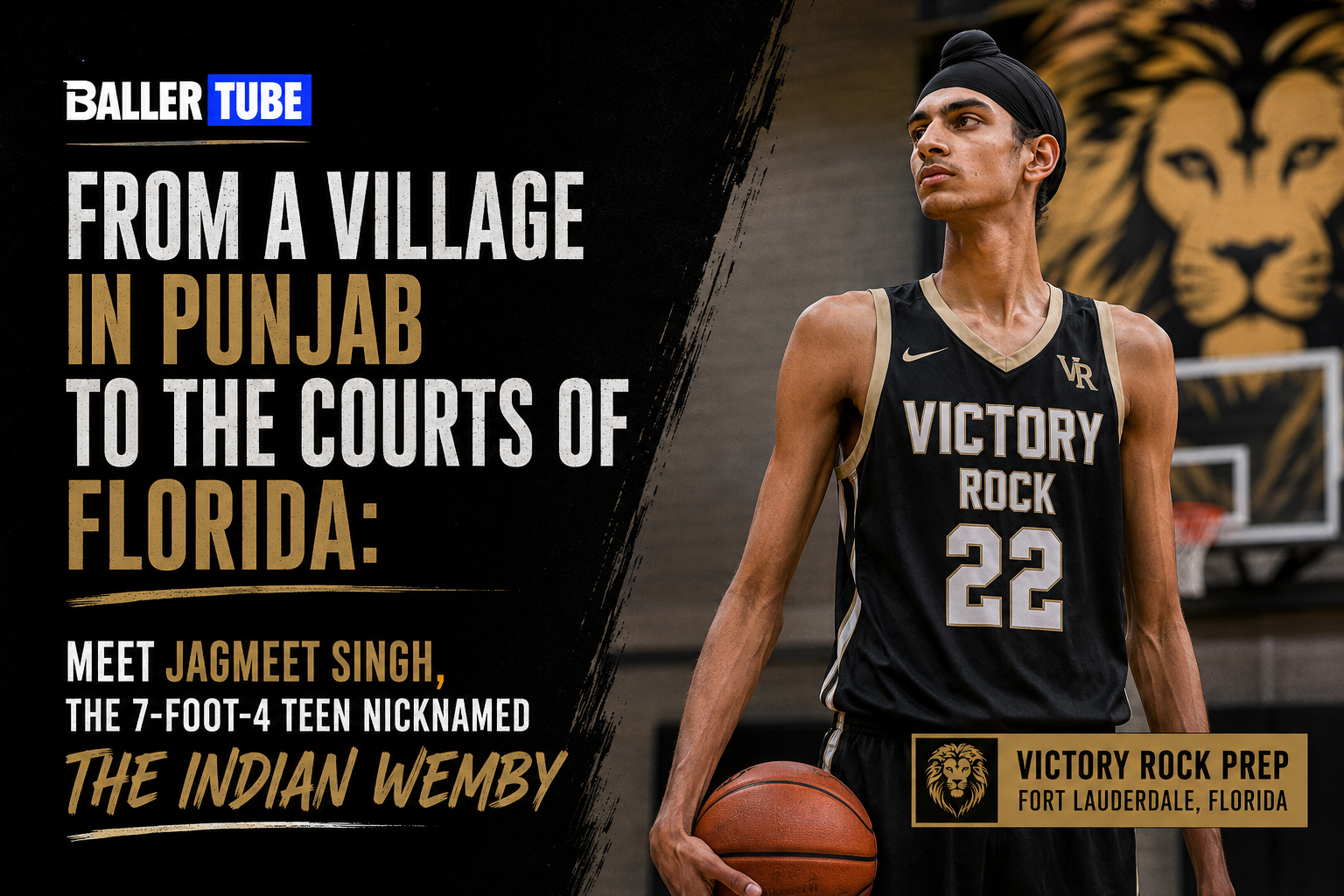
From a Village in Punjab to the Courts of Florida: Meet Jagmeet Singh, the 7-Foot-4 Teen Nicknamed the Indian Wemby
He grew up in a village in northern India. He picked up a basketball for the first time in 2022. He has since represented India on the international stage, moved to the United States, enrolled at a Florida prep school, lost his father to a heart attack, and become one of the most talked-about basketball prospects in the world. He is 18 years old. He stands 7 feet and 4 inches tall. And he is just getting started.
In the summer of 2026, a video posted by Courtside Films to social media stopped the basketball world in its tracks. The clip, brief and unpolished in the way that grassroots evaluation footage always is, showed a young man moving across a basketball court in ways that violated the basic visual logic of how someone his size is supposed to move. He handled the ball comfortably in transition. He shot from behind the three-point line. He finished at the rim with both hands. He protected the paint with an ease that came not from effort but from the specific geometrical advantage of being the tallest player on the floor by several inches. The caption read: "7'4 big man Jagmeet Singh looks DOMINANT. Class of 2027 big man from Punjab, India." The internet had its immediate response. "We got Indian Wemby before GTA 6." "Where do these dudes keep coming from." "Victor Wembanyama clone unlocked in India."
The nickname landed instantly and has stayed. Jagmeet Singh is the Indian Wemby. The name is a comparison that requires patience and perspective to evaluate honestly. It is also, for the purposes of describing what Singh's emergence represents for Indian basketball, basketball's global reach, and the sport's ongoing conversation about extraordinary physical gifts, entirely appropriate as a shorthand for why the world is paying attention.
Born in Tanda: The Village That Produced a Basketball Giant
Jagmeet Singh was born in January 2008 in Tanda village, Hoshiarpur district of Punjab. Tanda is a small town in the Doaba region of Punjab, nestled in the northwestern part of India where the state's agricultural heartland begins to give way to the foothills of the Himalayas. It is not a basketball town. It is not particularly a sports town of any specific kind. It is a place where people farm, where Sikh culture runs deep, and where the chances of a boy becoming a basketball prospect known across three continents would have seemed, until very recently, essentially zero.
Singh grew up in northern India and started playing basketball when he was 14, recruited to a local basketball academy while playing at a park. The discovery story follows a pattern that will be familiar to anyone who has followed the development of oversized talent in countries where basketball is not the dominant sport: a boy plays in a park, someone notices how tall he is, and a coach makes a decision to find out what is behind the height. He trained at the Ludhiana Basketball Academy, where his height and athletic ability helped him develop into one of India's most promising young talents. The Ludhiana Academy is one of India's most respected basketball development programs, a program with a track record of producing players who have represented the national team and competed internationally. The infrastructure it provided Singh in his first years of organized basketball gave him a foundation that has made everything that followed possible.
The timeline of his development is extraordinary even by the standards of late starters. Singh picked up a basketball for the first time in 2022. By 2024, he was competing for India's national youth team at the FIBA Under-16 Asia Championship in Doha, Qatar. By June 2026, he was the subject of a viral video that generated millions of views and the most immediate internationally recognized nickname in grassroots basketball history. Four years from playground discovery to international internet phenomenon. The acceleration has been as remarkable as the height.
What He Can Actually Do
The nickname and the height are the entry point. The basketball is what makes evaluators take the entry point seriously.
Videos from the Courtside Camp showcased Singh's ability to impact multiple areas of the floor. The Indian prospect displayed solid rim protection, the ability to handle the ball in transition, and a promising touch from both mid-range and beyond the arc. His elite physical measurements, highlighted by an impressive wingspan, place him in an exceptionally rare category. However, scouts believe the real differentiator at this stage is his lateral quickness and fluidity in the open floor.
That last point is the one that separates Singh from the long history of extraordinarily tall players who attracted attention and could not translate their physical gifts into functional basketball. Despite standing 7'4", he moves comfortably with the ball, can dribble across the court, finish strongly near the basket, and shoot from long range. His defensive skills, shot-blocking ability and mobility have also impressed coaches and scouts. The mobility and fluidity are the skills that cannot be taught. Footwork can be coached. Positioning can be drilled. Strength can be built in the weight room. But the lateral quickness and open-floor fluidity that Singh is already demonstrating at 18, after four years of playing basketball, is the kind of attribute that makes evaluators reach for the rarest available comparisons.
Victor Wembanyama, whose nickname Singh has inherited, demonstrated similar fluid movement at comparable stages of his development. The comparisons are not primarily about height, though the matching 7-foot-4 measurement is what makes the visual connection immediate. They are about the rarer and more significant quality of being a player of extraordinary size who moves like a player of ordinary size. Wembanyama was described in those terms throughout his development in France. Singh is beginning to be described in similar terms at the first stage of his American evaluation.
NBA Draft Room's assessment: "An incredibly tall and fairly mobile big man who is an intriguing long-term prospect. Changes the game on both ends with his immense height and length. Will have to add a lot of strength and put in a ton of work on his body but his rare size and impressive mobility make him one to watch." The strength caveat is real and important. Singh is a teenager who began playing basketball four years ago and whose physical development has not yet produced the body of a professional athlete. He needs significant strength and muscle mass. He needs the kind of high-level reps that his time in the United States is designed to provide. The potential is unmistakable. The work required to realize it is substantial.
The American Chapter: Chicago, Sarasota, and a Dream Shared With His Father
Singh is from Punjab and has been linked to development in the Chicago area, including grassroots exposure, camps and showcases. He has also represented India, competing in Doha, Qatar, at the FIBA Under-16 Asia Championship. The move to the United States reflected a calculated decision about where Singh's development could be accelerated most effectively. The American grassroots basketball ecosystem, with its year-round competition structure, its concentration of elite coaching talent, and its proximity to the college recruitment pipeline, offers developmental opportunities that India cannot yet match for a player at Singh's level.
The high schooler is currently preparing for his senior year at Victory Rock Prep in Sarasota, Florida. Victory Rock Prep is a basketball-specific preparatory school in the Sarasota-Bradenton area that has a history of developing international players and preparing them for NCAA opportunities. For Singh, the school represents the specific institutional bridge between his Indian development background and the American college basketball system that will determine his professional trajectory.
The personal cost of that journey has been real. Singh thinks of his father Jaswinder, who died earlier this year following a heart attack, "every time" he is playing on the court and hopes to keep their shared hoop dreams going. His father, who had shared the basketball dream with his son from the earliest days of Singh's discovery in that Punjab park, did not live to see the viral moment, the American attention, or the senior year in Florida. The weight of playing for both himself and the memory of his father gives every practice session and every game an additional layer of meaning that the highlight clips and the nickname cannot fully capture.
India's Basketball History and What Singh Could Change
The context of India and basketball is a story of potential consistently ahead of infrastructure. India has had basketball breakthroughs before. Satnam Singh became the first Indian-born player drafted into the NBA in 2015, while Sim Bhullar became the first player of Indian descent to appear in an NBA regular-season game. Both were tall. Both generated significant hope. Neither managed to sustain an NBA career. The combination of late development starts, limited domestic infrastructure, and the physical demands of the professional game has historically limited Indian basketball's ability to produce players who could compete at the game's highest levels.
Singh's situation is different in some structural ways. He is developing in the United States, at an American prep school, against American competition, within a system designed to prepare players for the NCAA and the professional pipeline beyond it. If his development continues at anything approaching its current trajectory, he will arrive at an NCAA program as the most physically imposing player on the floor in every game he plays, and with four or five years of American basketball experience rather than the developmental gaps that have historically limited Indian players attempting to bridge the gap to professional competition.
The 18-year-old has drawn comparisons to Wembanyama, who also stands 7 feet, 4 inches tall and was drafted from France into the NBA as the No. 1 pick in 2023, most recently playing with the Spurs in the 2026 NBA Finals. The comparison carries weight in a specific and important way: Wembanyama was, before his NBA career, proof that the sport's most extraordinary physical gifts can emerge from unexpected places. He was French. Singh is Indian. Both arrived in the American basketball conversation as young men whose physical profiles defied easy categorization and whose skill sets arrived before their bodies had fully developed. The Wembanyama precedent does not guarantee Singh's path. It does demonstrate that the path can exist.
"The ultimate dream is the NBA," Singh said when asked about his ambitions. Despite his advantage with dunking, Singh said transitioning to play basketball in the U.S. was tough, and he is taking it all one step at a time. The honesty in that assessment, combined with the ambition in the one before it, captures exactly where Singh is in his development: a player who knows what the destination is and acknowledges clearly that the road is real. He is 18 years old. He has been playing basketball for four years. He stands 7 feet and 4 inches tall and moves like he should not be able to. He is preparing for his senior year at a Florida prep school. He plays every game for a father he no longer has. And the entire basketball world, including the people who build rosters at the sport's highest level, is watching to find out what he becomes.
Jagmeet Singh: born January 2008, Tanda village, Hoshiarpur district, Punjab, India. Height: 7 feet 4 inches. Class: 2027. Current school: Victory Rock Prep, Sarasota, Florida. Previous development: Ludhiana Basketball Academy, Punjab; Chicago area camps and showcases; AR Elite program. International experience: India national youth team, FIBA Under-16 Asia Championship, Doha, Qatar. Viral moment: Courtside Camp video posted June 21, 2026 by Courtside Films. NBA Draft Room grade: intriguing long-term prospect. Father Jaswinder: died 2026, heart attack. Notable Indian NBA history: Satnam Singh (first Indian-born NBA draftee, 2015), Sim Bhullar (first player of Indian descent in NBA regular season game).