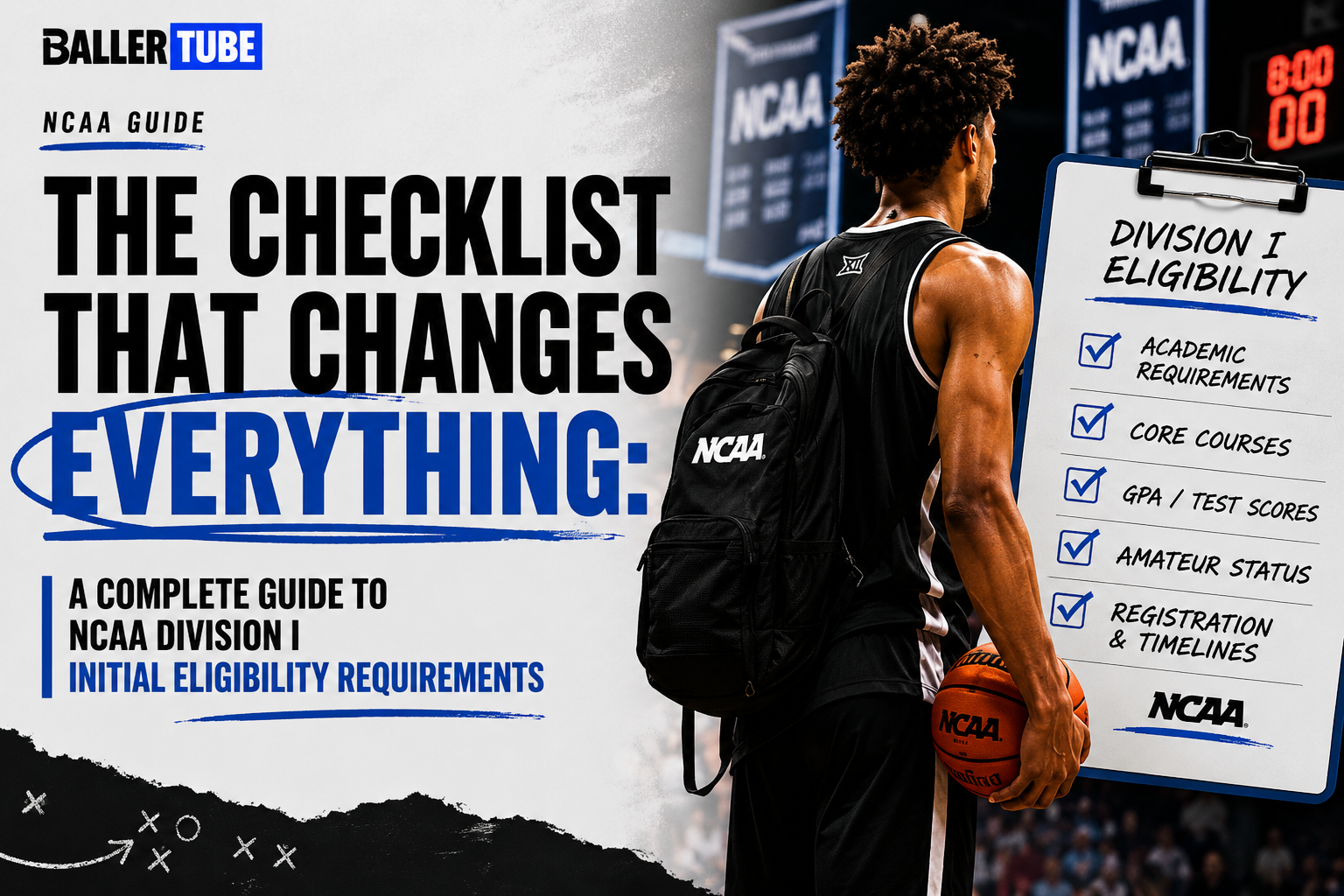
The Checklist That Changes Everything: A Complete Guide to NCAA Division I Initial Eligibility Requirements
You can be the most talented athlete in your state. You can have offers from every major program in the country. You can be the No. 1 recruit in your class. And if you have not met the NCAA's initial eligibility requirements, none of that matters. This is everything you need to know, and when you need to know it.
Every year, some percentage of high school athletes who were supposed to play at Division I programs do not. The talent was real. The scholarship was offered. The recruiting process produced the result the player and the family had been working toward. And then the NCAA Eligibility Center reviewed the academic record and determined that the student did not qualify to practice, compete, or receive athletics aid during their first year of full-time college enrollment. The reason is almost always the same: a misunderstanding of the rules that govern initial eligibility, discovered too late to fix.
The rules are not hidden. The NCAA publishes them clearly. The Eligibility Center's requirements for Division I participation are specific, documented, and available to every student, counselor, and coach in the country. The problem is not that the rules are unclear. The problem is that nobody explains them to incoming high school students when they are freshmen, when the planning decisions that will determine eligibility four years later are actually being made.
This is that explanation.
What the Eligibility Center Does and Why It Matters
Division I schools require students to meet both academic and athletics eligibility standards before they can participate. The NCAA Eligibility Center is the organization responsible for reviewing each student's academic records and athletics-related activities to make the determination of whether they qualify. That determination covers three specific things: the ability to practice, the ability to compete, and the ability to receive athletics aid during the student's first year of full-time college enrollment.
The process begins with creating an account. Division I-bound students need to create an Academic and Athletics Certification account through the NCAA Eligibility Center and work with their high school counselor to ensure they are taking NCAA-approved core courses. Both of those actions should happen as early as possible, ideally at the start of the freshman year in high school. The core course list is institution-specific, which means the courses that qualify at one high school may not qualify at another. Reviewing that list before scheduling classes is not optional. It is the foundational step that everything else depends on.
The 16 Core Course Requirement
Division I eligibility requires completion of 16 NCAA-approved core course credits in required subject areas. These are not just any classes a student takes in high school. They are specifically approved courses on the NCAA's list for that particular institution. A student who takes 16 classes and assumes they all count may find, at the point of Eligibility Center review, that several of them were not approved core courses and that they are short of the requirement.
The distribution of those 16 courses is specific and not negotiable. Four units must be in English or a native language. Three units must be in mathematics at the level of Algebra I or higher. Two units must be in natural or physical science. One additional unit must be in English or a native language, mathematics, or natural or physical science. Two units must be in social science. The remaining four units can be additional core courses, which may include world language, comparative religion, or philosophy courses.
The mathematics requirement deserves particular attention from student athletes who entered high school behind in math. The minimum threshold is Algebra I. Students who are placed in pre-Algebra courses in their freshman year need to understand that those courses do not count toward the core course requirement. They need to reach Algebra I, complete it, and continue building from there across their four years in order to satisfy the three required units of mathematics. A student who realizes in their senior year that they have only two qualifying mathematics units and no room in their schedule to add a third is not in a position that the Eligibility Center can fix retroactively.
The 10/7 Requirement: Timing Matters as Much as Total Numbers
One of the most misunderstood elements of Division I eligibility is the 10/7 progression requirement. It is not enough to have 16 core courses completed by graduation. The NCAA also requires that 10 of those courses, including at least 7 in English, mathematics, or natural or physical science, be completed before the start of the seventh semester of high school, which means before the beginning of senior year.
This requirement exists to prevent students from backloading their academic preparation into their senior year and arriving at college without the foundational coursework their classes require. It also means that students who fall behind in their core course progression in their freshman, sophomore, or junior years cannot fully recover in their senior year regardless of how many courses they take. The courses taken in the senior year can count toward the total of 16, but they cannot retroactively satisfy the 10/7 requirement if it was not met before senior year began.
The practical consequence is that students need to be accumulating core course credits from their freshman year forward, on a deliberate schedule, with awareness of both the total they need and the timing of when specific courses must be completed. A student who takes a light course load freshman year, a better load sophomore year, and then attempts to front-load senior year is likely to find themselves on the wrong side of the 10/7 calculation.
The Grade Point Average Requirement
Division I eligibility requires a minimum 2.3 core course grade point average. This GPA is not calculated using all of the classes a student takes in high school. It is calculated using only the NCAA-approved core courses on the school's list. This distinction matters in two directions. A student with a 3.5 GPA overall who has a 2.0 in their core courses is not eligible. A student with a 2.5 overall GPA who has a 2.4 in their core courses is potentially eligible on the GPA standard.
The implication of this calculation method is that students need to monitor their core course GPA specifically, not their overall academic standing. The courses that are not on the NCAA-approved core course list at their institution do not help the eligibility GPA even if the student performs well in them. The counselor, who has access to both the school's approved course list and the student's transcript, is the most important resource for tracking this number accurately throughout the student's high school career.
What Happens After High School
Students who graduate on time have one additional option available to them. A student who graduates within the required timeframe may be able to use one additional NCAA-approved core course taken within one year after high school graduation and before full-time college enrollment to satisfy the 16-course requirement. Students who do not graduate within the required timeframe may not be able to use courses taken after their expected graduation date for Division I certification at all.
This means that a student who is one core course short of the requirement at graduation and who graduates on time has a pathway to satisfy the requirement before they enroll full-time in college. A student who graduates late, for any reason, may not have that option. On-time graduation is not just a secondary consideration. It is part of the eligibility calculation.
Once You Are Enrolled: Initial Eligibility Is Only the Beginning
Initial eligibility allows a student to begin their college athletics career. It does not guarantee that they remain eligible throughout it. Once enrolled in Division I, student athletes must continue to meet ongoing academic requirements that cover progress toward their degree, credit hour completion, and grade point average standards. These continuing eligibility requirements are separate from the initial eligibility process and are governed by Division I academic standards that apply throughout the student's collegiate career.
The Practical Steps Every Student Athlete Needs to Take Right Now
Register with the NCAA Eligibility Center. Create an Academic and Athletics Certification account as early as possible in high school, ideally in the freshman year. Work with your high school counselor to review the school's NCAA-approved core course list and confirm that your planned schedule includes the right courses in the right sequence. Monitor your core course GPA specifically, not just your overall GPA. Track the 10/7 requirement actively, counting both the total number of core courses you have completed and confirming that the required 7 in English, mathematics, or science are on pace to be finished before senior year begins. Submit your final transcript and proof of graduation through your counselor when the time comes.
The students who navigate this process successfully are not the ones who were better students than the ones who did not. They are the ones who learned the rules early, planned their course schedules accordingly, and checked their progress regularly enough to correct course before it was too late. The Eligibility Center does not make exceptions based on athletic talent. It reviews records. Making sure those records reflect compliance with the requirements is entirely within the student's control, starting on the first day of freshman year.
NCAA Division I initial eligibility requirements summary: 16 core courses required (4 English, 3 math at Algebra I or above, 2 natural or physical science, 1 additional English or math or science, 2 social science, 4 additional core courses including world language, comparative religion, or philosophy). Minimum core course GPA: 2.3. Timing requirement: 10 of 16 core courses, including 7 in English, math, or science, must be completed before start of seventh semester (senior year). Post-graduation option: one additional approved core course may be used within one year after on-time graduation. Registration: NCAA Eligibility Center account required. Contact: domestic students call 877-262-1492, Monday through Friday, 9 a.m. to 5 p.m. ET.