The Court Said Yes: How Every Division I Athlete From the High School Class of 2022 Just Got a Fifth Year of Eligibility
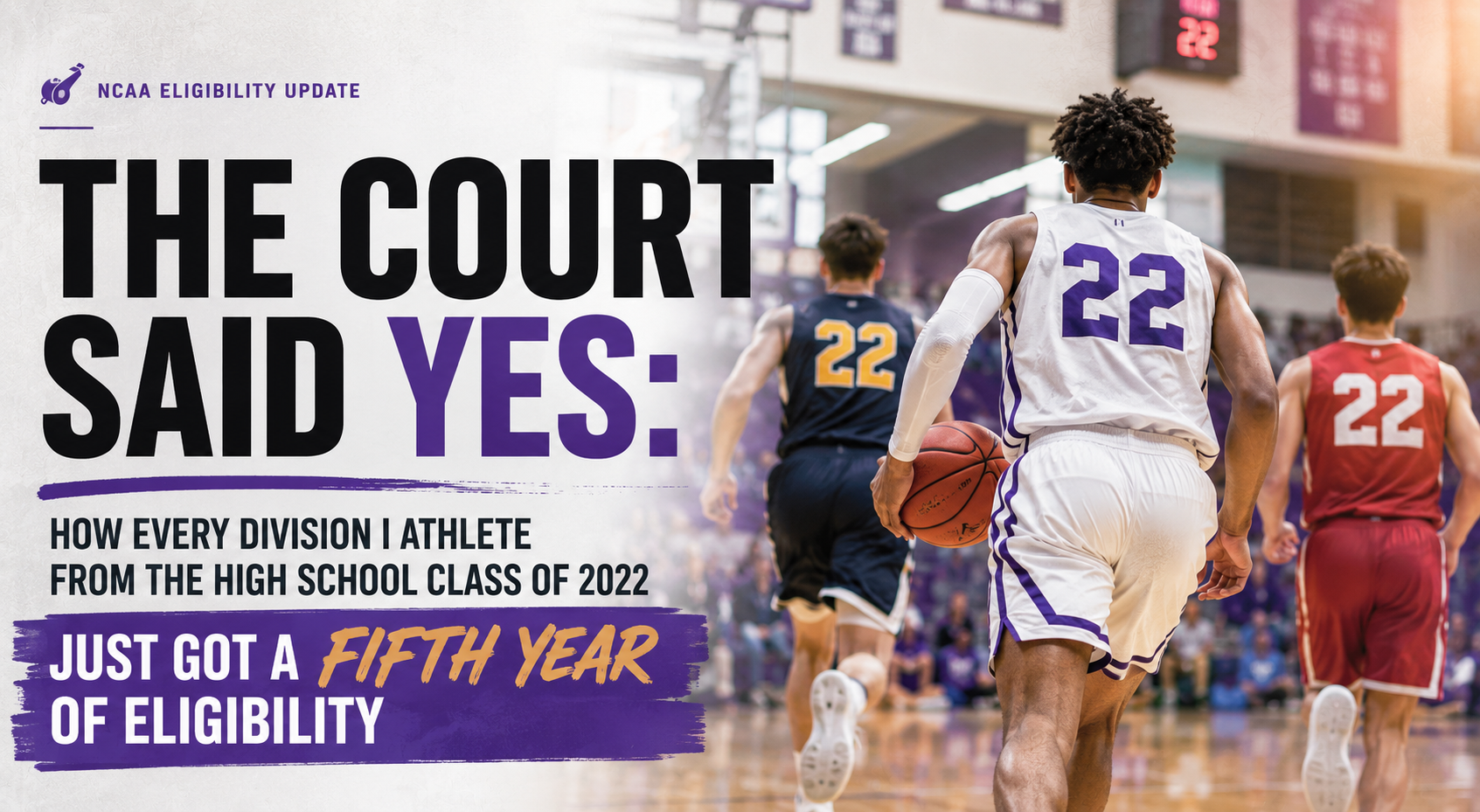
The COVID class got a free year. The incoming 2026-27 class gets five years under the new rule. The class that slipped through the crack in between sued the NCAA for antitrust violations. On Friday, a federal judge in Denver agreed with them. The most consequential eligibility ruling in college sports since COVID now applies to tens of thousands of athletes who thought their careers were finished.
On the morning of August 1, 2026, U.S. District Judge Charlotte N. Sweeney of the federal court in Denver issued a 50-page ruling that immediately and fundamentally changed the eligibility landscape of American college athletics. A preliminary injunction in the case of Wisne et al v. NCAA certified a class of plaintiffs and granted a fifth year of eligibility to every Division I athlete who began their collegiate career in the 2022-23 academic year and exhausted their four years of eligibility by the conclusion of the 2025-26 season. The ruling placed these athletes on par with the COVID class of 2020, which received a free year due to the pandemic, and with the incoming 2026-27 class, which will benefit from the NCAA's newly adopted five-year eligibility model. The class of 2022 had been explicitly excluded from both accommodations. Friday's ruling said that exclusion violated federal antitrust law.
The decision landed like a thunderclap. It was issued without the season having yet begun, without rosters having finalized, and without athletic departments having had any opportunity to plan for what its implementation means across every sport at every Division I institution in the country. The NCAA's chief legal officer Scott Bearby called the ruling "egregiously wrong" and said the organization would appeal immediately. That appeal was filed Sunday. The governing body also requested a pause on the ruling pending appeal, and the court gave both parties one week to brief that issue. As of Monday, the preliminary injunction stands and a transfer portal window opened August 3 specifically for athletes newly eligible under the ruling.
Who Is Actually Affected and What Did They Lose
To understand the ruling, you have to understand the specific injustice it addresses. The NCAA's new five-year eligibility model, announced in June 2026 and effective immediately for the 2026-27 academic year, gives Division I student-athletes five years of competition across a five-year window beginning on their 19th birthday or the date they enrolled in college, whichever came first. The rule acknowledges what critics of the previous four-year limit had argued for years: that a college career should not be truncated by a redshirt season, an injury year, or the kind of unforeseen circumstance that forces athletes to miss significant time.
The problem was a carve-out built directly into the new rule. Athletes from the high school class of 2022 who had completed four years of eligibility by the end of the 2025-26 season were explicitly excluded from the five-year model. They had already used their four years. The new rule did not apply retroactively to them. So the class immediately behind the COVID year, and the class immediately in front of the 2026-27 incoming group, was the only cohort in modern college sports history to receive neither the pandemic-era accommodation nor the benefit of the new rule. They graduated into a gap that the NCAA had apparently identified, acknowledged internally, and decided to leave open.
The plaintiff who initiated the class action was Brock Wisne, a University of Northern Colorado basketball player who argued in federal court that this specific exclusion violated federal antitrust law. His argument was that the NCAA's decision to implement the five-year rule immediately while denying its benefits to his exact cohort constituted an anticompetitive restriction on the affected athletes' ability to earn NIL revenue and access educational benefits available to athletes in adjacent classes. He asked for a class-wide remedy rather than an individual injunction, taking a different legal route from the wave of state-court individual lawsuits that had preceded his filing.
Judge Sweeney agreed. In a 50-page ruling, she found that the class members' injuries were sufficiently similar to be remedied by a single injunction covering all Division I athletes who began playing in the 2022-23 season, competed under NCAA rules, and exhausted four years of eligibility by June 2026. The class definition was specific, clean, and encompassing. Tens of thousands of athletes across every Division I sport fell within it.
What It Means in Practice
The immediate practical implications are enormous and genuinely complicated. In most cases, athletes who want to use their fifth year must return to the school where they played during the 2025-26 season, because the transfer portal was closed to athletes who were not already in it at the time of the ruling. The August 3 special portal window provided some flexibility for athletes who want to use the fifth year at a different institution, but that window was narrow and its rules were specific. For most affected athletes, the fifth year is most accessible at their current program.
In college basketball, the implications could reshape rosters at every major program overnight. Seniors who had signed with agents, entered the NBA Draft process, or begun their post-playing careers received the news that their college eligibility was suddenly restored. The decision whether to use it involves a complex calculation that differs for every player: the NIL money available for a fifth year versus the opportunity cost of delaying their professional careers; the desire for more college competition versus the physical demands of a fifth season; the scholarship situation at their previous program versus the transfer portal opportunity in the special window.
In college football, the ruling arrived weeks before fall camp was scheduled to begin, creating roster chaos at programs that had already distributed scholarship offers and assumed their roster was set. The NCAA's argument that the ruling "invites further chaos in college sports" reflected a genuine logistical crisis that athletic departments are now scrambling to manage. How do you fit a potential wave of returning fifth-year players onto a roster you believed was finalized? How do you honor scholarship commitments to incoming freshmen while simultaneously accommodating seniors who suddenly have another year of eligibility? The answers to those questions do not exist yet, and programs are navigating them in real time.
The NCAA's Response and What Comes Next
NCAA president Charlie Baker issued a statement immediately after the ruling that pointed in the direction the organization has been pointing for years. "Without targeted intervention from Congress, college sports cannot set nationwide rules everyone can play by and without Congress, failed professionals will continue to use college sports as a fallback option, robbing the next class of young athletes of college scholarships," Baker wrote, calling on Congress to pass the Protect College Sports Act, the legislative vehicle the NCAA has been pushing to give it antitrust exemptions and clearer authority over eligibility rules.
The appeal to the Tenth Circuit Court of Appeals was filed Sunday. The NCAA's argument is that the ruling was granted "with virtually no evidence" and that it "irreparably harms thousands of student-athletes already on campus" by creating roster instability. The appeal's success or failure will determine whether the preliminary injunction becomes permanent or is reversed before it can reshape the 2026-27 season in full. A ruling from the appeals court is not expected before the fall season begins, meaning the preliminary injunction is effectively the operative reality for the next several months of college athletics regardless of where the legal process ultimately lands.
For the affected athletes, the window is open and the decision is immediate. The players who were told their college careers were over in May now have a legal path to one more year. What they do with it is a personal choice that the court has restored to them. The NCAA would like to take it back. A federal judge said no. The next word belongs to the appellate court.
Ruling: Wisne et al v. NCAA, U.S. District Court for the District of Colorado, Judge Charlotte N. Sweeney. Date issued: July 31, 2026. Remedy: preliminary injunction granting fifth year to all Division I athletes who began collegiate careers in 2022-23, competed under NCAA rules, and exhausted four years of eligibility by end of 2025-26 season. New transfer portal window for affected athletes: opened August 3, 2026. NCAA appeal: filed Sunday, August 2, to U.S. Court of Appeals for the Tenth Circuit. Lead plaintiff: Brock Wisne, University of Northern Colorado basketball. NCAA president's response: called on Congress to pass the Protect College Sports Act. Previous COVID accommodation: granted a free year to the class of 2020. New 5-for-5 rule: effective 2026-27, applies to incoming athletes, excluded class of 2022.