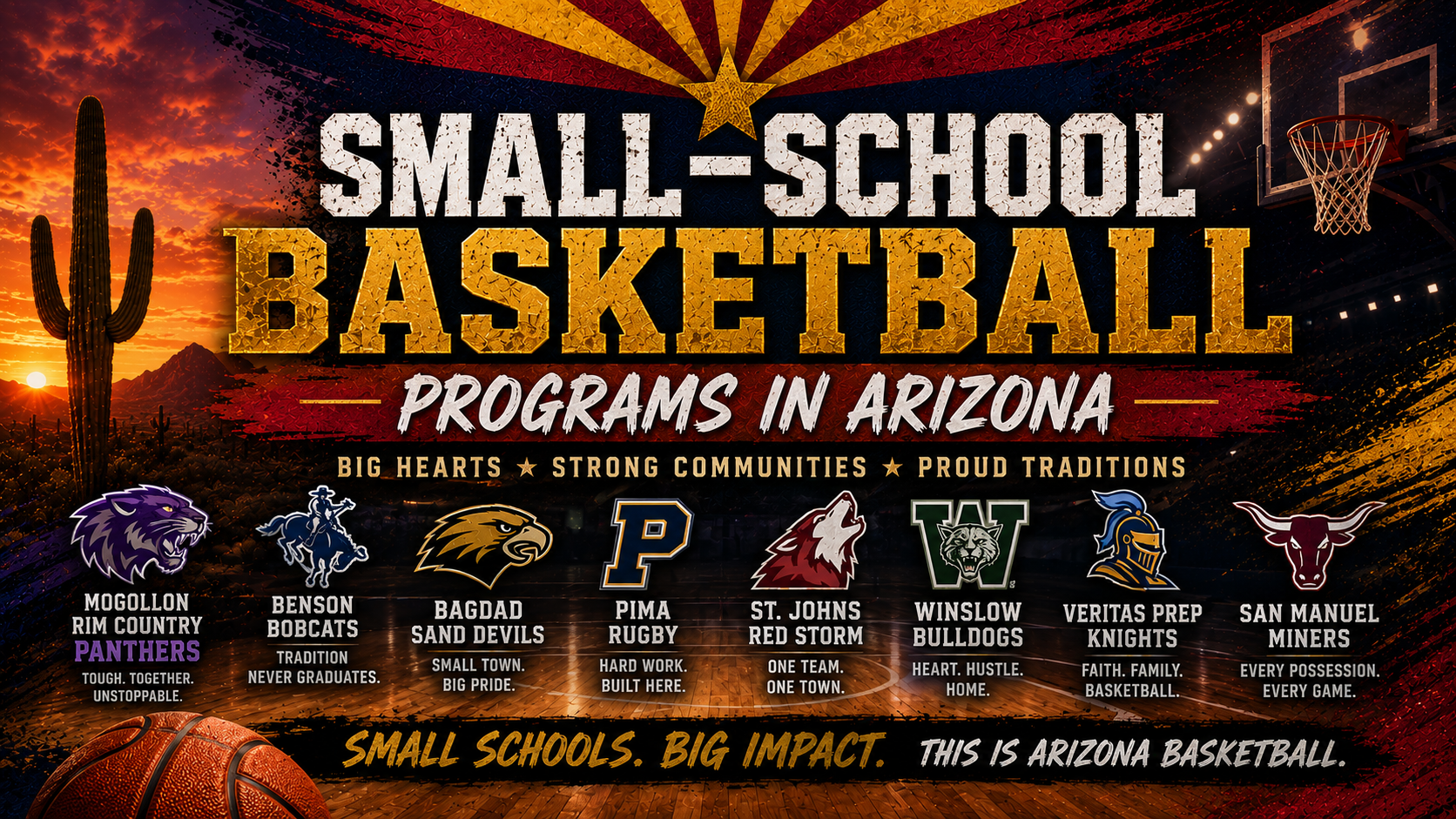
Arizona is often recognized for its nationally ranked basketball powerhouses, elite prep schools, and major metropolitan programs. While those teams receive much of the spotlight, the heart of high school basketball can often be found in the state’s small-school communities. From desert towns to mountain communities, small-school programs continue to produce exciting basketball, passionate fan bases, and memorable championship runs.
These schools may not have massive enrollments or state-of-the-art facilities, but they consistently prove that success is built through commitment, discipline, teamwork, and community pride. Every season, small-school athletes remind basketball fans that championships are not determined by school size but by preparation and heart.
More Than Just Basketball
For many small schools, basketball is more than a winter sport.
Game nights become community events where families, alumni, and local businesses come together to support their hometown team. The gym often becomes the gathering place for an entire town. Students fill the stands, parents volunteer, and former players return to cheer on the next generation.
The atmosphere creates lifelong memories for players and fans alike.
Unlike larger schools where attention may be divided among numerous activities, basketball often serves as one of the biggest events of the school year. Every home game carries added excitement because everyone knows everyone.
Building a Winning Culture
Successful small-school programs rarely experience overnight success.
Winning cultures are established through years of consistent coaching, accountability, and player development. Younger athletes grow up watching older players compete, learning the expectations long before they reach varsity.
When freshmen finally wear the varsity uniform, they already understand the program’s standards.
Strong cultures also encourage players to embrace their roles. Some become leading scorers, while others contribute through defense, rebounding, hustle, or leadership. Every role matters when roster sizes are limited.
Coaches Who Wear Many Hats
Coaching at a small school often extends well beyond practices and games.
Many coaches teach full-time, supervise school activities, drive team buses, organize youth camps, and mentor students outside of basketball. Their influence reaches classrooms, hallways, and the community.
Because of these relationships, coaches often know players long before high school begins. They understand each athlete’s strengths, weaknesses, and personality, allowing them to build teams that play together instead of relying on individual talent.
Long-term coaching stability also creates consistency. Players know what is expected every season, making transitions smoother from one graduating class to the next.
Developing Talent Instead of Recruiting It
Large schools may have deeper talent pools, but small schools often rely on developing every athlete available.
Players improve because they spend countless hours in the gym working on shooting, ball handling, footwork, and conditioning. Coaches cannot afford to overlook anyone because every player becomes valuable throughout the season.
Many athletes who receive little attention as freshmen become standout seniors after years of steady improvement.
This emphasis on development builds confidence and teaches athletes that effort can close the gap against more naturally talented opponents.
https://www.ballertube.com/news/277/which-high-school-basketball-rankings-actually-matter-the-truth-about-espn-rivals-and-the-copy-paste-ranking-industry/
Multi-Sport Athletes Make a Difference
One of the defining characteristics of small-school basketball is the number of multi-sport athletes.
It is common for basketball players to also compete in football, baseball, softball, volleyball, track, wrestling, or golf. Rather than specializing year-round, many athletes benefit from competing in multiple sports.
Football develops toughness.
Track improves speed and conditioning.
Baseball strengthens hand-eye coordination.
Wrestling builds balance and mental toughness.
These experiences often create more complete basketball players who understand competition in different environments.
Every Player Matters
Depth is a luxury many small schools do not have.
An injury or illness can dramatically change a team’s season because every rotation player carries significant responsibility.
As a result, teammates often become incredibly close. Practices emphasize communication, trust, and accountability because every possession can influence the outcome of a game.
Bench players also understand their importance. Whether providing energy during practice or stepping into larger roles when needed, everyone contributes to team success.
Passionate Home-Court Atmospheres
Small-school gyms create some of Arizona’s most exciting basketball environments.
Packed bleachers, loud student sections, pep bands, and enthusiastic communities generate tremendous energy. Visiting teams quickly realize that every possession will be played in front of fans who genuinely care about their hometown program.
Many gyms feature decades of championship banners, retired jerseys, and photos celebrating former teams.
These reminders of tradition motivate current players to continue building the program’s legacy.
Long Road Trips Build Toughness
Travel is part of life for many Arizona small schools.
Some teams spend hours riding buses through deserts, mountains, and rural highways just to reach conference opponents. While these trips can be physically demanding, they also strengthen team chemistry.
Players spend time talking, laughing, studying, and preparing together before games.
By season’s end, teammates often describe those long bus rides as some of their favorite memories.
Learning to compete despite travel fatigue also builds mental resilience that becomes valuable during postseason play.
Rivalries That Bring Out the Best
Few sporting events create excitement like a local rivalry.
Small-school rivalries often involve neighboring communities that have competed against each other for decades. Families, former players, and longtime residents eagerly anticipate these matchups every season.
The gyms are louder.
The defense becomes more intense.
Every possession feels meaningful.
Records sometimes become irrelevant because rivalry games frequently produce unexpected results.
Players understand that these contests create memories lasting long after graduation.
Youth Programs Lay the Foundation
Many successful varsity teams begin years before players enter high school.
Youth leagues, elementary school clinics, and middle school teams introduce children to the fundamentals of basketball while helping them build friendships with future teammates.
Older varsity players frequently volunteer at youth camps, creating role models for younger athletes.
Children dream about one day wearing the same uniform, competing on the same court, and representing their hometown school.
That continuity strengthens programs for years to come.
https://www.cbssports.com/college-basketball/news/dusty-mays-michigan-basketball-warde-manuel/
Overcoming Limited Resources
Small-school basketball programs often succeed despite facing challenges that larger schools rarely encounter. Budgets may be smaller, facilities may be older, and access to specialized trainers or advanced equipment may be limited. Instead of viewing those obstacles as excuses, many programs turn them into motivation.
Players learn to appreciate every opportunity they have. Whether it’s squeezing in extra shooting sessions before school, lifting weights in a modest facility, or practicing on a court that has hosted generations of athletes, they develop a mindset centered on hard work rather than comfort.
Creativity also becomes a strength. Coaches find ways to maximize every practice, making sure each drill has a purpose. With fewer players on the roster, practices are often fast-paced, competitive, and focused on improving every individual’s skills.
Leadership Starts with Seniors
Senior leadership plays an enormous role in small-school basketball.
Veteran players are expected to set the tone every day, not just during games. Their effort during conditioning, their attitude in practice, and the way they encourage younger teammates often determine the direction of the season.
Because teammates usually know one another for years before reaching high school, leadership becomes personal. Seniors understand the responsibility of passing down traditions and maintaining the standards established by previous teams.
The best leaders recognize that their legacy is measured not only by wins and losses but also by the example they leave behind.
Defense Creates Opportunities
Many successful small-school programs build their identity on defense.
Teams that may not have overwhelming size or elite athleticism often make up for it with relentless effort, communication, and discipline. Diving for loose balls, taking charges, contesting every shot, and boxing out become defining characteristics.
A strong defensive mindset also allows underdogs to compete against more talented opponents. By forcing turnovers, controlling the pace, and limiting easy scoring opportunities, disciplined teams can stay within reach until the closing minutes.
Championship teams are rarely built on offense alone. Defense remains the foundation for many of Arizona’s most respected small-school programs.
The Importance of Team Chemistry
Talent helps teams win games, but chemistry often determines how far they advance in the postseason.
Small-school athletes frequently grow up together, attend the same classes, and participate in other sports as teammates. Those shared experiences create trust that becomes invaluable during close games.
Players understand one another’s tendencies without needing constant instruction. They know who will make the extra pass, who wants the ball in pressure situations, and who will step up defensively when the game is on the line.
That chemistry cannot be measured on a stat sheet, but it often separates good teams from great ones.
Academic Success Matters
Basketball may be a major part of the high school experience, but successful programs also emphasize academics.
Coaches consistently remind athletes that their responsibilities extend beyond the court. Maintaining strong grades, attending class, and demonstrating respect for teachers are expectations that reinforce accountability.
Student-athletes who develop good study habits often become better teammates because they learn discipline, organization, and time management.
For seniors hoping to continue their education after graduation, academic success can open doors to scholarships and additional opportunities.
Chasing the State Tournament
Every season begins with the same goal: earning a chance to compete for a state championship.
For small-school programs, reaching the postseason represents the reward for months of hard work. Every practice, early-morning workout, and difficult road trip contributes to preparing for that moment.
The state tournament creates unforgettable experiences. Communities travel across Arizona to support their teams, filling arenas with school colors and hometown pride.
For players, simply hearing their school’s name announced before tipoff becomes a memory they carry for life.
Unsung Players Make Championship Runs Possible
While leading scorers often receive recognition, every successful team depends on players willing to embrace less glamorous roles.
Some athletes provide lockdown defense against the opposing team’s best player. Others focus on rebounding, setting screens, making hustle plays, or bringing energy from the bench.
Those contributions rarely dominate highlight reels, but coaches understand their value.
Championship basketball requires sacrifice, and small-school programs often excel because players genuinely care more about team success than individual statistics.
Community Pride Never Fades
The connection between a small-town basketball team and its community is unique.
Businesses decorate storefronts with school colors during tournament runs. Alumni return to games decades after graduation. Local newspapers and radio stations celebrate team accomplishments, while neighbors proudly discuss Friday night’s victory.
For many residents, the basketball program represents the spirit of the entire community.
Players recognize that every time they wear their school’s uniform, they represent generations of former athletes who helped build the program’s tradition.
That responsibility creates pride and inspires players to compete with passion every night.
Preparing Players for Life
One of the greatest strengths of small-school basketball extends beyond wins and championships.
Players learn responsibility by balancing athletics with academics. They develop resilience after difficult losses and humility after meaningful victories. They discover the importance of communication, trust, and perseverance.
Many former athletes credit high school basketball with teaching lessons they continue to use as parents, employees, coaches, business owners, and community leaders.
The scoreboard eventually fades from memory, but the character developed through years of competition lasts a lifetime.
Looking Toward the Future
Arizona’s small-school basketball programs continue to evolve while staying true to the values that have defined them for generations.
Technology has improved player development through film study and skill training. Strength and conditioning programs continue to advance, and athletes have greater access to year-round basketball opportunities than ever before.
Even with these changes, the core identity of small-school basketball remains the same. Success is still built through hard work, teamwork, accountability, and unwavering community support.
Every season introduces a new group of players eager to leave their mark. Some teams will surprise the state with unexpected playoff runs, while others will continue long-standing traditions of excellence. Regardless of the final standings, every small-school program contributes something valuable to Arizona basketball.
They remind everyone that championships are earned through dedication, that communities grow stronger when they rally behind their schools, and that the love of the game can thrive anywhere—from bustling cities to the smallest towns scattered across the Arizona landscape.
Small-school basketball may not always receive the biggest headlines, but its impact is impossible to overlook. The passion inside those packed gyms, the commitment shown by coaches and players, and the pride shared by entire communities ensure these programs will remain an essential part of Arizona’s basketball tradition for generations to come.