Two Million Dollars, Two Brackets, and One Wild Summer: Your Complete Guide to the 2026 Basketball Tournament
The defending champions opened their title defense by winning by 21 at home. Louisville's Montrezl Harrell dropped 35 points to send the series to a decisive Game 3. Baron Davis is coaching a Las Vegas non-alumni team competing for the same prize. And somewhere in the middle of all of it, Boeheim's Army is quietly loading up to make another run. The TBT is back — and the 2026 edition is unlike any tournament the event has ever produced.
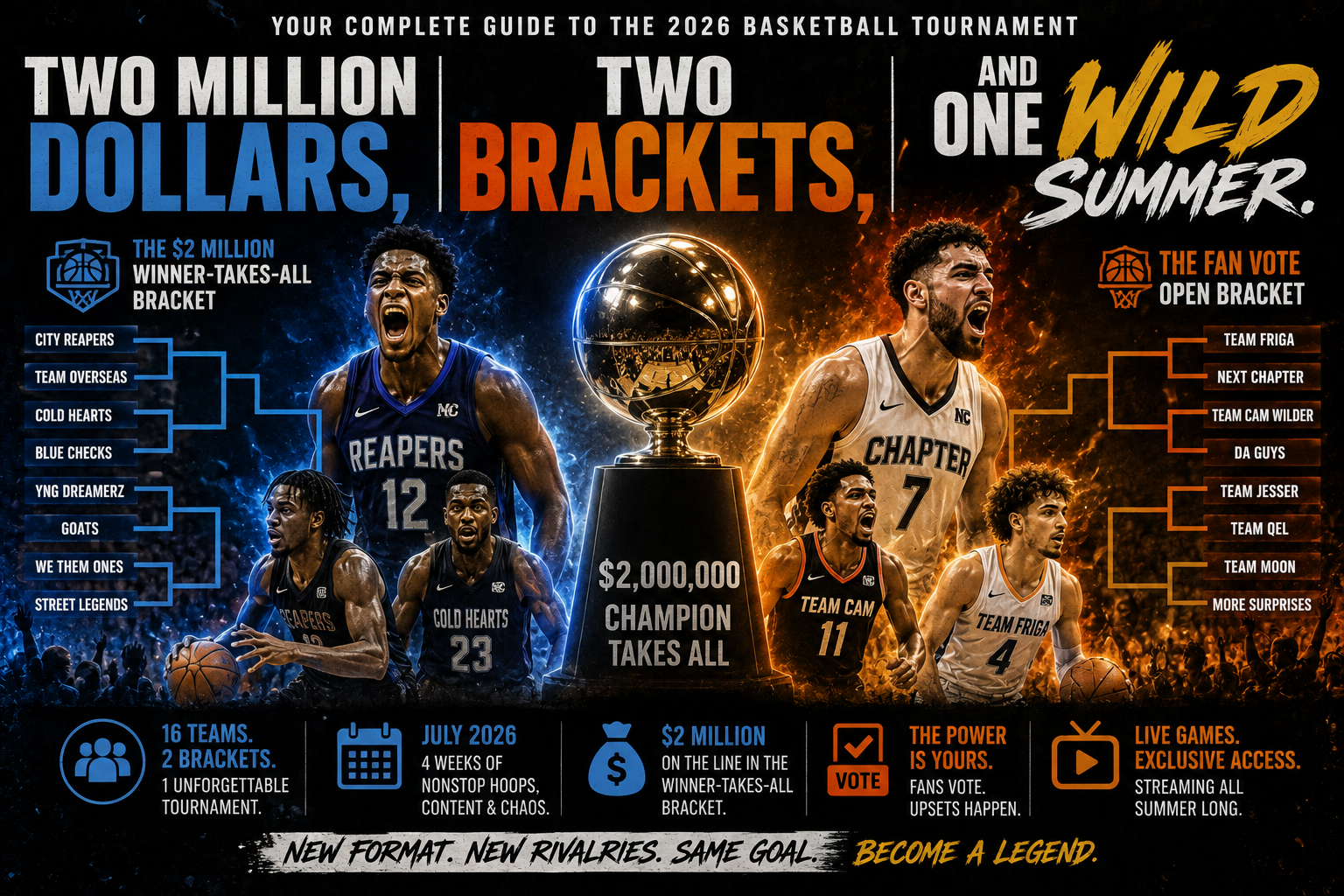
The Basketball Tournament returns for its 13th edition beginning July 18, 2026, and this year's version looks fundamentally different from every previous iteration of the event. The field has been slashed from 61 teams in 2025 to 16 in 2026. The prize money has doubled from one million dollars to two million dollars winner-take-all, the largest purse since 2019 and the highest the tournament has ever offered against this size of a competitive field. The format has been restructured completely, splitting the bracket between eight college alumni teams and eight non-alumni squads competing in Las Vegas, with the winners of each bracket meeting in a championship game on August 2 that will air live on FOX. TBT founder Jonathan Mugar and his organization signed a two-year extension with FOX Sports earlier this summer, guaranteeing the tournament a national broadcast home through at least 2027 and providing the kind of institutional stability that allows the event to make the bold format changes 2026 represents.
The result is the most concentrated, most financially significant, and most structurally elegant TBT the sport has ever held. Twenty games will be broadcast nationally across FOX, FS1, and FS2. Two million dollars will go to one team. And the basketball being played in college gyms and Las Vegas hotel casinos this summer is already delivering.
The New Format: Alumni vs. Non-Alumni, Two Paths to One Trophy
The 2026 TBT operates on a split-bracket model that is genuinely new in the tournament's history. Eight college alumni teams compete in the Alumni Bracket, playing at home court sites across the country in a format that begins with best-of-three first-round series before shifting to single-elimination games for the quarterfinals, semifinals, and championship. The home court structure is one of TBT's most beloved elements, creating genuine home-crowd atmosphere at campus gyms and arena venues that generate the kind of intensity normally reserved for actual college basketball postseason play.
The first-round matchups in the Alumni Bracket are as follows: La Familia (Kentucky alumni) versus The Ville (Louisville alumni), one of the tournament's great regional rivalry games; JXH Hoops (Kansas alumni) versus Purple Reign (Kansas State alumni), a Big 12 rival matchup that brings its own decades of competitive history; Boeheim's Army (Syracuse alumni) versus Hall In (Seton Hall alumni); and AfterShocks (Wichita State alumni), the defending TBT champions, against The Enchantment (New Mexico alumni).
Eight non-alumni and sponsor-backed teams compete in the Vegas Bracket at the M Resort Spa Casino in Las Vegas, tipping off July 22 and running through July 30. The Vegas Bracket winner will play the Alumni Bracket winner at the alumni champion's home gym on August 2 in what promises to be one of the most unusual championship game environments in recent basketball history. The winner-take-all two-million-dollar prize creates a financial stakes level that makes every possession of that final meaningful in a way that most exhibition summer basketball cannot replicate.
The Defending Champions Make a Statement
AfterShocks, the Wichita State alumni team that won the 2025 TBT title with Marcus Keene earning MVP honors, opened their title defense on Monday night in dominant fashion. Before a strong home crowd at Charles Koch Arena in Wichita, the defending champions defeated The Enchantment, the New Mexico alumni squad led by recent UCLA and New Mexico guard Donovan Dent, 98-77 in Game 1 of their best-of-three first-round series. It was exactly the kind of statement opening that tournament favorites are supposed to make, and Charles Koch Arena, one of the TBT's most reliably electric home-court environments, delivered the atmosphere the occasion required.
AfterShocks carry the psychological advantages of defending champions into every game they play. They know what it takes to win this tournament across multiple rounds of elimination basketball. Their roster retains core contributors from the 2025 championship run, and their organizational infrastructure has produced consistent deep runs that speak to a program culture rather than a single-year talent surge. A 98-77 Game 1 win is the defending champions doing exactly what defending champions should do when given home court for the opening series.
The Rivalry Renewed: Kentucky vs. Louisville Series Goes to a Decisive Game 3
The tournament's most electric first-round series is already living up to its billing. The first game between La Familia, the Kentucky alumni team, and The Ville, the Louisville alumni squad, produced an immediate classic. Darryl Morsell's game-winning dunk capped a dramatic Elam Ending as the Kentucky alumni held off a furious Louisville comeback for a 72-68 Game 1 victory in front of fans at Historic Memorial Coliseum. The game aired nationally on FOX, making it the tournament's opening broadcast showcase, and it delivered everything the rivalry's history suggested it would.
Game 2 swung the series decisively. Montrezl Harrell, the former NBA Sixth Man of the Year Award winner and Louisville alumnus who has become one of the TBT's most consistently dominant performers over multiple tournament appearances, delivered a career-high 35 points at Freedom Hall to lead The Ville to an 82-62 victory that evened the series at one game apiece. Harrell's combination of interior finishing, offensive rebounding, and relentless competitive energy at 32 years old is exactly the type of performance that makes TBT basketball compelling in a way that summer leagues and exhibition games rarely achieve. He played like a man who remembered every one of the moments in this specific rivalry and came to Freedom Hall on Monday intent on writing his own.
The series now heads to a decisive Game 3, the date to be determined by the best-of-three schedule, with the Kentucky-Louisville rivalry on the line for a spot in the Alumni Bracket quarterfinals and a path toward the two-million-dollar prize.
Boeheim's Army, Purple Reign, and the Rest of the Field
Boeheim's Army, the Syracuse alumni team that won the TBT outright in 2021 and has been a consistent deep threat in every subsequent tournament, enters 2026 with a roster that includes Eric Devendorf, Jimmy Boeheim, Wesley Johnson, Elijah Hughes, Buddy Boeheim, and newly announced addition Cole Swider. Swider, the former Duke and Syracuse wing who played in the NBA before returning to the TBT circuit, adds shooting range and positional versatility to a group that already has the program continuity and alumni identity that TBT teams with multiple deep runs tend to develop. Boeheim's Army is always a team to respect regardless of seeding, and their first-round matchup against Hall In, the Seton Hall alumni squad headlined by former NBA player Isaiah Whitehead, is a series where the veteran cohesion of the Syracuse program should give them an advantage.
Notable players participating in the 2026 tournament include Michael Beasley representing Purple Reign, the Kansas State alumni team, alongside Frank Mason III competing for JXH Hoops on the Kansas side of the Big 12 rivalry matchup. Willie Cauley-Stein plays for La Familia. Russ Smith is with The Ville. The non-alumni Vegas Bracket is headlined by Team Big.io, founded by two-time NBA All-Star Baron Davis, who has assembled one of the most intriguing non-alumni rosters in the tournament's history.
The Elam Ending: Why TBT Basketball Is Unlike Any Other Summer Basketball
The element that makes TBT basketball genuinely distinct from every other summer basketball format is the Elam Ending, which kicks in at the four-minute mark of the second half. When the game clock reaches four minutes, it is turned off at the first dead ball. A target score is then set by adding eight points to the leading team's score at that moment. The first team to reach the target score wins the game outright, meaning every TBT contest ends on a made basket with no possibility of overtime. The format eliminates the end-of-game fouling that drains energy from conventional basketball and replaces it with the most pressure-concentrated final possessions the sport can produce. Every basket in the Elam Ending has the potential to be the last one. The awareness of that possibility changes how players and fans experience the final minutes in a way that is genuinely unlike anything else in basketball.
Morsell's game-winning dunk against Louisville in Game 1 was an Elam Ending moment. The tension of a Kentucky-Louisville series going down to a target-score final possession, with the home crowd at Memorial Coliseum aware that any basket from either team could end the game, produced exactly the kind of dramatic conclusion that Jonathan Mugar designed the rule to create when he implemented it in 2018.
What Comes Next
The Alumni Bracket quarterfinals are scheduled for July 26-27. The semifinals are July 29. The two-million-dollar championship is Sunday, August 2 on FOX, at the alumni champion's home gym. The Vegas Bracket runs concurrently through July 30 at the M Resort, producing its own champion who arrives at the championship game as the underdog against a team surrounded by its own alumni community and home crowd advantage.
The AfterShocks look like the team to beat in the Alumni Bracket. The Kentucky-Louisville series will produce one of the bracket's most compelling quarterfinalists regardless of which side wins the decisive Game 3. Boeheim's Army will arrive in the quarterfinals with the same quiet confidence that has made them a consistent force over multiple editions of this tournament. And two million dollars will go to one team on the first Sunday of August, in one of the purest winner-take-all formats in American professional sports. The TBT is back. It is bigger than it has ever been. And the basketball it is already producing is worth every dollar of the prize money on the line.
2026 TBT: 13th edition, July 18 to August 2. Prize: $2 million winner-take-all (largest since 2019). Format: 16 teams, split between Alumni Bracket (8 teams, campus sites) and Vegas Bracket (8 teams, M Resort Spa Casino, Las Vegas). First-round Alumni Bracket: best-of-three. Quarterfinals through championship: single-elimination. Championship: August 2, FOX. Defending champion: AfterShocks (Wichita State alumni). AfterShocks Game 1 result: 98-77 W over The Enchantment. Kentucky-Louisville series: tied 1-1 after Montrezl Harrell's 35-point Game 2. Notable players: Harrell (Louisville), Michael Beasley (Kansas State), Frank Mason III (Kansas), Donovan Dent (New Mexico), Isaiah Whitehead (Seton Hall), Buddy Boeheim/Cole Swider (Syracuse), Baron Davis (Team Big.io, Vegas Bracket). Broadcast: FOX, FS1, FS2, YouTube.