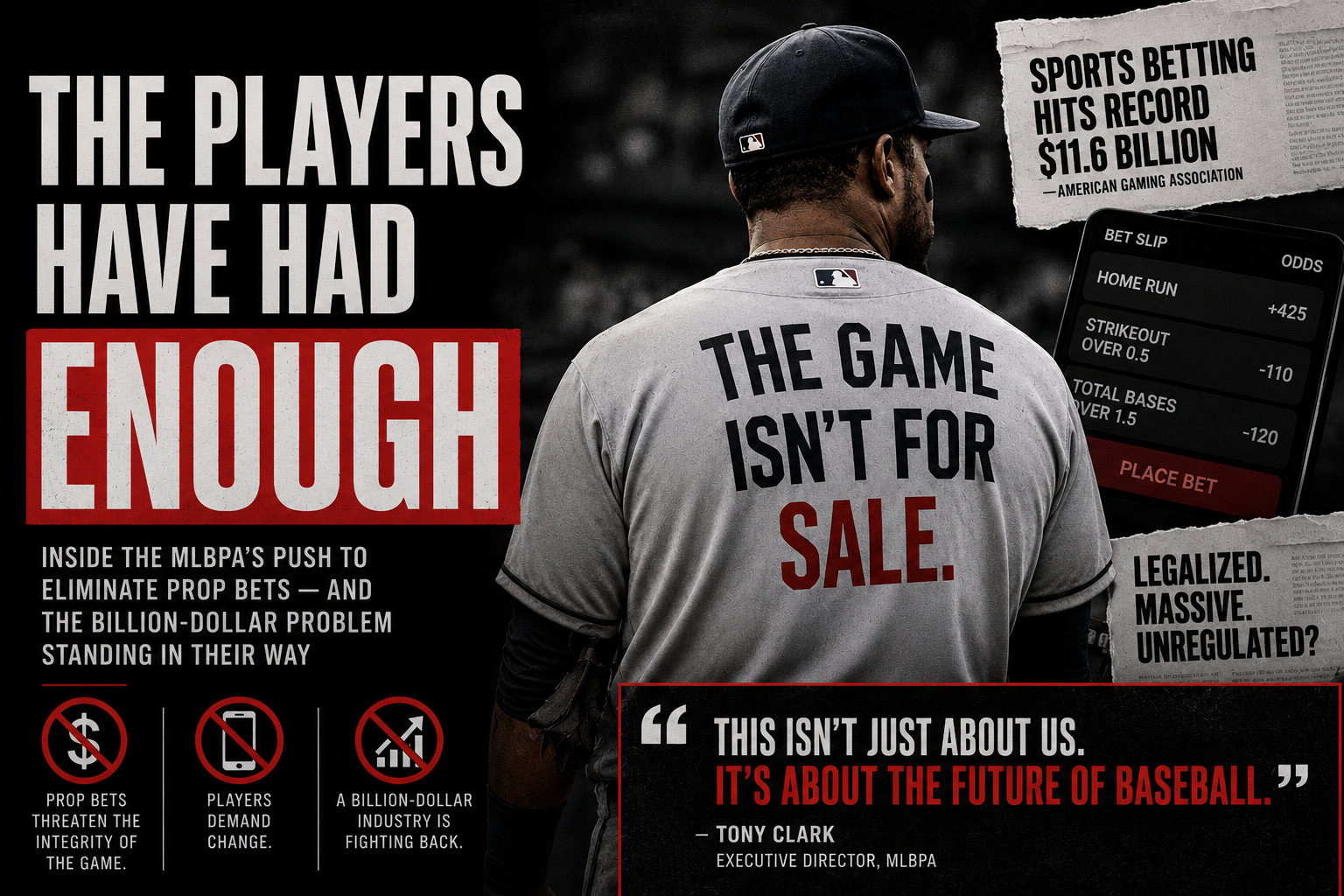
The Players Have Had Enough: Inside the MLBPA's Push to Eliminate Prop Bets — and the Billion-Dollar Problem Standing in Their Way
Two Cleveland Guardians pitchers were indicted for rigging first-pitch prop bets. Players are receiving death threats from gamblers after a bad game. And the union that represents every major league baseball player just walked into collective bargaining negotiations and proposed something nobody in the sports betting industry was ready to hear: ban all of it.
For the better part of a decade, professional sports leagues and their broadcast partners have embraced the legalized gambling economy with the enthusiasm of organizations that have discovered an entirely new revenue stream. Sportsbook logos appear on stadium walls, on broadcast lower-thirds, on jersey patches, on everything. DraftKings and FanDuel have spent billions of dollars buying their way into the cultural fabric of watching a baseball game, a basketball game, a football game — transforming the act of passive spectatorship into something financially participatory and, for a growing number of fans, financially devastating. The leagues collected their partnership fees. The operators collected their vig. And the players, whose names and statistics and performance outcomes were being packaged and sold to gamblers across the country, collected harassment.
On Thursday, the Major League Baseball Players Association decided that arrangement was no longer acceptable. The Major League Baseball Players Association proposed a ban on prop betting on individual players to help combat harassment from disgruntled gamblers, a union source told ESPN. During collective bargaining negotiations with Major League Baseball, the MLBPA suggested a joint lobbying effort with the league to pursue a prohibition on prop betting at sportsbooks and with daily fantasy operators. Event contracts at prediction markets that are centered on individual player performance also would be prohibited. The ban would include all prop bets on individual players, placed before or during a game, including popular offerings such as the odds for a player to hit a home run.
The proposal is the most significant labor-driven push to restrict sports betting markets that any professional sports union has ever made in the United States. It arrived in the middle of ongoing CBA negotiations between the MLBPA and MLB, with the current collective bargaining agreement set to expire December 1 and the threat of a lockout already hovering over talks that have featured significant disagreements on multiple fronts. And it landed in an industry that is not going to give up twenty to thirty percent of its total wagering revenue without a fight.
What Is a Prop Bet and Why Does It Matter
To understand the full scope of what the MLBPA is proposing, it helps to understand what player prop bets actually are and how they function in the current sports betting ecosystem. A player prop bet — short for proposition bet — is a wager placed on the individual statistical performance of a specific player within a game, rather than on the overall game outcome. The bet is not on whether the Yankees beat the Red Sox. It is on whether Gerrit Cole strikes out more than seven batters. It is not on whether the Dodgers cover the run line. It is on whether Freddie Freeman gets at least two hits.
Prop bets transform human beings into the dice on the craps table, the steel ball on the roulette wheel. That framing, while pointed, captures something real about how the market functions. When a bettor places a player prop, they are not wagering on a team outcome in which the individual player is one of many contributing factors. They are wagering on what a specific, named, identifiable human being does with his body and his skill set over the next three hours. And when that human being does not perform to the statistical threshold the bettor required, the bettor knows exactly who is responsible.
Prop bets can account for upward of 20 to 30 percent of the total amount wagered on a game, according to multiple sportsbook sources. That number is the core of the financial argument against the MLBPA's proposal. If the major sportsbooks operating in America — DraftKings, FanDuel, BetMGM, Caesars — lose 20 to 30 percent of their total MLB wagering volume, the revenue impact runs into the hundreds of millions of dollars annually. Those operators have advertising agreements, stadium partnerships, and broadcast integrations with Major League Baseball that are worth billions of dollars over their full terms. Asking those operators to eliminate their most granular and profitable product category is, in the bluntest possible terms, asking MLB's most important commercial partners to take a significant financial hit in the middle of a business relationship that the league has been cultivating for years.
The Harassment Problem Is Real and It Is Getting Worse
The MLBPA's proposal did not emerge from abstract principle. It emerged from the lived experience of players who have spent the past several years discovering, in real time, what it means to have millions of dollars in gambling action tied to whether they get a strikeout in the second inning. When a player fails to reach a certain threshold of performance, they are often subjected to a barrage of vitriol on social media platforms, creating a hostile work environment. Whether it is a star on the New York Yankees or a rookie finding their footing with the Baltimore Orioles, no athlete should have to contend with the wrath of gamblers over a missed strikeout or a base hit.
The scale of that harassment has been documented publicly by multiple players and is understood privately by virtually every major leaguer currently active. Cade Povich of the Baltimore Orioles publicly called out online harassment after his wife received threats from gamblers following a bad outing. Multiple players have spoken about the specific toxicity of prop bet losses — the way they differ from ordinary criticism in their intensity and their personal targeting — because the gambler who lost money on a pitcher strikeout over/under is not simply disappointed in the performance. He is financially victimized by it, in his own mind, and he knows exactly whose fault it is.
There is another layer to this that would probably be beneficial for both the players and the league: it would not only help curb anger from gamblers, it would also remove some incentive for players to take part in gambling schemes. That observation cuts to the most serious dimension of the prop bet problem — the integrity dimension. Last season, two Cleveland Guardians pitchers, Luis Ortiz and Emmanuel Clase, were indicted on charges related to a pitch-rigging scheme that saw them throw intentional balls to help win first-pitch prop bets. The existence of a profitable, accessible, real-time market for individual pitch outcomes created an incentive for players to manipulate individual pitch outcomes. The market and the corruption were directly linked. Eliminating the market eliminates the specific incentive that created the corruption.
In November, after two Cleveland Guardians pitchers were indicted on charges related to an alleged pitch-rigging betting scheme, MLB and its partner sportsbooks initiated a $250 limit on first-pitch prop bets. The $250 cap was a reactive, limited response to a specific integrity crisis. The MLBPA's proposal is a structural response to the underlying condition that made the crisis possible — and will make the next one possible if nothing more fundamental changes.
The No-Win Situation MLB Now Faces
If the players are going to the league to say that the harassment they face as a result of individual prop bets has gotten out of control, it will be a terrible look if the league denies the request to ban props. However, the betting operators make a significant amount of money off of prop bets. Will MLB risk damage to its relationship with betting companies? Everything says MLB should grant the MLBPA's request and sign off on ending individual prop bets. However, this would lead to a significant drop in revenue for MLB's gambling partners. Will the almighty dollar win out or will MLB do right by its players?
That question — simply stated but genuinely difficult to answer — is the one MLB now has to sit with. The league has built significant commercial infrastructure around its gambling partnerships. The sportsbook advertising that runs during every television broadcast, the integrations built into the MLB app, the stadium partnerships that have placed DraftKings and FanDuel branding in eye-line distance of every fan in nearly every ballpark in the country — all of it was constructed on a foundation that includes the prop bet market the players are now asking to dismantle. Agreeing to a joint lobbying effort with the MLBPA to ban individual player props would put MLB in direct opposition to the commercial interests of partners who are currently paying the league very large amounts of money. Refusing to do so would put MLB on record as prioritizing gambling revenue over the safety and well-being of the players whose labor produces every game that revenue is generated from.
An MLB official said the league would respond to the union's proposal during negotiations. That response has not yet been made public. The league's calculation, when it arrives, will tell us a great deal about how seriously it takes the premise that its players are its most important asset — or whether, when the choice is framed concretely enough, the answer turns out to be the gambling partners after all.
The MLBPA has also made clear that banning props does not mean abandoning the gambling economy entirely. The MLBPA asked the league to clarify that players may engage in endorsements and sponsorships from legal betting operators, including prediction markets. Players want to profit from the gambling industry's presence in baseball. They simply do not want to be the dice. The distinction is reasonable. Whether the league and the industry accept it is the question that the next several months of CBA negotiations will answer — with a December 1 expiration date and the possibility of a lockout providing the specific urgency that makes abstract disputes into concrete decisions.
MLBPA prop bet ban proposal: submitted during CBA negotiations with MLB, June 2026. Scope: all player prop bets at sportsbooks, daily fantasy operators, and prediction markets — pre-game and in-game. Estimated prop bet share of total MLB wagering: 20-30%. Two Cleveland Guardians pitchers indicted for pitch-rigging first-pitch prop bets: Luis Ortiz, Emmanuel Clase (November 2025). MLB and sportsbook partner response to indictments: $250 cap on first-pitch prop bets. CBA expiration: December 1, 2026. Potential consequence of failed negotiations: lockout. MLBPA also proposed: endorsement clarity with legal sportsbooks; adjustments to gambling investigation procedures; 15-day minor league rehab option near end of gambling suspension.