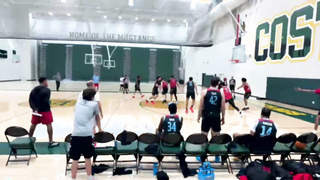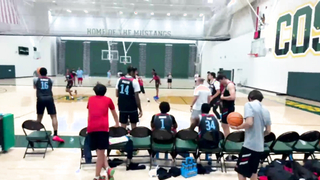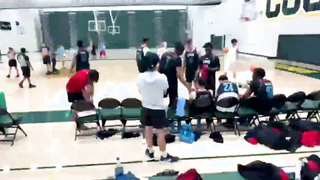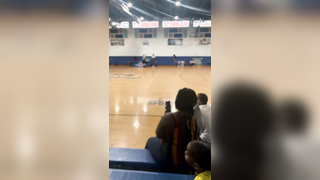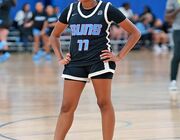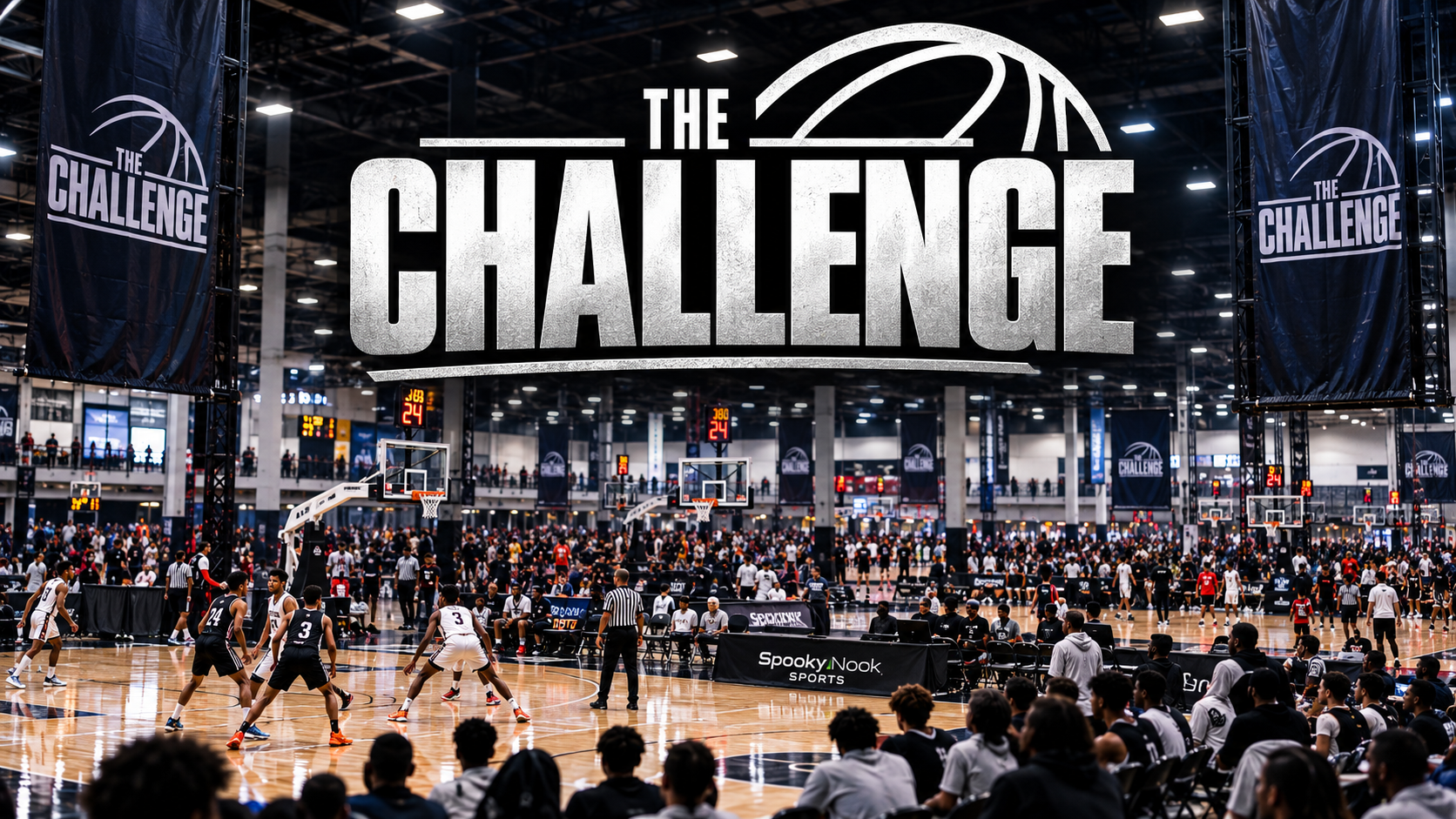
Something interesting is happening in high school basketball, and this past weekend at Spooky Nook Sports may have provided one of the clearest examples yet. The Challenge 2026 brought more than 175 teams together for over 200 games across 12 courts, creating a massive basketball environment that looked less like a traditional high school event and much more like the type of AAU tournament that has dominated spring and summer recruiting for years. Boys and girls teams, traditional high schools, prep programs and junior colleges were all brought together in one location, with games being streamed and college coaches, scouts and media able to evaluate players throughout the weekend.
The Challenge itself is impressive, but the bigger story is what an event of this size represents. For decades, the basketball calendar had a fairly clear separation. High school basketball belonged to the winter, while spring and summer belonged to AAU programs, shoe circuits and exposure tournaments. Players competed for their schools during one part of the year and then changed uniforms to enter a completely different recruiting ecosystem during another. That separation is becoming much less defined. Events like The Challenge and Border League are bringing the massive multi-court tournament format into the fall, while EYBL Scholastic, Grindhouse Basketball and Overtime Elite are experimenting with league structures that give elite high school-age players more opportunities to compete nationally.
In many ways, high school basketball is beginning to adopt the infrastructure that made AAU basketball so influential in recruiting. Think about what happens during a major Nike EYBL weekend. Hundreds of prospects arrive in one location. Games are played simultaneously across multiple courts. College coaches can watch one prospect, walk 50 feet and immediately evaluate another. Recruiting services can compare players against elite competition. Media companies can produce highlights throughout the weekend. Players can dramatically increase their exposure without requiring college coaches to travel to dozens of individual high school gyms.
Now consider what happened at The Challenge. More than 175 teams were concentrated at Spooky Nook. More than 200 games were scheduled across 12 courts. Instead of one high school playing another high school in an isolated gym on a Tuesday night, an entire basketball ecosystem was placed under one roof. That type of concentration is exactly what made AAU basketball so valuable to college recruiters in the first place.
The AAU Model Is Moving Into High School Basketball
The difference is that players can now receive some of that same exposure while wearing their school uniforms.
That could become an important shift in recruiting. One of the biggest advantages AAU basketball has always provided college coaches is efficiency. If an assistant coach wants to evaluate prospects from Florida, Maryland, Pennsylvania, New Jersey and New York during the traditional high school season, that could require several flights, rental cars and individual trips. At a major event, those same players can potentially be evaluated over one weekend.
The Challenge provides that opportunity in the fall, and Border League is doing something similar on an even larger national scale. The 2026 Border League in Las Vegas brought together more than 250 boys' and girls' teams and created high-profile matchups involving nationally recognized high schools, prep academies and elite prospects. Instead of simply playing whoever happens to be on a regional schedule, programs can intentionally face opponents from different parts of the country. A highly recruited guard from Florida can play another nationally ranked prospect from Arizona or California, and college coaches can evaluate them against each other rather than trying to compare performances from completely different environments.
That is very similar to what shoe circuits accomplished during the summer. EYBL became valuable not simply because Nike sponsored it, but because elite players repeatedly competed against other elite players. The concentration of talent created an evaluation standard. When everyone on the floor is good, scouts learn much more about who can actually create shots, defend, make decisions and impact winning.
EYBL Scholastic is now pushing that idea even further by bringing a recognizable national competition structure into scholastic basketball. High school basketball has always had nationally ranked teams and major holiday tournaments, but it has traditionally remained fragmented by geography. Schools belong to state associations and regional conferences. A powerhouse in Florida and a powerhouse in California can both be nationally ranked without ever sharing a meaningful competitive structure.
A national scholastic league changes that equation. Instead of elite programs occasionally meeting at holiday tournaments or showcases, they can exist within a recognizable ecosystem where national matchups become part of the schedule itself. That begins to look less like traditional high school basketball and more like the circuit model that has already proven successful during the summer.
Grindhouse and OTE Show There Isn't Just One Model
Then there is Grindhouse Basketball, which adds another piece to the evolution. Rather than everything being built around individual tournament weekends, league and circuit-style concepts can create continuity. Teams meet repeatedly, storylines develop throughout the season, players accumulate performances against recognizable competition and recruiters know where high-level basketball is going to be played.
That consistency is another lesson borrowed from AAU circuits. A single showcase can create exposure, but a circuit creates an ecosystem. Scouts see the same prospects multiple times. Players get opportunities to respond after poor performances. Teams build identities. Rivalries develop. Rankings and standings become more meaningful because the teams are connected by a common competitive structure.
And then there is Overtime Elite, which may be the most extreme example of how far the traditional model can be pushed. OTE didn't simply create another showcase or national tournament. It built an alternative basketball environment for elite high school-age players where competition, development, recruiting, entertainment and media exist together. Teams have their own identities, games are produced as content, individual players are marketed and major matchups can be promoted nationally.
OTE proved something important: elite high school-age basketball does not necessarily need to follow the traditional high school model to attract players, recruiters or an audience. It can be packaged differently while still serving many of the same competitive and developmental purposes.
That doesn't mean OTE, EYBL Scholastic, Grindhouse, Border League and The Challenge are the same thing. They aren't. But their differences may actually make the overall trend more significant. Multiple organizations are independently arriving at versions of the same idea: elite scholastic-age basketball can become more national, more centralized, more media-driven and more accessible to recruiters.
College Recruiting May Be the Biggest Reason This Works
For college coaches, the advantages are obvious. Recruiting is largely an information business. Coaches want to evaluate players repeatedly, see them against strong competition, compare prospects at similar positions and understand how they respond when they're no longer clearly the best athlete on the floor.
The traditional high school model doesn't always make that easy. A prospect may dominate his local schedule without facing another Division I player for weeks. Another prospect may play on a loaded team where he doesn't need to score 25 points every night. Comparing those situations can be difficult.
Large-scale events solve some of that problem. Put the players in the same building. Put elite programs against one another. Let coaches watch them in person. Stream the games so they can be reviewed later. Allow scouts and media to provide additional evaluation. Suddenly the amount of information available on a prospect increases dramatically.
That's exactly what AAU basketball figured out years ago, and high school basketball appears increasingly willing to borrow from it.
Streaming makes the model even more powerful. Twenty years ago, putting 200 games in one facility still meant that most of those games disappeared once the final buzzer sounded. Today, the physical event can become an enormous digital content library. Full games can be archived. Highlights can be clipped. Player performances can circulate on social media. Recruiting analysts can review film. College staffs can revisit prospects they weren't able to watch live.
The event no longer ends when everyone leaves the building.
Basketball Is Becoming a Year-Round Recruiting Ecosystem
That may eventually change the meaning of the basketball calendar itself. A highly recruited player can now potentially compete in fall showcases, preseason tournaments, national scholastic league games, traditional high school games, holiday events, state playoffs, spring AAU tournaments, summer shoe circuits and elite camps before returning to fall competition again.
There is increasingly no true offseason for national basketball exposure.
That doesn't mean traditional high school basketball is disappearing. Rivalry games still matter. State championships still matter. Playing in front of classmates and communities still matters. Those are experiences a massive showcase cannot replace.
What's happening instead is that another layer is being built on top of traditional high school basketball.
The school schedule remains, but national events are being added around it. Major programs can compete locally while also building national schedules. Players can represent their schools while receiving exposure that once largely required an AAU uniform. College coaches can increasingly find centralized recruiting environments outside the traditional spring and summer live periods.
And event organizers are discovering that fall itself is valuable basketball real estate.
October was once primarily a preparation period. Now Border League can bring hundreds of teams to Las Vegas while The Challenge can put more than 175 teams inside Spooky Nook on the same type of massive weekend format associated with grassroots basketball.
The next logical question is how far this goes.
If EYBL Scholastic continues expanding, Grindhouse and similar leagues grow, Border League and The Challenge continue attracting hundreds of programs, and OTE continues demonstrating the value of an alternative national basketball product, the country could eventually have something that didn't really exist before: a year-round national scholastic basketball ecosystem.
Not one league controlling everything. Not one tournament determining a champion. Instead, interconnected events, leagues, showcases, school programs, prep academies, shoe companies, streaming platforms and recruiting services operating throughout the year.
That would fundamentally change how players are discovered.
For years, the recruiting pathway was relatively straightforward: perform during the high school season, then prove yourself again during AAU.
The future may be much more continuous.
Perform at Border League in October. Play national scholastic competition during the winter. Compete for a state championship. Enter EYBL or another grassroots circuit in the spring. Play through July. Attend camps. Return to fall showcases.
Every part of the calendar becomes another evaluation opportunity.
The Challenge Is Bigger Than the Scores
That's why the biggest story coming out of The Challenge isn't necessarily which program won by 20 points or which team went undefeated.
It's the fact that more than 175 teams showed up.
It's that more than 200 games could be played across 12 courts in one weekend. It's that college coaches, scouts and media could walk into one facility and access an enormous collection of players. It's that those games could be streamed and turned into recruiting content. And it's that school teams are increasingly participating in the type of basketball environment that once belonged almost exclusively to grassroots basketball.
Zoom out and the picture becomes even clearer.
The Challenge is doing it with a massive event.
Border League is doing it with nationally marketed showcase competition.
Grindhouse is exploring the league and circuit approach.
EYBL Scholastic is bringing one of grassroots basketball's most recognizable brands into the scholastic space.
Overtime Elite has built an entirely different league and media model around elite high school-age talent.
These organizations aren't necessarily building toward the same destination, but they're all pushing basketball in a similar direction.
The boundaries between high school basketball, prep basketball, AAU, recruiting and basketball media are becoming increasingly difficult to see.
AAU basketball isn't replacing high school basketball.
High school basketball is beginning to adopt the systems that made AAU basketball powerful.
And The Challenge 2026 may be one of the clearest examples yet that the transformation is already underway.