BallerTube Sports News | October 9, 2026
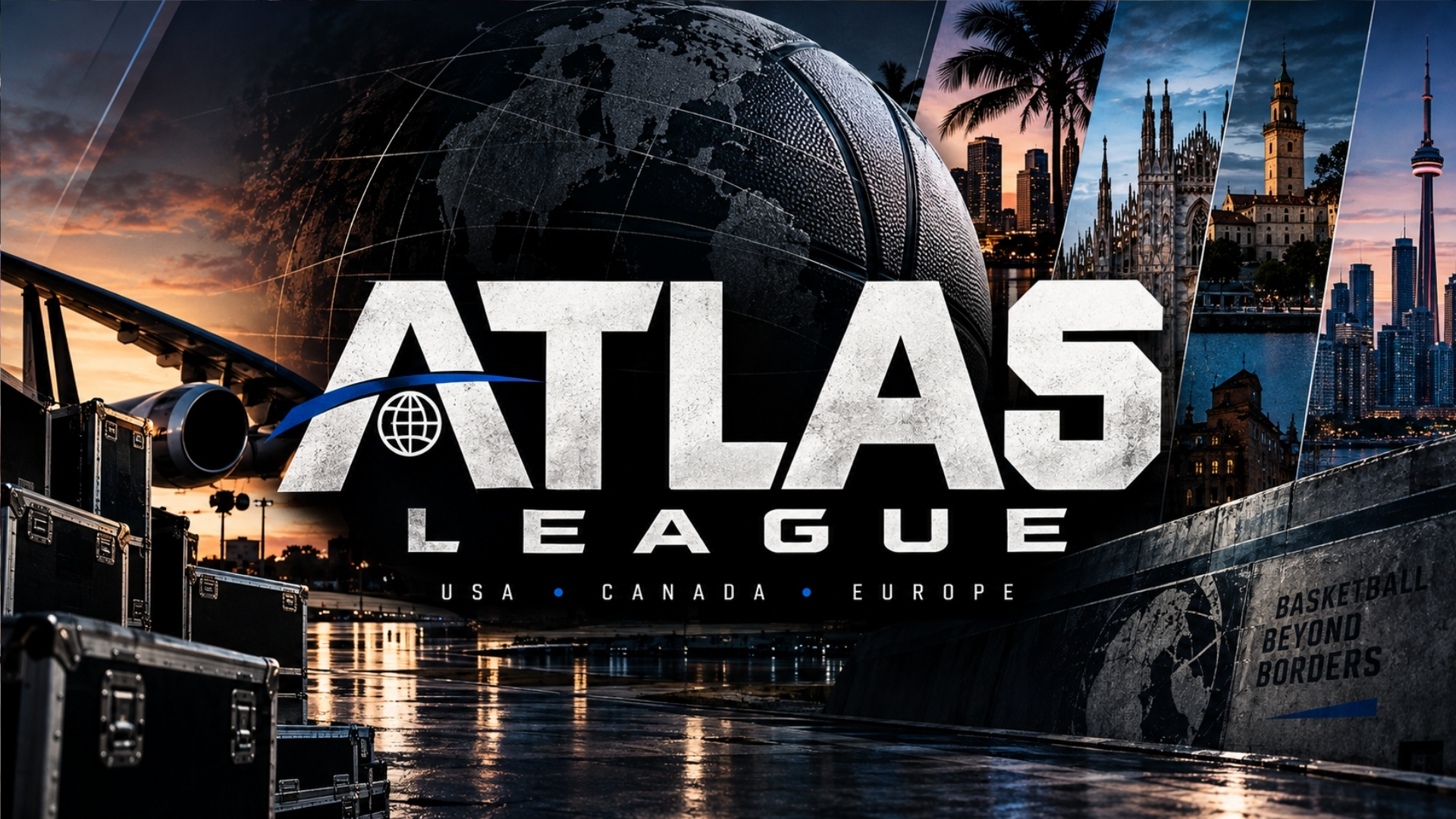
The landscape of elite high school basketball is changing rapidly, and the arrival of the newly announced ATLAS League could represent another major shift in how the world's top young basketball players compete, develop and gain exposure.
Announced October 8, ATLAS brings together 11 elite basketball programs from the United States, Canada and Europe in an international competition that will span the 2026–27 season. The founding membership includes American prep basketball powers IMG Academy, Prolific Prep, SPIRE Academy, Sunrise Christian Academy and DME Academy, alongside established international development programs from Canada, Serbia, Italy, Germany and Lithuania.
The league is scheduled to open November 11 at IMG Academy in Bradenton, Florida, before traveling across North America and Europe, ultimately concluding with its inaugural playoffs in Toronto in March 2027.
But ATLAS represents something bigger than another basketball schedule.
Its arrival comes as Nike's EYBL Scholastic, Overtime Elite and the Grind Session have already helped transform elite high school basketball into an increasingly competitive marketplace built around national exposure, player development, recruiting opportunities and media distribution.
Now, with another major league entering the picture, the battle to shape the future of elite scholastic basketball appears to be intensifying.
And while ATLAS has not officially announced adidas as a league-wide sponsor, its connections to the footwear industry have created an additional storyline worth watching.
Who Is Behind the ATLAS League?
ATLAS is operated by WorldStage Sports, a sports venture focused on developing international competition and commercial opportunities around elite basketball.
The league's commissioner is Mike Morreale, a former professional football player and sports executive who co-founded and served as commissioner of the Canadian Elite Basketball League (CEBL).
Morreale's involvement gives ATLAS leadership with experience building and operating a professional sports competition. That background is important because ATLAS is being positioned as more than a series of independent showcases. Its organizers are attempting to establish a structured international league with recognizable members, recurring competition, a championship and long-term commercial potential.
Another significant figure is Kevin Boyle, the accomplished prep basketball coach who previously led IMG Academy and now coaches at SPIRE Academy. Boyle is serving as chief basketball officer for the new venture.
Boyle has coached some of the most recognizable names in modern basketball, including Kyrie Irving, Ben Simmons, Cade Cunningham and Cooper Flagg. His involvement provides the league with credibility among elite coaches, basketball academies and college recruiting circles.
The venture has also reportedly attracted investment from private financial backers, including venture capital and private equity interests, although specific investors and financial commitments have not been fully disclosed.
That combination of experienced sports executives, established prep basketball leadership and outside investment illustrates the larger direction of elite scholastic basketball. These competitions are increasingly being developed not simply as athletic leagues, but as sports properties capable of generating revenue through sponsorships, media rights, events and commercial partnerships.
The Founding Programs: American Prep Powers Meet International Basketball Clubs
ATLAS launches with 11 founding programs across six countries, combining nationally recognized American prep schools with international basketball development organizations.
United States
-
IMG Academy — Florida
-
Prolific Prep — Florida
-
SPIRE Academy — Ohio
-
Sunrise Christian Academy — Kansas
-
DME Academy — Florida
Canada
-
Orangeville Prep
Serbia
-
Mega Basket
Italy
-
Orange1 Bassano
-
Pallacanestro Varese
Germany
-
OrangeAcademy Ulm
Lithuania
-
Žalgiris
The American membership immediately establishes ATLAS as a serious player in the prep basketball landscape. IMG Academy, Prolific Prep, SPIRE and Sunrise Christian have established reputations for competing against nationally recognized opposition and developing major college prospects.
The international programs bring a different dimension.
Serbia's Mega Basket and Lithuania's Žalgiris are connected to basketball environments with established professional development pathways. European basketball academies traditionally operate within club systems that emphasize tactical development, team concepts and progression toward professional competition.
By bringing these organizations into regular competition with American prep academies, ATLAS creates opportunities for players to experience different basketball philosophies before reaching college or the professional ranks.
For American athletes, that means competing against international prospects developed in different systems. For European athletes, it means direct exposure to American recruiting networks and some of the most recognizable prep basketball brands in the United States.
The result could be a more comprehensive evaluation environment for college coaches, professional scouts and recruiting services.
Is ATLAS an adidas-Connected Challenger to Nike's EYBL Scholastic?
Perhaps the most intriguing storyline surrounding ATLAS is its relationship to the increasingly competitive footwear landscape in high school basketball.
Although adidas has not been officially announced as a league-wide ATLAS sponsor, the footwear relationships of its American member programs make the possibility of a deeper adidas connection particularly interesting.
SPIRE Academy, one of the league's founding members, announced a multiyear partnership with adidas in 2026. The inclusion of SPIRE alongside other major prep basketball programs has fueled speculation about whether ATLAS could eventually provide adidas with a larger presence in the elite scholastic basketball marketplace.
However, not every participating American academy is confirmed to be adidas-sponsored. IMG Academy, for example, has an Under Armour relationship. The current membership therefore appears capable of bringing together programs with different apparel partnerships rather than operating exclusively under one footwear brand.
That distinction is important, but it does not diminish the potential commercial implications.
Adidas already competes with Nike in grassroots basketball through its 3SSB circuit. Nike's EYBL remains one of the most influential summer basketball platforms, while EYBL Scholastic extended the Nike brand into the traditional school-year competition calendar.
An expanded adidas presence in elite scholastic basketball could create opportunities to connect summer grassroots competition with school-year development, recruiting exposure and national media coverage.
The timing also deserves attention.
EYBL Scholastic emerged from the National Interscholastic Basketball Conference, combining established national prep basketball competition with Nike's branding and commercial reach. The league has featured several of the country's most recognizable basketball academies.
For the 2026–27 season, however, EYBL Scholastic has experienced membership changes, including departures involving programs now associated with ATLAS.
SPIRE Academy and Sunrise Christian Academy previously competed in EYBL Scholastic, while IMG Academy and Orangeville Prep have also been associated with the competition.
The movement of established programs between competing leagues demonstrates how fluid the elite scholastic basketball market has become.
Schools and academies are increasingly positioned to evaluate which competitions offer the strongest combination of opponents, recruiting visibility, travel opportunities, sponsorship relationships and media exposure.
ATLAS introduces another option.
Whether adidas eventually becomes an official commercial partner remains unknown. But the presence of adidas-connected programs, the league's international ambitions and its entry into a market already shaped by Nike make the footwear angle one of the most important developments to follow.
The larger question may not be whether ATLAS becomes an adidas league, but whether it creates a new competitive structure that changes how footwear companies invest in high school basketball altogether.
ATLAS Announces Nine Stops Across North America and Europe
The inaugural ATLAS season will feature nine scheduled competition dates or event windows across the United States, Italy, Lithuania and Canada, beginning in November 2026 and concluding with the league championship in March 2027.
Unlike traditional high school conferences, ATLAS will operate across international borders, with participating programs traveling between continents throughout the season.
The proposed schedule features major events involving all 11 founding teams, alongside smaller competition windows designed to build regular-season standings ahead of the playoffs.
Announced 2026–27 ATLAS League Schedule
| Dates | Location | Games |
|---|---|---|
| November 11–13, 2026 | Bradenton, Florida | 12 |
| November 19, 2026 | Daytona Beach, Florida | 1 |
| December 2, 2026 | Florida, venue TBD | 1 |
| December 6, 2026 | Miami, Florida | 2 |
| December 14–16, 2026 | Varese, Italy | 6 |
| January 4–7, 2027 | Kaunas, Lithuania | 16 |
| February 5–7, 2027 | Geneva, Ohio | 4 |
| February 18–20, 2027 | Phoenix, Arizona | 13 |
| March 4–7, 2027 | Toronto, Canada | 15 playoff games |
Schedule subject to change.
The league will open at IMG Academy in Bradenton, where all 11 programs are scheduled to participate in a 12-game event. That opening competition will offer an early opportunity to compare American prep basketball powerhouses against established European development programs.
The schedule then moves to Daytona Beach for a matchup between DME Academy and IMG Academy on November 19, followed by an IMG Academy–Prolific Prep matchup on December 2 at a Florida location still to be announced.
Miami will host two games on December 6 involving Sunrise Christian, DME Academy, SPIRE Academy and Prolific Prep.
The competition then moves overseas, beginning with a December 14–16 event in Varese, Italy, featuring Žalgiris, OrangeAcademy Ulm, Mega Basket, Pallacanestro Varese and Orange1 Bassano.
One of the season's biggest international events will take place January 4–7 in Kaunas, Lithuania, where all 11 teams are expected to participate in 16 games.
The league returns to the United States in February, with a four-game event at SPIRE Academy's home in Geneva, Ohio, followed by a 13-game event in Phoenix featuring the entire membership.
The inaugural ATLAS championship will be decided March 4–7 in Toronto, with 15 playoff games scheduled.
What ATLAS Means for High School Basketball
The emergence of ATLAS represents another step in the separation between traditional high school basketball and the increasingly sophisticated world of elite prep basketball.
For decades, high school competition was largely defined by state associations, regional conferences and local rivalries. Even nationally recognized programs primarily built their schedules around domestic opponents and showcase tournaments.
That model has been changing as elite basketball academies recruit nationally, travel extensively and compete in privately organized leagues designed to maximize exposure.
ATLAS takes the concept further by connecting American academies directly with established European basketball clubs.
For players, the benefits could be substantial. American prospects will have opportunities to compete against athletes developed within European club systems, where tactical execution, team concepts and professional development pathways are often emphasized from an early age.
International prospects, meanwhile, will gain access to American recruiting networks, college coaches and national basketball media coverage.
The potential impact on college recruiting is significant. Instead of evaluating American and international prospects almost exclusively in separate environments, scouts will have opportunities to compare them directly against common opponents.
However, the growth of international scholastic competition also introduces challenges involving travel costs, academic schedules, eligibility requirements and athlete welfare.
As private leagues expand, those issues will become increasingly important in determining which organizations can establish sustainable long-term models.
Overtime Elite, EYBL Scholastic, Grind Session and ATLAS: A New Basketball Economy
The emergence of ATLAS also demonstrates how rapidly elite basketball is becoming a year-round sports business.
Overtime Elite has built a development and entertainment model combining high-level basketball, athlete branding and digital media. EYBL Scholastic has connected major prep programs under Nike's recognizable basketball identity. The Grind Session has established a national competition platform with international participation.
ATLAS now enters the market with an international league structure and a collection of established American and European programs.
While these organizations operate under different models, they increasingly compete for the same valuable assets: elite players, coaching talent, recruiting attention, sponsorships, audiences and media distribution.
The commercial opportunities extend well beyond ticket sales.
A league featuring IMG Academy, Prolific Prep, SPIRE and internationally recognized European clubs offers potential value through streaming, broadcast rights, sponsorship packages, advertising, licensing and branded content.
ATLAS's international schedule could also help attract audiences across multiple basketball markets, creating opportunities that are difficult to replicate through traditional regional high school competition.
Media rights could become particularly important. As leagues seek to build recognizable identities, controlling the distribution of games, highlights and athlete-focused programming will likely play a major role in determining their financial success.
ATLAS has not yet announced its full media distribution arrangements, but the combination of international competition and established basketball brands provides a potentially valuable foundation.
The Bigger Picture: Who Will Control Elite High School Basketball?
ATLAS's arrival raises a question that extends beyond the success of one new league.
Who will ultimately control the highest level of high school basketball?
Will it be traditional school associations, major footwear companies, privately financed leagues, national academies or sports media organizations?
The answer may involve a combination of all five.
Traditional high school basketball will continue serving the overwhelming majority of student-athletes, but the elite academy market is developing into something fundamentally different.
The most recognizable programs are increasingly operating within an environment shaped by national recruiting, international competition, commercial sponsorships and professional-style media coverage.
The arrival of ATLAS provides another indication that the highest levels of scholastic basketball are becoming more global, more commercially competitive and more independent from traditional geographic boundaries.
Whether ATLAS becomes a dominant international basketball property will depend on its ability to deliver meaningful competition, attract audiences, secure commercial partners and maintain a sustainable operating model.
But its founding membership and ambitious inaugural schedule make it one of the most significant new developments in elite prep basketball.
With EYBL Scholastic, Overtime Elite, the Grind Session and now ATLAS competing for attention, the future of high school basketball is no longer being shaped exclusively on the court. It is increasingly being shaped by the organizations building the leagues, controlling the content and investing in the next generation of athletes.
And the competition is only beginning.