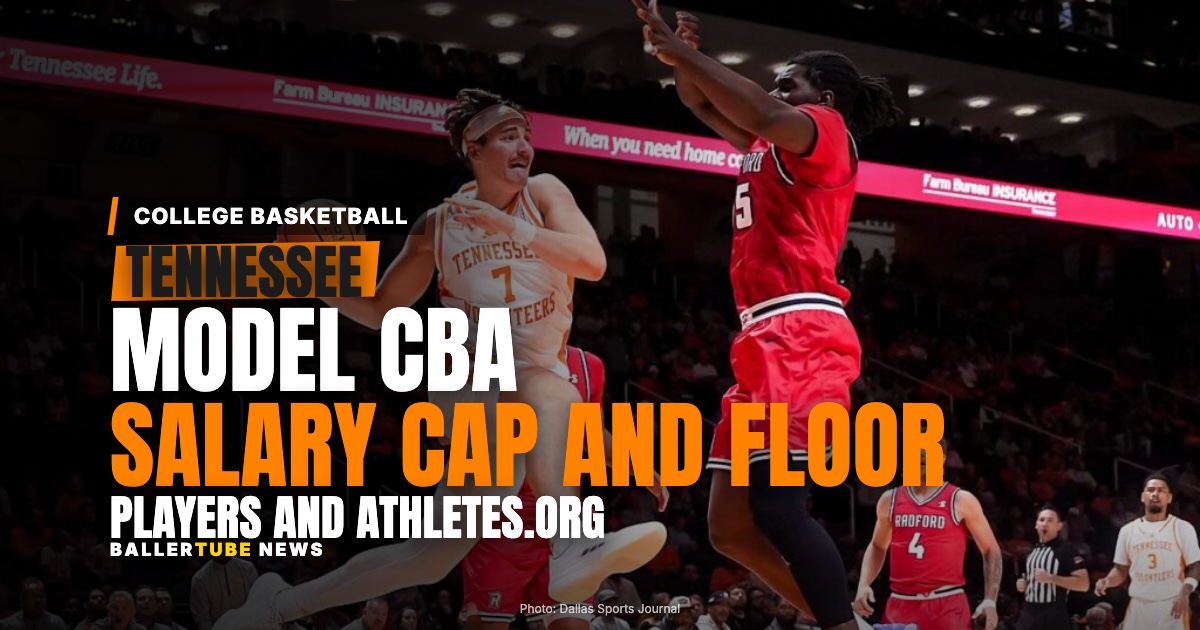

College sports does not have a collective bargaining agreement. On Tuesday, Tennessee's men's basketball players released what one could look like. Working with the athlete group Athletes.org and with Tennessee's athletic department at the table, the team produced a term sheet that sets a salary cap and a spending floor, pays players to play instead of for promotional work, and guarantees health coverage after their careers end.
It is not a contract. Athletes.org says on its term sheet summary that the document is not a signed agreement or a ratified CBA and that the school's administration has not agreed to or endorsed the terms. The Associated Press reports that Athletes.org approached the players in June and that the two sides agreed to the sheet on Oct. 1.
Tyler Lundblade, Campbell Duncan and DeWayne Brown II at the Table
The Tennessee Volunteers had three elected player representatives: graduate student Tyler Lundblade, junior Campbell Duncan and sophomore DeWayne Brown II, per AP and CBS Sports. Tennessee is ranked 11th in the AP poll. Athletes.org executive director Brandon Copeland told the AP the exercise "hopefully proves to the industry that this can happen in college sports."
The school side matters. Athletic director Danny White has argued for collective bargaining since at least May 2025, and he told CBS Sports that "collective bargaining is a proven model that works across all of professional sports."
What Is in the Tennessee Term Sheet: Salary Cap, Floor and Portal Window
CBS Sports' Matt Norlander lists the terms under five headings: money, player movement, health and time, rules and enforcement, and academics. Among them:
Pay starts when a player arrives on campus, with no NIL influencer deliverables attached. There are incentives for winning, and a raise for players who come back and stay at least two years. Every roster player, up to 15 in basketball, gets a salary floor, and schools face a cap. The transfer portal window is 15 days and opens at least one week after the national championship game. Injured players keep guaranteed pay. Health coverage runs at least two years after eligibility, five years for veteran athletes, and for life after a catastrophic injury. Disputes go to a neutral arbitrator, and the sheet protects a dead period with no mandatory athletic activity.
The AP adds the structure behind it: a central employer that is not a state entity, modeled on how Major League Soccer employs its players, which supporters say would not need Congress. Today a school can share up to $21.5 million a year with its athletes, per AP, and CBS reports Tennessee is one of 11 schools spending more than $20 million on a men's basketball roster this season.
Tennessee Football Is Next, and Congress Is Still Stuck
The AP reports Athletes.org also met with Tennessee's football team, which privately voted to have the group represent it, and Athletes.org says the football process is on hold until the season ends. In Washington, the Protect College Sports Act passed the Senate 77-22 in October but still needs the House, per CBS Sports, and it largely sidesteps employee status and bargaining. Yankees president Randy Levine, who helped write that bill, told the AP a real CBA would require changes to federal and state labor law.
More on athlete pay is on BallerTube's NIL page.