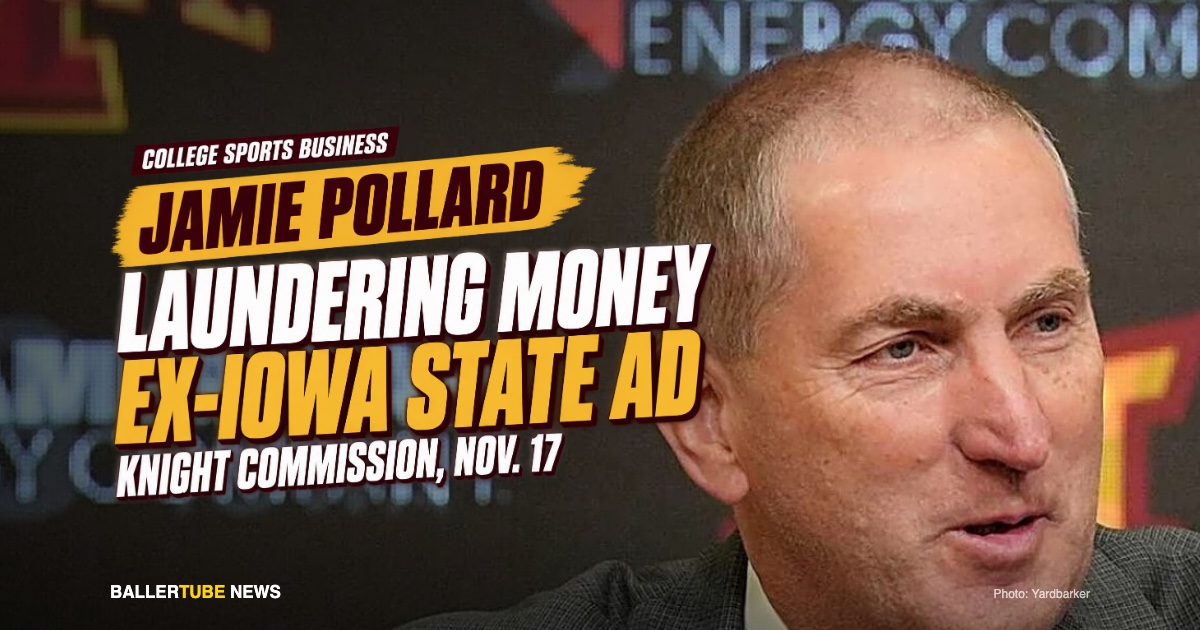

Athletic directors usually save this kind of talk for after the microphones are off. Jamie Pollard said it into one.
Pollard, who ran Iowa State athletics for 21 years before stepping down this fall, told the Knight Commission's annual public meeting on Tuesday, Nov. 17, that his industry is "laundering money" through name, image and likeness deals. He also said higher education could be headed for something like the savings and loan collapse. The Associated Press and Yahoo Sports both reported from the session, which Yahoo placed in Arlington, Virginia, just outside Washington.
At a Knight Commission meeting in Washington, D.C., former Iowa State AD Jamie Pollard flatly says, “I want to be honest: Our industry right now is laundering money. That’s what we’re doing.”
Ross Dellenger (@RossDellenger) November 17, 2026
What Jamie Pollard Means by 'Laundering Money' in NIL
The House settlement lets a school pay its athletes directly up to a cap, which the AP puts at $21.5 million. Money above that has to come from outside NIL deals.
Pollard's complaint is about where that outside money starts. Donations that once went straight to athletic departments are now being steered to businesses closely tied to the schools, the AP reported, and those businesses then sign athletes to third-party NIL contracts. Most Power 4 schools work with third parties this way. It is allowed, and it lets them spend past the cap.
In Pollard's telling, that is money meant for the institution being routed around the institution so it can come back as a manufactured NIL deal.
He also went after the lack of daylight. Schools report player contracts to the College Sports Commission, but the commission publishes only a broad overview, so there is little verified information on what any one school spends on a roster. A handful are reportedly at $50 million for football, per the AP. Pollard said that guessing game is pushing schools into emotional, irrational decisions.
The Savings and Loan Warning and the Numbers Behind It
Pollard pointed to research showing about 16 percent of public universities lost money in at least five fiscal years between 2014 and 2023, and tied rising sports costs to the trend. The AP added a federal number: a 2026 Government Accountability Office report found 94 percent of Division I athletic programs spent more than they brought in during 2023-24.
Pollard told the commission that higher education is sitting on its own version of that crisis, per the AP. More than 1,000 savings and loan institutions closed in the late 1980s and early 1990s.
Yahoo's Ross Dellenger reported Pollard's other worry: schools borrowing against future television money. Pollard questioned whether the Big 12's next media deal will bring in enough to cover what its members have borrowed.
The program he left sits in the middle of that league. Iowa State is 5-5 this football season and 3-4 in the Big 12, according to CollegeFootballData.com: 5-1 at home and 0-4 on the road.
Robin Harris and the Ivy League Want Top Football Treated as a Business
Pollard was not the only blunt voice in the room. Robin Harris, the Ivy League's executive director, said the richest football programs should be split off as a for-profit venture affiliated with their schools, Yahoo reported. The Ivy League has not opted into revenue sharing. About four dozen of Division I's 365 schools have stayed out, per the AP.
Harris also said the College Football Playoff's move to 24 teams makes it time to examine the financial relationship between top-level football and the NCAA.
Steve Eigenbrot, the athletic director at Towson, put the pay scale in one comparison: the average NBA G League salary is $45,000, while college players are often getting six and seven figures, according to the AP.
Congress Has Three Working Weeks, and the SEC Has a Plan B
The federal fix college leaders want is the Protect College Sports Act. It has passed the Senate, but it faces a hard House vote with three full working weeks left before a new Congress is seated in January, Yahoo reported. A Knight Commission expert told the meeting it is unlikely to get there.
That is why the conferences are writing their own rules. The Big Ten passed a cap policy for its members last month, and the SEC is drafting a luxury-tax style penalty for schools that spend past the cap, a proposal BallerTube broke down in its revenue sharing coverage on Nov. 15.
If the bill stalls, the next move belongs to the conferences, and Pollard has already said what he thinks of how they spend.