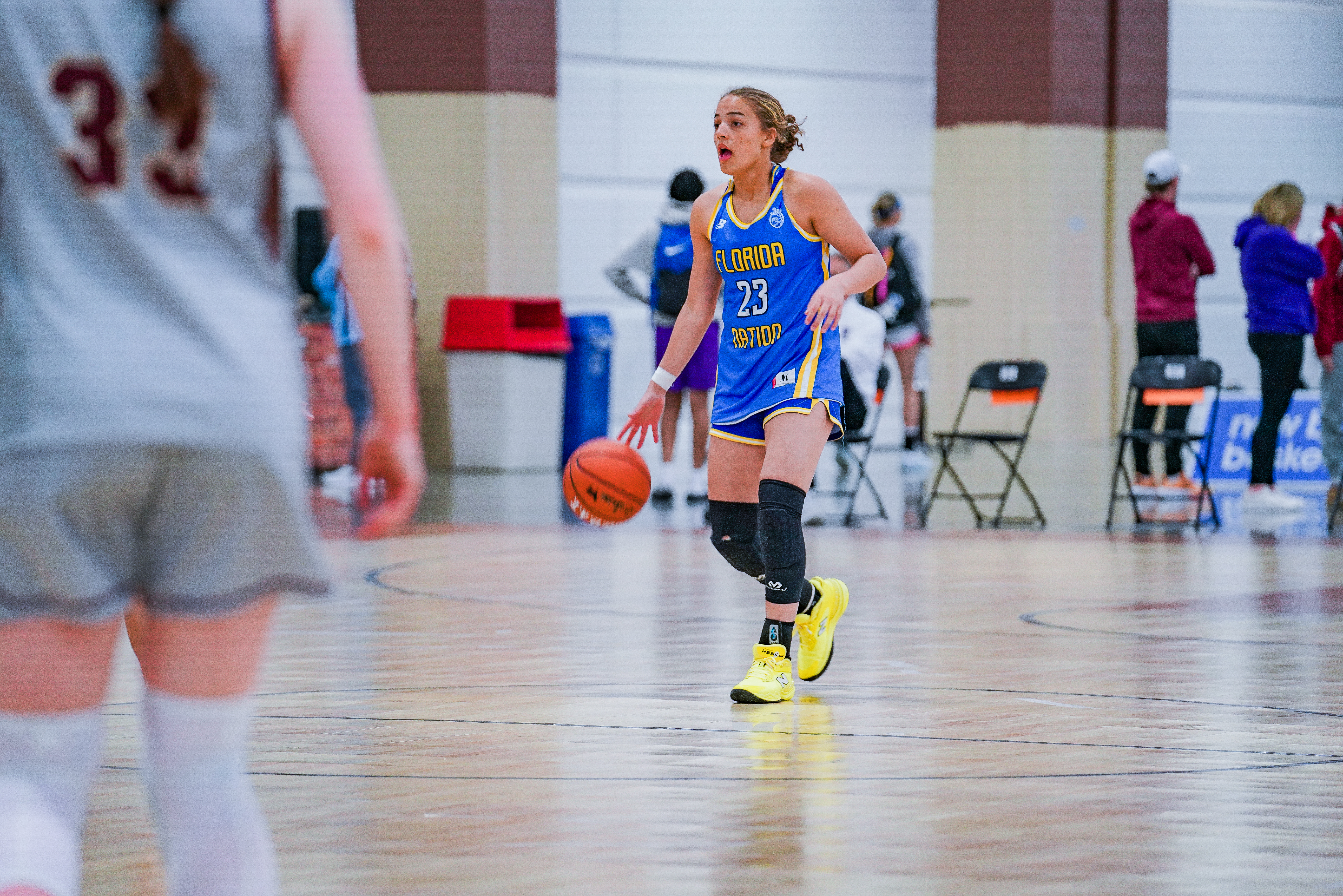

Florida Nation LE32 Blue 17U | New Balance P32 Session 3, Chicago | July 24-27
Four days in Chicago, six games, a 4-2 finish for Florida Nation's 17U Blue group, and a Synergy sheet that tells two very different stories about No. 23 Frida Acevedo depending on which end of the floor you look at. On offense she was a pace merchant who scored 33 points and created 49. On defense she was close to a lockdown, allowing nine points on 20 logged possessions while opponents shot 14.3 percent against her.
Put the two ends together and the summary is short: she scored at 0.805 points per possession and gave up 0.450. That is the kind of gap that gets a guard recruited.
The Defense Was the Story
Synergy logged 20 possessions with Acevedo as the primary defender across the session. Opponents produced nine points on them, 0.450 points per possession, a 79th percentile mark graded Very Good.
The shooting numbers she forced are the part worth sitting with. Players guarded by Acevedo went 2-of-14 from the field, 14.3 percent, with a 17.9 effective field goal percentage and a 17.9 true shooting percentage. On field goal attempts specifically she surrendered 0.36 points per shot, an 88th percentile figure that Synergy grades as Excellent. She forced a turnover on 15.0 percent of the possessions she defended.
Break the 14 attempts down and the coverage quality holds up everywhere:
- Two-point attempts: 1-of-10, 10.0 percent. She took away the interior.
- At the rim: 1-of-5, 20.0 percent. Four of five finishes at the basket did not go.
- Catch and shoot: 0-of-3. All three were threes, including 0-of-2 with a hand in the shooter's face and 0-of-1 when the shooter was open. She contested the ones she could reach and the open one missed anyway.
- Two-point jumpers: 0-of-4.
- Pull-up and dribble jumpers: 1-of-5, 20.0 percent.
- Runners: 0-of-1.
The only two shots that fell against her all weekend were a layup against Chicago Hoops Express on 7/26 and a long pull-up three against iDream on 7/25. Both were rated medium shot quality, in the 20th to 80th percentile band. She did not allow a single make on a high shot quality look. That is not variance. That is a defender who never gave up a clean one.
Four Shutout Games
Broken out by game, the points allowed line reads: zero, zero, six, zero, three, zero.
Acevedo did not give up a point in four of six games in Chicago. The six she surrendered came against Chicago Hoops Express on 7/26, four of them on the two-point end. The three came against iDream on 7/25 on that single pull-up.
Ninety percent of her defensive workload came in man coverage, 18 of the 20 possessions, and she held that assignment to 0.500 PPP at a 74th percentile Very Good grade on 2-of-12 shooting, a 20.8 eFG, and a 16.7 percent forced turnover rate. The two possessions she defended inside a zone produced 0-of-2 shooting and no points.
One honest note on the sample: 20 possessions across six games is a modest number, and Synergy only logs a possession when the tracked player is the primary defender. The rate is elite. The volume is small enough that it reads as a strong indicator rather than a settled conclusion.
Offense: Transition Is the Identity
On the other end, Acevedo finished with 33 points on 41 possessions, 0.805 PPP, a 78th percentile Very Good mark. She shot 13-of-33 from the field, 39.4 percent, with a 45.5 eFG. The two-point work was the steady part: 9-of-17 inside the arc at 52.9 percent. The three-point line was the streaky part, 4-of-16 at 25.0 percent, and the shape of those attempts matters more than the number.
This is where scouts will circle. Acevedo used 46.3 percent of her possessions in transition, a 92nd percentile frequency. She is not a player waiting for a set to be called.
The production backed the volume. Nineteen transition possessions produced 18 points at 0.947 PPP, 74th percentile, Very Good. She shot 7-of-15 in the open floor at 46.7 percent, got to 6-of-11 on transition twos at 54.5 percent, and turned it over on only 10.5 percent of those possessions. That last number is the one that separates a fast player from a transition player. Speed without decisions leaks possessions. Hers did not.
Add her passing and it sharpens. Across transition possessions plus assists she generated 1.182 points per opportunity, 75th percentile, with a 1.50 assist-to-turnover ratio and 26 total points created.
The Half Court Split: Zone Was a Green Light
Acevedo's half-court possessions came in at 22, 53.7 percent of her total, but at only a 4th percentile frequency relative to her peer group. She was not a high-usage half-court option in this rotation, which makes the split inside those possessions the most interesting read.
Against zone she was a problem: 11 possessions, 11 points, 1.000 PPP, 88th percentile, Excellent. She shot 4-of-10 for a 55.0 eFG and turned it over on just 9.1 percent of those possessions.
Against man the results flipped: 11 possessions, four points, 0.364 PPP, 17th percentile, on 2-of-8 shooting with a 27.3 percent turnover rate. That is the honest growth area and a solvable one. It points at shot creation off live-dribble pressure, not anything conceptual, and it is the kind of split a fall of on-ball work moves quickly. The man-coverage sample is 11 possessions across six games, so treat it as directional.
Overall her half-court possessions produced 15 points at 0.682 PPP, 62nd percentile, Good. Folding in assists she created 23 points on 25 half-court opportunities at 0.920 per, 66th percentile.
Set Plays: She Executed What Was Drawn Up
The most efficient numbers on the entire offensive sheet came out of timeouts. Three possessions after a timeout, three attempts, three makes. Eight points, 2.667 PPP, a 133.3 effective field goal percentage, zero turnovers. Two of the three makes were from three.
Side out of bounds told the same story: two possessions, two makes, both twos, four points at 2.000 PPP, no turnovers.
Together that is a perfect 5-of-5 for 12 points on designed ATO and SLOB actions. A player who executes what is drawn up, and a staff that trusted her to be the option in the drawn-up look. Coaches read that differently than a raw scoring average.
The one situational gap was baseline out of bounds, where four possessions produced no points on 0-for-3 shooting, all three from behind the arc. That accounts for a real chunk of her overall three-point sample and reflects the action she was assigned in those sets more than her shooting.
Playmaking and Points Created
Acevedo finished with six assists against six turnovers, a 1.00 assist-to-turnover ratio, on a 12.8 percent assist rate. She handled 87.2 percent of her opportunities as scoring possessions and 12.8 percent as passes, the split of a scoring guard who makes the extra read rather than a pure lead initiator.
The quality of those passes is the tell. Two-thirds of her assists, 66.7 percent, produced three-pointers, and she averaged 2.667 points per assist. She was finding shooters in rhythm, not padding a number with dump-offs.
Total points created: 49, on 47 possessions plus assists, 1.043 per opportunity, 77th percentile, Very Good.
Game by Game, Both Ends
| Date | Opponent | Result | Pts Scored | Pts Allowed |
|---|---|---|---|---|
| 7/24 | @ Marlin Academy LE32 Stillabower 17U | W 50-30 | 0 | 0 |
| 7/25 | @ iDream LE32 White 17U | L 34-64 | 15 | 3 |
| 7/25 | vs Diamond Elite LE32 West 17U | L 28-38 | 10 | 0 |
| 7/26 | @ Chicago Hoops Express LE32 The Family 17U | W 60-31 | 4 | 6 |
| 7/26 | vs Legacy Girls E32 Allen 17U | W 57-47 | 0 | 0 |
| 7/27 | vs ALLN LE32 Barber 17U | W 49-34 | 4 | 0 |
Two things stand out. First, her two biggest offensive nights, 15 and 10 points, came in the two losses. When Florida Nation needed someone to generate offense against a team controlling the game, Acevedo found it. The 15-point night against iDream included 11 in transition and four on a side out of bounds, meaning she scored in the two phases where the possession was hers to attack, and she still held her assignment to three points that game.
Second, her offensive production was concentrated rather than constant. Three of six games produced zero points, and in the blowout wins her scoring dropped as the rotation widened. Her defense never took a night off in the same way. Four of the six games ended with a zero in the points-allowed column.
The Projection
What Chicago showed is a two-way guard whose best minutes come with pace attached. She pushed at a 92nd percentile transition rate and stayed efficient doing it, protected the ball better in the open floor than in the half court, went 100 percent on designed after-timeout looks, and scored at an 88th percentile clip against zone.
Then she went to the other end and held opponents to 14.3 percent shooting, 10.0 percent on twos, 20.0 percent at the rim, and 0-for-3 on catch-and-shoot attempts, with an 88th percentile Excellent grade on points allowed per shot. Guards who defend at that level and run the floor at that level do not have to be primary scorers to be valuable.
The runway is on-ball creation against man pressure and getting the three-point attempts to migrate from baseline out of bounds sets into rhythm catch-and-shoot and pull-up looks. She already proved she can make them when the shot is scripted, 2-of-2 from three out of timeouts. The next step is making that number look the same when the shot is one she has to manufacture.
Programs looking for a guard who plays fast without playing loose, executes what the staff draws up, and defends her position at a high level should have No. 23 on the Session 3 list.
Statistics via Synergy Sports. Team listed in Synergy as Nation LE32 Blue 17U, New Balance P32 Session 3, Chicago. Six games logged. Defensive possessions reflect plays where Acevedo was the primary defender.