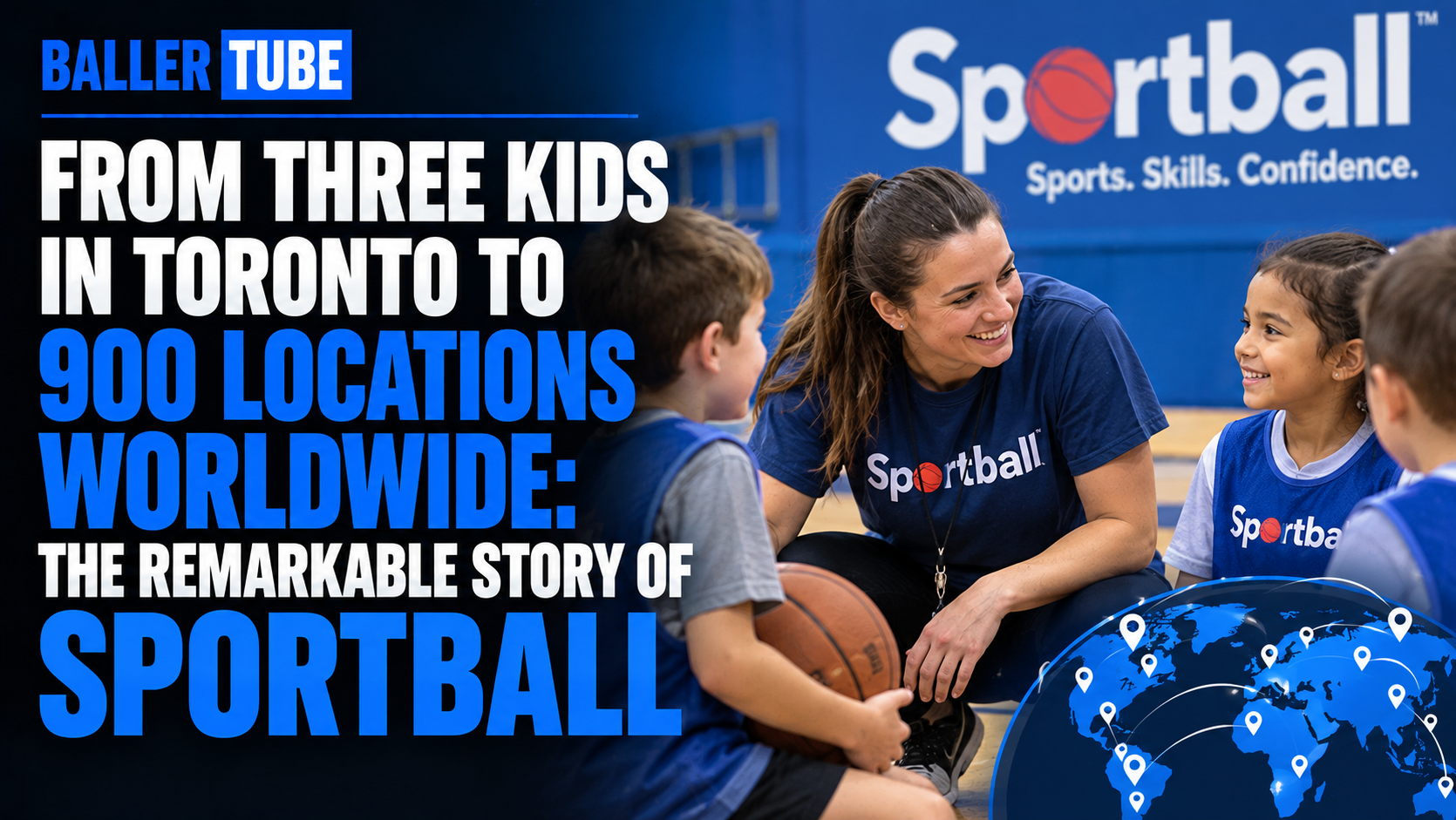
From Three Kids in Toronto to 900 Locations Worldwide: The Remarkable Story of Sportball
It started in 1995 with three children, one location, and a belief that sports should be fun before they are anything else. Thirty years later, it is the fastest growing youth sports franchise in North America, operating across four countries, and it has never once cared who wins the game.
There is a version of youth sports that most parents know. It involves tryouts. It involves early specialization, travel teams, tournament weekends that take over entire falls and winters, pressure applied to eight-year-olds to perform at a level that determines their trajectory before they have finished losing their baby teeth. It is a version of youth sports that has produced serious athletes and serious early burnout in roughly equal measure, and that has left a growing population of children outside the sport ecosystem entirely because the competitive entry point arrived before they were developmentally ready for it.
Sportball was founded specifically as an alternative to all of that.
The very first Sportball program was held in Toronto, Canada, in 1995 with only three kids. Founders Carmella and Mark Gelgor, who came to Canada with an entrepreneurial spirit and a genuine passion for helping children get active, had a simple and radical idea at the time: apply the principles of early childhood education to sports training and let children experience sports the way they experience play, which is without scores, without rankings, and without the psychological pressure that competitive structures impose on developing minds and bodies. Sportball was one of the first companies in the world to incorporate principles of early childhood education into sports training for kids twelve and under. That distinction, in 1995, was genuinely novel. In the thirty years since, it has become the organizing principle of a franchise that now has over 900 locations open or in development across North America and beyond.
The mission has never changed. CEO Quinten Griffiths puts it directly: "Our Sportball programs are intentionally designed to support kids' physical, social and emotional growth." The phrase the company has used since its earliest days is "Fun with Purpose," and it captures the specific philosophy that has driven Sportball's expansion more precisely than any marketing language could. Fun is the point. The purpose is physical literacy, confidence, coordination, social skill development, and a relationship with movement that lasts into adulthood rather than ending with a bad season at age twelve.
What Sportball Actually Does
The program model is built around multi-sport exposure rather than early specialization. Children ages sixteen months to twelve years rotate through up to eight different sports within single sessions, with curriculum designed around early childhood education principles and physical literacy development. Soccer, baseball, basketball, hockey, football, tennis, volleyball, and more appear within the same program framework, adapted to the developmental stage of the child who is experiencing them. A three-year-old in a Sportball class is learning how to kick, catch, throw, and move in ways that will serve them across any sport they eventually choose to pursue. A seven-year-old is building the coordination, confidence, and physical vocabulary that makes athletic participation accessible rather than intimidating.
The non-competitive structure is not simply a marketing choice. It reflects a genuine developmental philosophy backed by research. Sportball partners with schools, community centers, and research institutions to offer programs and align its curriculum with the latest research on cognitive, social, and motor skills development. The research consistently shows that early competitive pressure narrows participation rather than producing better athletes. Children who experience sports as joyful, mastery-oriented activities in their early years are more likely to remain active across their lifetimes than children who experience sports as win-or-lose environments from the beginning. Sportball's curriculum reflects that finding at every level.
Jason D'Rocha, Vice President and Growth Coach at Sportball, who has spent more than twenty years helping develop and evolve the company's programming, describes the environment Sportball creates as something meaningfully different from what most parents experience in traditional youth sports structures. "With various pressures impacting children's engagement in sports, Sportball offers a beneficial solution that promotes learning, growth, and the sheer joy of play," he said. The American youth sports landscape, where early specialization has become the cultural norm in many communities, is an environment D'Rocha views as particularly well-suited to what Sportball offers: a structured, research-backed, developmentally appropriate alternative to the pressure-first model that has dominated.
Thirty Years of Growth: From Toronto to Four Countries
Sportball began franchising in 2005, a decade after its founding, once the organizational infrastructure and training systems were sufficiently robust to support a franchise model that could maintain the program's quality and philosophy across multiple operators. The first U.S. Sportball location opened in Austin, Texas, where franchise owners Mica and Alyssa Villalon began as coaches before transitioning into ownership. That Austin location has since served as the foundation of a Texas presence that now includes Katy, North Houston, San Antonio, and multiple Dallas-area markets including Plano and Frisco.
From that single location in a Toronto gym to over 900 locations open or in development, the scale of Sportball's expansion reflects both the strength of its franchise model and the growing demand for what it provides. The company operates through corporate and franchise locations in Canada, the United States, Singapore, and India. In Canada, Sportball is present in virtually every major metropolitan market including Toronto, Montreal, Calgary, Edmonton, Vancouver, Winnipeg, Ottawa, Halifax, and Quebec City, with coverage extending into smaller cities and regions through franchise operators who have purchased territorial rights to serve their communities.
The franchise model itself has been one of Sportball's most distinctive competitive advantages. Because programs are delivered in community facilities, schools, recreation centers, and parks rather than owned physical locations, the capital requirement for opening a Sportball franchise is significantly lower than most franchise concepts. Franchisees are not building gyms or leasing permanent locations. They are delivering programs where children and families already gather. That infrastructure-light model means qualified franchise partners can scale quickly and that Sportball's geographic footprint can expand in ways that brick-and-mortar concepts cannot replicate. A Sportball franchisee who purchases territorial rights to a medium-sized Canadian city can begin delivering programs within weeks of completing their training.
The training itself reflects the company's roots in early childhood education. New franchisees receive up to two weeks of initial instruction covering curriculum delivery, methodology, scheduling, program administration, and the underlying developmental philosophy that makes Sportball what it is. The emphasis on understanding why the program is built the way it is, not simply how to deliver it, ensures that operators who expand across multiple locations are extending the program's identity rather than simply replicating its format.
The American Expansion: Building for the Long Term
The United States represents the next major chapter of Sportball's growth, and the company has been deliberate and patient about how it approaches American markets. "Opening our first corporate location in the U.S. is a meaningful step forward and a clear message that we're dedicated to building in the States for the long term," Griffiths said when the company's first corporate-operated U.S. location opened in Plano, Texas. The corporate location serves a specific function: it is a testing site for new classes, formats, and programming innovations that could eventually be introduced at other Sportball locations. Having a directly operated presence in the American market gives Sportball's programming team real-time feedback from a new consumer environment as they develop the next generation of curriculum.
The franchise growth in the U.S. has been driven by the same profile of operator that has built Sportball's Canadian presence: people with backgrounds in education, coaching, and child development who see a business opportunity that aligns with a genuine mission they care about. Empire builder Matt Pearce, who purchased the Boston territory and also owns multiple locations in the province of Quebec, represents one model. Jothan and Amanda Richie, who own areas in both Phoenix and Los Angeles, represent another. The combination of mission alignment and entrepreneurial ambition has consistently produced the most successful Sportball franchise operations, whether in Canada, the United States, or internationally.
Sportball has now served over 700,000 children worldwide across its thirty years of operation. That number represents a tangible measure of the company's impact, and it continues to grow as the 900-location development pipeline matures. In Boston and Phoenix and Singapore and Plano and Halifax and every community where a Sportball franchisee is delivering programs this week, children between sixteen months and twelve years old are kicking balls, catching, throwing, running, and discovering that sport is something they enjoy rather than something they fear. That is what three children in a Toronto gym in 1995 grew into. It is not done growing.
Sportball founded: 1995, Toronto, Canada. Founders: Carmella and Mark Gelgor. CEO: Quinten Griffiths, headquartered in Thornhill, Ontario. VP and Growth Coach: Jason D'Rocha (20-plus years with company). Began franchising: 2005. Total locations open or in development: 900-plus. Countries of operation: Canada, United States, Singapore, India. Age range served: 16 months to 12 years. Children served to date: 700,000-plus. U.S. markets: Austin, Katy, North Houston, San Antonio, Dallas-Plano, Frisco-McKinney, Boston, Phoenix, Los Angeles, Plano (first corporate U.S. location). Philosophy: non-competitive, multi-sport, research-backed, early childhood education principles applied to physical literacy development.n