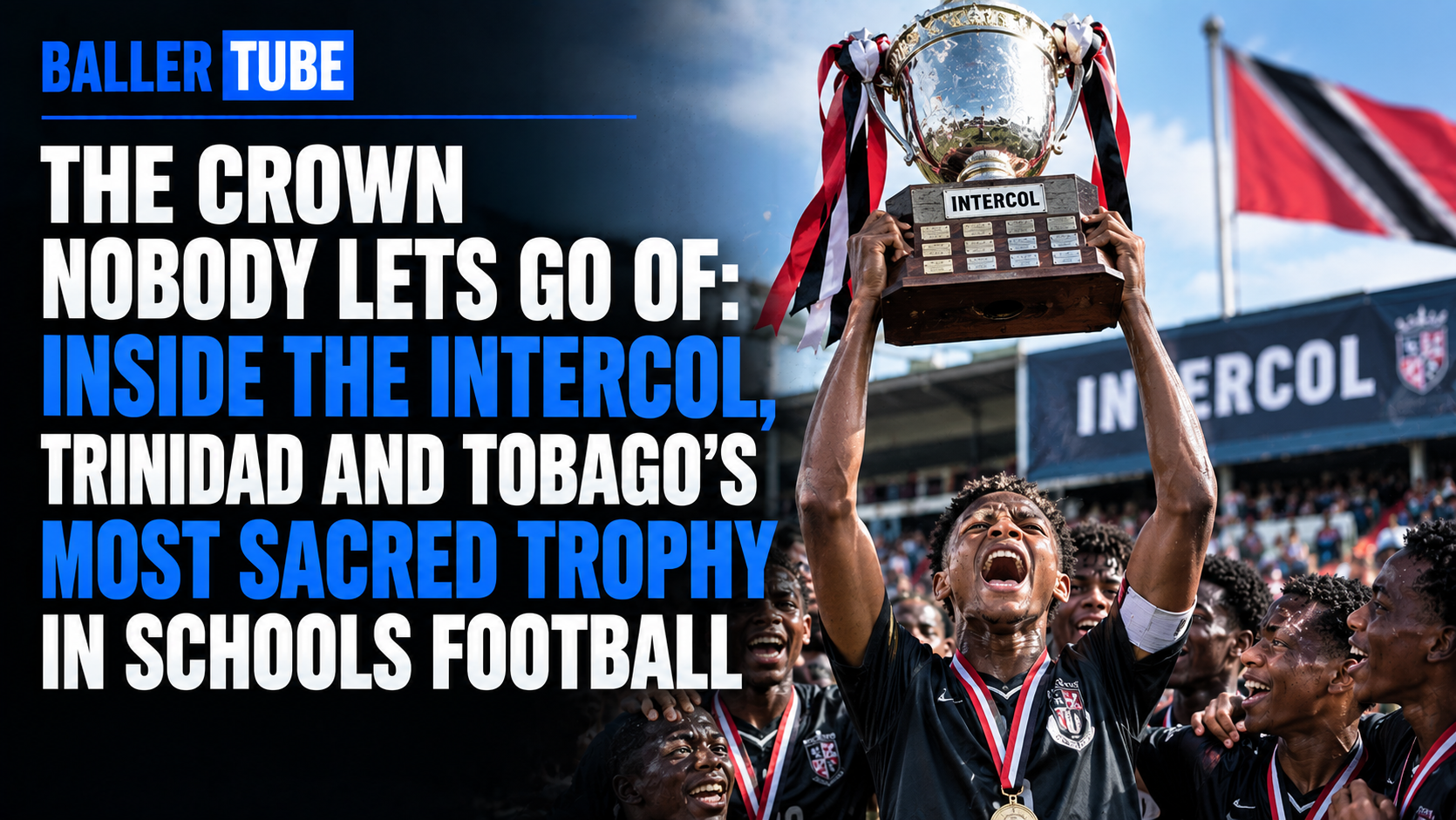
It began in the earliest days of Trinidad and Tobago's secondary school sporting culture. It has been contested across north zones and south zones, Tobago brackets and national finals, for more than six decades. Schools have built identities around winning it. Players have built careers on the strength of performances in it. And every November, the entire country watches.
There is no singular prize in Trinidad and Tobago's secondary school sporting calendar that carries the weight of the Coca-Cola National InterCol. Not the league title, which carries its own prestige. Not the individual zone championships. Not the cup competitions that populate the early months of the Secondary Schools Football League calendar. The InterCol is the trophy that defines seasons, cements legacies, and separates programs that are good from programs that are great. It is the knockout competition that every school in the SSFL Premier and Championship Divisions enters in November, and the one that every school spends the entire preceding months preparing for. To understand secondary schools football in Trinidad and Tobago is to understand the InterCol. Everything else is prologue.
The History: From the Colleges Football League to the SSFL Era
Research indicates that schools played football in Trinidad as far back as 1908, when St. Mary's College played among clubs in the Trinidad Amateur Football Association. The organized competition that would eventually become the InterCol grew out of the Colleges Football League, which formalized inter-school competition in an era when only a small number of elite colleges participated. The founding members of the Colleges Football League established the framework for what would become the most competitive schools football competition in the Caribbean.
The history of the InterCol stretches back to the 1960s and beyond, deepening alongside Trinidad and Tobago's own development as an independent nation. When Trinidad and Tobago gained independence in 1962, a number of five-year secondary schools were built, expanding the participant pool and intensifying competition across geographic zones. The north, south, east, and Tobago zones developed their own InterCol competitions, with zone champions advancing to a national stage that made the final the year's most watched schoolboy football match.
The year 1982 represents a landmark in the competition's history. It was the first time two teams from the senior division contested a national InterCol final, and also the first occasion a team from Tobago won the national title. Signal Hill Senior Comprehensive, the Tobago school, provided Ricardo Dalrymple's goal that gave them a 1-0 win over San Fernando Technical Institute and permanently established Tobago as a legitimate national competitor rather than simply a regional participant. Signal Hill have since won the national InterCol six times, with their 2025 final appearance against Naparima College continuing a tradition of Tobago reaching the sport's biggest stage.
The Trinidad and Tobago Secondary Schools Football League was incorporated by an act of parliament on August 22, 1995, transforming what had been an association into a formal governing body affiliated with the Trinidad and Tobago Football Association. By 1989, membership had grown to 28 schools, necessitating the name change from the Colleges Football League to the Secondary Schools Football League. The InterCol competition formalized within this new structure, with the Premier Division schools competing in a knockout format that runs from November through December after the league season concludes.
How It Works: Format, Zones, and the Road to the Final
The InterCol competition involves both Premier and Championship division schools, organized geographically across the north, south, east, and Tobago zones. Zone preliminaries, quarter-finals, and semi-finals determine the regional champions, who then advance to the national stage. The national semi-finals and final are typically held at major national venues including the Hasely Crawford Stadium in Port of Spain, the Ato Boldon Stadium in Couva, and the Brian Lara Cricket Academy ground, giving the competition a stage that reflects its status as the most significant event in the school football calendar.
The format is knockout from the preliminary rounds through the final, meaning every game carries the highest possible stakes. A single defeat eliminates a school from the competition entirely, producing the kind of dramatic do-or-die football that knockout formats uniquely generate. The interplay between league performance and InterCol success defines how programs are evaluated across a full season. Winning the league establishes consistency and depth. Winning the InterCol, which requires winning six or seven consecutive knockout games against the full competitive range of Trinidad and Tobago schoolboy football, establishes something different: the ability to perform under maximum pressure at the highest available intensity.
The competition is sponsored by Coca-Cola and has been known as the Coca-Cola National InterCol for multiple years, with the sponsorship reflecting both the commercial investment in schools football and the competition's cultural profile. The InterCol final is a national event in the truest sense, drawing crowds that dwarf the attendance at league fixtures and generating media coverage across all of Trinidad and Tobago's major newspapers and broadcast outlets.
The Programs That Define the Competition
Certain schools have made the InterCol the organizing principle of their football identity. Presentation College San Fernando, Naparima College, Fatima College, St. Benedict's College, St. Anthony's College, and Signal Hill Secondary have between them accounted for the majority of the competition's modern-era titles.
Presentation College San Fernando, known across the island as Pres Lions, won back-to-back national InterCol titles in 2023 and 2024. Their 2023 victory over St. Anthony's College was decided on penalty kicks after a 7-6 shootout, the kind of margin that defines the competition's dramatic character. The 2024 title continued a run of southern dominance that reflects Pres San Fernando's organizational investment in their football program and their consistent production of technically developed, tactically disciplined players.
Naparima College, the south Trinidad powerhouse based in San Fernando, completed what their supporters will describe as the most complete season in recent SSFL history in 2025. Naparima won the Premier League title, the South Zone InterCol, and the National InterCol in a clean sweep of the three major prizes available to a Premier Division school. Their 1-0 national final victory over Signal Hill, decided by a goalkeeping error in the 22nd minute, was not the most dramatic conclusion the competition has produced, but the accumulation of three titles across a single season placed the achievement in a category that most programs never reach. Naparima had done the same in the 2025 season, completing a triple crown that included the Under-16 championship in addition to the senior titles.
Fatima College, the north Trinidad Catholic institution based in Port of Spain, have been consistent InterCol competitors across multiple decades. They were losing finalists in both 2023 and 2024 before their momentum building in the 2026 cycle gave them genuine quarterfinal presence. Queen's Royal College produced the 2023 competition's signature upset, eliminating defending champion Fatima with a 2-1 victory at the Hasely Crawford Stadium in one of the results that exemplifies what knockout football does to even the most powerful programs. The InterCol does not care about previous titles.
What the InterCol Produces
The competition's legacy extends well beyond the silverware. The InterCol has been the competitive stage on which generations of players who went on to represent Trinidad and Tobago at the senior international level developed their ability to perform in high-pressure football environments. Former national team players, Caribbean professional league regulars, and players who eventually competed in European leagues have universally described the InterCol as the formative competition that taught them what playing for something that mattered actually felt like.
The sport's relationship to national identity runs through the InterCol in a specific and irreplaceable way. Trinidad and Tobago is a twin-island nation where football is woven into the cultural fabric more deeply than any other team sport. The 2006 World Cup appearance, the era of Dwight Yorke, Russell Latapy, and Shaka Hislop in English football, and the sustained regional football presence of Soca Warriors have given the national team an identity that filters down to the grassroots in concrete ways. The InterCol is where that identity begins, where young players from every corner of Trinidad and from Tobago first experience what it means to represent a school, a community, and a tradition in front of a crowd that has been watching this competition for longer than most of them have been alive.
Every November, when the preliminary rounds begin, every secondary school in the SSFL turns its full collective attention to the same question: which team will lift the trophy this year? The answer will define the season, cement or create legacies, and produce the moments that players remember for the rest of their lives. That is what the InterCol has always done. It shows no signs of stopping.
SSFL InterCol format: Premier and Championship division schools, zone-based knockout competition, November through December. National final venues: Hasely Crawford Stadium, Ato Boldon Stadium, Brian Lara Cricket Academy. Sponsor: Coca-Cola. 2025 National InterCol winner: Naparima College (1-0 vs. Signal Hill). 2024 winner: Presentation College San Fernando. 2023 winner: Presentation College San Fernando (7-6 on penalties vs. St Anthony's College). Notable signal hill history: six national InterCol titles, first Tobago winner in 1982. SSFL incorporated by act of parliament: August 22, 1995. SSFL affiliate: Trinidad and Tobago Football Association.