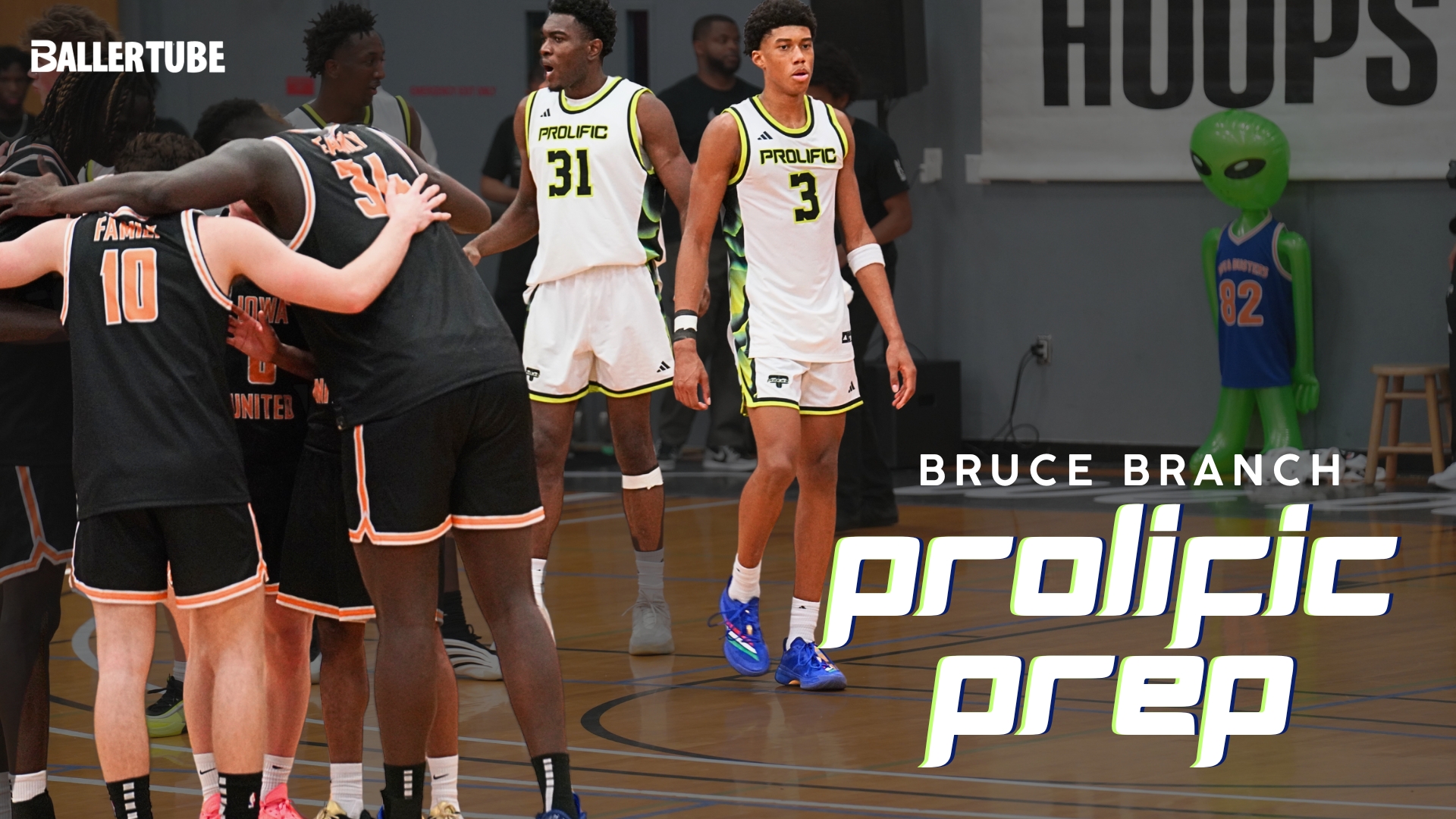
Bruce Branch III has spent the last few years playing basketball surrounded by expectations.
At Perry High School in Arizona, he played alongside Koa Peat and won championships. At Prolific Prep, he stepped into one of the most talent-rich environments in high school basketball and became an All-American. He reclassified from 2027 into the 2026 recruiting class, played in the McDonald's All-American Game, represented the United States internationally and eventually chose BYU.
Now comes the part that matters most.
Branch is about to play college basketball.
And while the NBA conversation surrounding the 6-foot-7 freshman has already become impossible to ignore, calling him a guaranteed lottery pick before he has played a minute for BYU would miss what makes his freshman season so interesting.
Branch absolutely has lottery-pick talent. He could play himself much higher than that. But there is still something he has to prove.
NBA evaluators will finally get to see whether one of the most intriguing young two-way wings in basketball can turn projection into production.
Branch arrives in Provo as a five-star prospect who finished his prep career at Prolific Prep averaging 18 points, 10 rebounds, four assists and two blocks per game. ESPN ranked him No. 6 in the 2026 class when he signed with BYU, while the current Rivals Industry Ranking places him No. 6 nationally as well.
Those numbers only tell part of the story.
Branch was originally one of the premier players in the Class of 2027. When he announced in November 2025 that he would reclassify into 2026, NBA.com reported that the move immediately put him into the conversation surrounding the No. 1 pick in the 2027 NBA Draft. One NBA scout cited his shooting, size and ability to defend multiple positions as reasons he could eventually enter that discussion.
That was before college basketball had a chance to expose any of his weaknesses.
Now BYU gets to find out exactly how advanced he really is.
Branch Isn't AJ Dybantsa 2.0, and He Doesn't Need to Be
The easiest thing to do with Branch will be to compare him with AJ Dybantsa.
Both were elite wings. Both came through Prolific Prep. Both arrived at BYU carrying NBA expectations. Both entered Kevin Young's program knowing there was a legitimate possibility they would only be there for one season.
But they're different prospects.
Dybantsa entered college with the type of individual scoring package that naturally made an offense gravitate toward him. Branch's value is more subtle, and potentially more versatile.
Even Young has cautioned against expecting the same player. The BYU coach described Branch this summer as an extremely talented freshman who can affect games with his defense, rebounding, catch-and-shoot ability and play with the basketball in his hands. Young also stressed patience with a player who reclassified and is effectively arriving in college a year earlier than originally expected.
That's an important part of evaluating Branch.
He doesn't have to average 20 points per game to establish himself as an elite NBA prospect.
At 6-foot-7, his pathway to the lottery is built around versatility.
Branch shot 39 percent from three while averaging 15.9 points and 5.2 rebounds for Compton Magic on the adidas 3SSB circuit. At Prolific Prep, he demonstrated that he could rebound well beyond what is typically expected from a perimeter player. Defensively, he has the length and competitiveness to switch across multiple positions.
Then there are the possessions that don't show up cleanly in a box score.
A contested rebound in traffic. A rotation that prevents a layup. Making the extra pass instead of forcing a shot. Running the floor. Guarding a bigger player after a switch. Spacing the weak side and punishing a defense when it helps.
Those are NBA skills too.
And Branch already understands that.
What BYU Should Expect Immediately
The first thing that should translate is the shooting.
Branch doesn't need to dominate the basketball to score. That's particularly valuable for a freshman because college defenses aren't going to allow him to play the same way elite prospects sometimes can at the high school level.
He can play alongside another creator, space the floor and punish help.
That gives Kevin Young options.
BYU can use Branch as a spot-up threat, move him into actions, let him attack closeouts and gradually increase the amount of offense he is responsible for creating. His size also allows him to finish possessions on the glass rather than simply drifting around the perimeter.
But the rebounding may be just as important.
Branch returned from the 2026 FIBA U18 AmeriCup after averaging 8.6 points and 8.6 rebounds, including two double-doubles. Young specifically highlighted Branch's length, defense, shooting and ability to affect games even when he isn't scoring.
That is probably the best way to understand what BYU is getting.
Branch doesn't need 18 shots to matter.
He can have an impactful night scoring 13 points if he's also grabbing eight rebounds, defending the opposing team's best wing, making shots and keeping BYU's offense moving.
That makes him different from many highly ranked freshmen whose NBA stock becomes heavily dependent upon whether they can immediately become primary scorers.
The Question NBA Scouts Will Be Watching
There is one area that could determine whether Branch becomes merely a first-round prospect or starts pushing toward the very top of the 2027 draft.
Creation.
Branch can shoot. He can attack. He can finish. He has good feel.
But can he consistently create advantages against college defenders when there isn't already an advantage waiting for him?
That's different.
NBA teams selecting in the middle of the first round can find complementary wings. Players selected in the top five usually need something that separates them.
For Branch, developing into a legitimate creator could become that separator.
Can he break down a defender from a standstill?
Can he operate pick-and-roll?
Can he consistently get to his pull-up when defenders take away the rim?
Can he make the second read after the defense rotates?
Can he generate efficient offense late in the shot clock?
Recent draft scouting has identified shot creation as one of his primary swing skills. Sports Illustrated's NBA Draft coverage currently projects Branch in the lottery but notes that his eventual range could vary significantly depending upon how his creation and defense develop.
That's why his BYU season matters so much.
We already know what Branch looks like when he's surrounded by elite high school players.
Now we get to see what happens when Kevin Young starts giving him NBA-level responsibilities.
So Is Bruce Branch a Guaranteed Lottery Pick?
No player entering his freshman season should be treated as guaranteed.
And the current 2027 projections actually show why.
There is significant disagreement.
Recent projections have placed Branch anywhere from the top five to around No. 15 or 16. Bleacher Report and NBA Draft Room have projected him around the top five, while CBS Sports placed him No. 15 in an early 2027 mock. Sports Illustrated's draft analysis considers him a lottery-level prospect with an opportunity to move into the top three-to-five range if his freshman season goes well.
That range is enormous.
It also tells us exactly where Branch stands entering BYU.
The NBA believes in the tools. College basketball will determine how much scouts believe in the player.
The floor is appealing because shooting, size, rebounding and defensive versatility are all characteristics NBA teams want from wings.
The ceiling becomes much more interesting if Branch demonstrates that he can create offense.
If he becomes a legitimate secondary playmaker while maintaining the shooting and defensive impact, suddenly we're not discussing whether he belongs in the lottery.
We're discussing how early his name should be called.
BYU May Be the Perfect Laboratory
Kevin Young's arrival changed the perception of BYU basketball as an NBA destination.
Egor Demin became the No. 8 pick in the 2025 NBA Draft after playing for Young. AJ Dybantsa followed him into the lottery in 2026. BYU has now positioned itself as a place where elite young prospects can receive significant responsibility while playing in the Big 12 and preparing for the NBA.
Branch is the next test of that model.
And perhaps the most interesting one.
Dybantsa arrived as a superstar prospect. Branch arrives with more uncertainty attached to his ultimate NBA ceiling, but also with an unusual collection of attributes for his age.
He's long.
He can shoot.
He rebounds.
He defends.
He has experience playing alongside elite talent.
And he doesn't need the basketball constantly to affect winning.
The next step is proving he can do all of that against grown men.
The BallerTube View
Bruce Branch III shouldn't enter BYU carrying the burden of being a guaranteed lottery pick.
He should enter carrying something more valuable: a legitimate opportunity to become one.
There is even a path beyond that.
If Branch shoots the basketball efficiently, rebounds at a high level, becomes one of BYU's most versatile defenders and begins showing substantially more self-creation, the top-five discussion that already exists around him becomes considerably more credible.
And remember how young he is.
Branch reclassified.
This was supposed to be his senior year of high school.
Instead, he'll spend it playing Big 12 basketball while NBA scouts determine where he belongs in the 2027 draft.
That context makes his freshman season one of the more fascinating evaluations in college basketball.
Prolific Prep showed us the prospect.
BYU now has the opportunity to show us the NBA player.
And by next June, the question may no longer be whether Bruce Branch belongs in the lottery.
It may be how far up the board he can go.