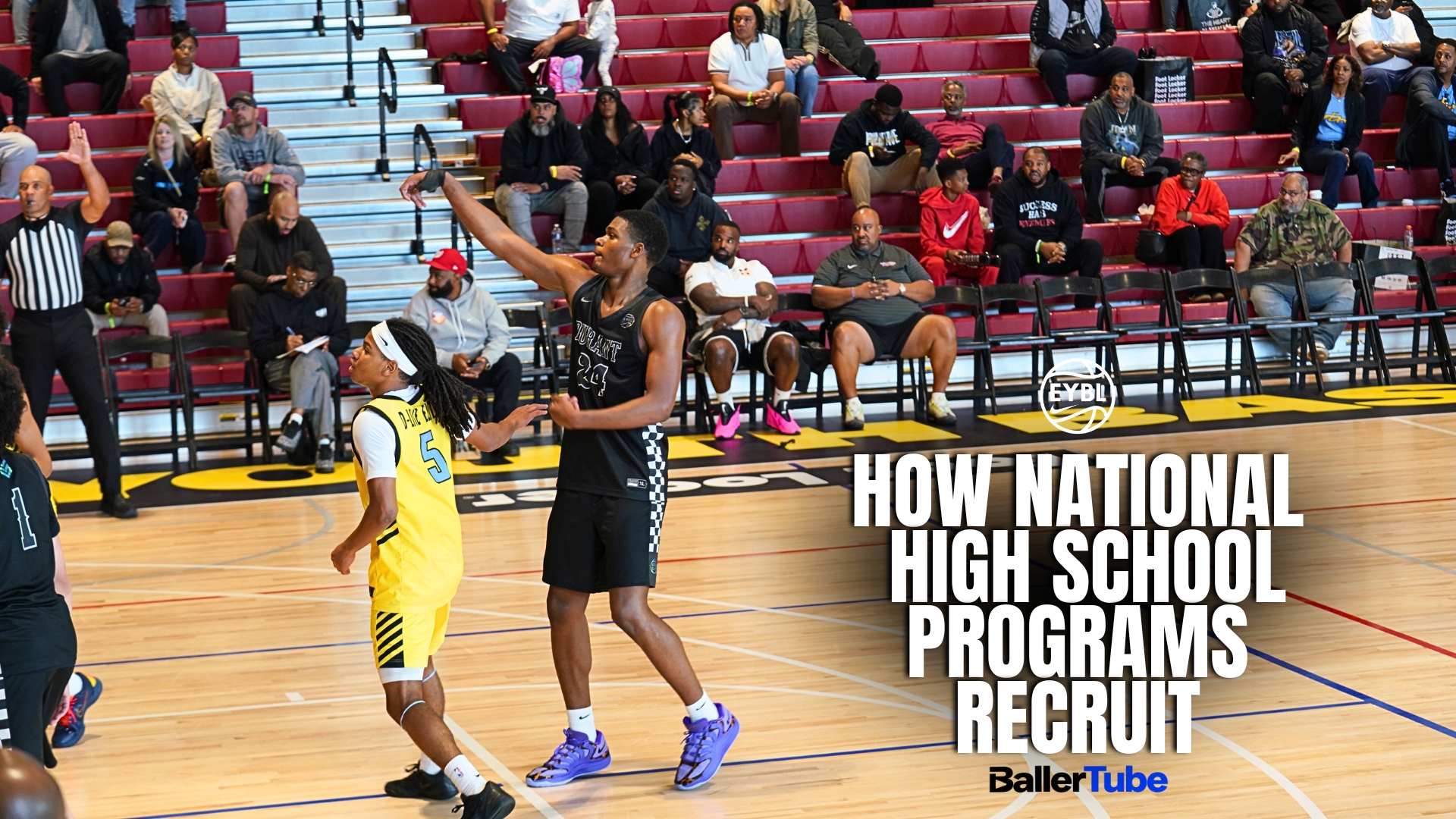
When basketball families hear the words “live period,” the conversation usually centers on college recruiting. College coaches line the baselines, prospects compete for scholarship opportunities, and grassroots programs spend months preparing their players for those few important weekends.
But college coaches aren't the only ones evaluating talent.
Across the country, national high school programs, prep schools and basketball academies are working the same gyms, watching the same circuits and identifying players who could eventually become part of their own programs. In many cases, the spring and summer grassroots season has become an important recruiting period for the next level of high school basketball itself.
For programs attempting to compete nationally, roster construction doesn't begin when the school season starts. Much of the work is being done months earlier.
The Grassroots Circuit Has Become a High School Recruiting Ground
Today's elite basketball ecosystem is increasingly interconnected.
Players compete during the school season, transition into grassroots basketball during the spring and summer, attend camps and showcases, and then return to school basketball. Throughout that process, coaches, trainers, scouts, media outlets and program directors are constantly exchanging information.
National high school programs are part of that network.
A coach can spend a weekend watching dozens of prospects at one event. Instead of relying entirely on highlight clips or recommendations, that coach can evaluate players against high-level competition and begin identifying athletes who could fit a future roster.
That makes the grassroots circuit valuable for reasons extending beyond NCAA exposure.
A seventh-, eighth-, ninth- or tenth-grade player may be years away from making a college decision, but his or her performance can still generate recruiting interest. That interest may come from a national high school program searching for another guard, wing or post player for the following season.
The recruiting process has effectively moved downstream.
What National Programs Are Actually Evaluating
Statistics matter, but evaluating a player in person provides considerably more information than a box score.
Coaches can see how a prospect responds when the game becomes physical. They can evaluate defensive effort, communication, decision-making and how the player operates when the ball isn't in their hands.
They can also see something highlights rarely capture: role acceptance.
A player averaging 20 points locally might enter a national event and suddenly be surrounded by several other high-level prospects. How that athlete adjusts can tell coaches a great deal about whether the player could succeed on a roster filled with talent.
Does the player defend when shots aren't falling? Can they make the extra pass? How do they respond to being substituted? Do they communicate with teammates? Can they contribute without dominating possession?
For programs assembling national schedules and competing against elite opponents, those details matter.
The Evaluation Doesn't End When the Game Does
Watching the player is only the beginning.
Once a national program becomes interested in a prospect, the due diligence can extend far beyond what happened during four quarters.
Coaches can communicate with grassroots directors, high school coaches and trainers who know the athlete. They may want to understand the player's work habits, academics, family situation, personality and long-term basketball goals.
Film becomes another part of the evaluation.
A coach who sees a player perform well during one weekend can go back and study additional games to determine whether that performance represents a consistent pattern or simply one strong outing.
That is why maintaining a deeper basketball profile is becoming increasingly important for young athletes.
One viral clip can generate attention. A collection of full games, highlights and performances across multiple seasons provides context.
Recruiting Is Happening Earlier
The growth of national high school basketball has changed when meaningful recruiting can begin.
Some athletes aren't simply deciding which grassroots team they will play for next summer. They may also be considering whether their current school environment provides the competition, development, exposure and opportunity they want.
National programs know this.
They are constantly evaluating which players could potentially become available, which prospects are emerging and which younger athletes should be followed over the next several seasons.
That doesn't mean every player competing on a circuit is looking to transfer. Far from it. But it does mean the basketball world surrounding those players is paying attention.
A strong summer can change how an athlete is viewed before the next school season ever begins.
Relationships Still Drive the Basketball World
Technology has made discovering players easier, but relationships remain central to recruiting.
Grassroots coaches know high school coaches. Trainers know program directors. National programs communicate with people throughout the basketball community, and information travels quickly when an emerging player begins performing well.
This is one reason playing against strong competition matters.
A prospect doesn't necessarily need to be the highest-ranked player in the gym. Sometimes one performance against a nationally recognized opponent is enough to make someone ask a simple question:
Who is that kid?
From there, the evaluation begins.
A coach may watch another game. Someone sends film. A grassroots director receives a phone call. The family eventually hears that a program has interest.
What looks like an opportunity that appeared overnight may actually be the result of weeks or months of evaluation behind the scenes.
The Live Period Has More Than One Audience
For young players and their families, understanding this ecosystem changes the way exposure should be viewed.
The coach standing on the baseline might represent a college program. Another person watching could be connected to a national high school program. Someone else might operate a grassroots organization, scouting service or basketball academy.
Each is evaluating talent for a different reason.
That means the value of a live-period performance isn't limited to receiving a scholarship offer that weekend.
For younger prospects especially, the immediate opportunity might come somewhere else first.
A high school opportunity can lead to a different competitive environment. That environment can create additional national exposure. More exposure can eventually create more college opportunities.
The development pipeline is connected.
Athlete Discovery Now Happens Year-Round
The modern basketball calendar rarely stops.
School basketball leads into grassroots basketball. Grassroots basketball leads into camps, showcases and elite events. Those events lead back into preseason workouts and another school season.
Evaluation continues throughout the entire cycle.
That is why the concept of an athlete's basketball profile is becoming bigger than traditional college recruiting.
Players aren't being discovered by only one audience at one specific age. They are being evaluated at different stages by high school programs, grassroots organizations, college staffs, trainers, scouts and media.
The live period remains one of the most important windows for college coaches to evaluate prospects in person.
It just isn't exclusively theirs anymore.
Behind the college staffs lining the courts is another layer of basketball recruiting taking place. National high school programs are identifying talent, building relationships, studying film and doing the groundwork necessary to construct future rosters.
For players, particularly younger prospects, that creates another reason every competitive environment matters.
The next opportunity generated by a live-period performance might not begin with a college scholarship.
It might begin with the high school program that eventually helps put that player in position to earn one.