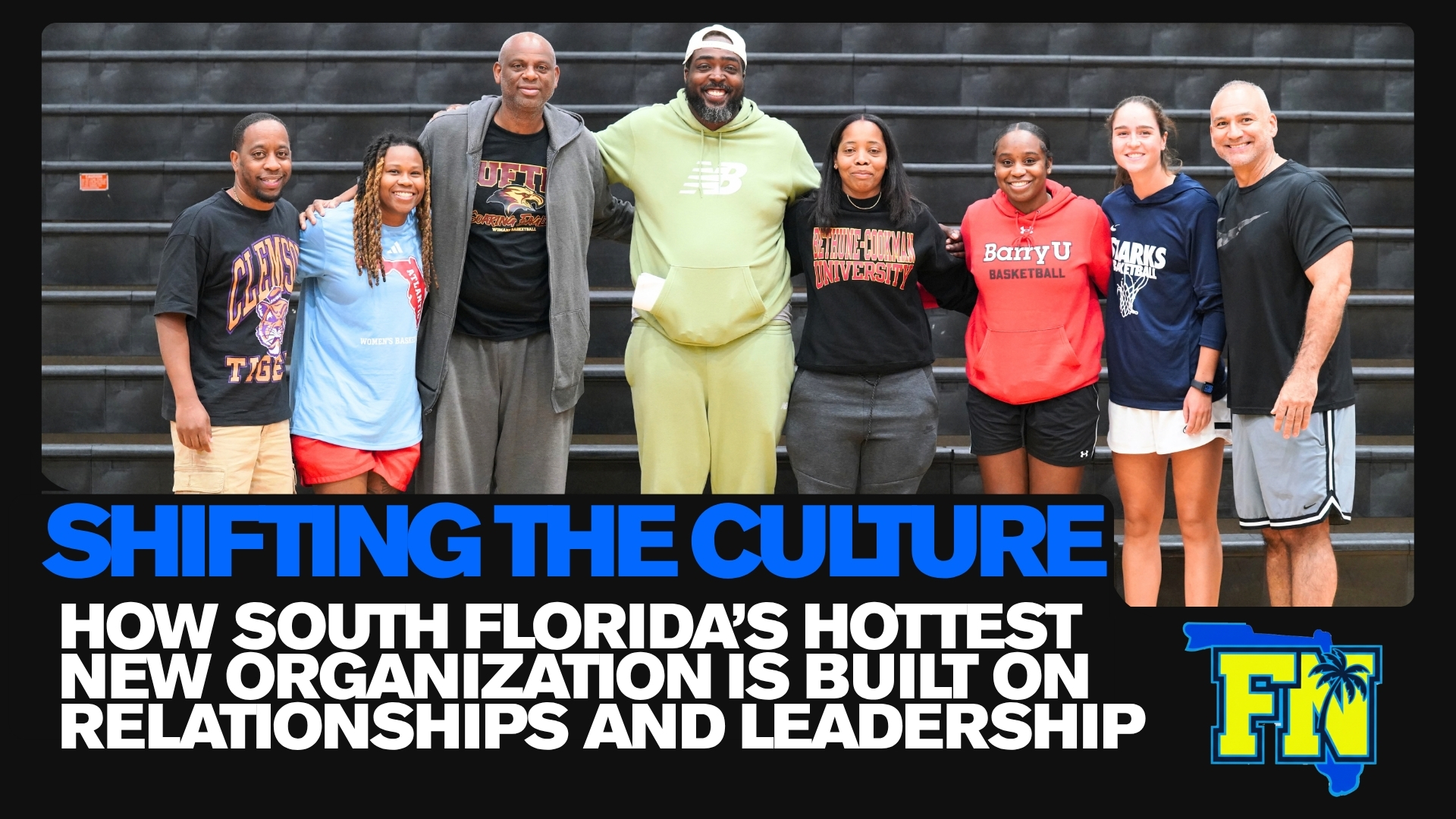
If you have paid attention to girls basketball in South Florida over the last decade, there are certain names you have heard over and over again, even if you never fully understood just how much influence existed behind them.
Two of those names are Carlyle “Coach Slim” Lewis and Greg Farias.
Lewis has spent years deeply connected to the development of South Florida basketball talent, including his work at Miami Country Day and within the Miami Suns organization. Farias has built a championship résumé of his own as the head coach at American Heritage.
Between them, the two coaches have been connected to more than 15 state championships.
That number speaks for itself.
But championships aren't really the story here.
The story is how you build something capable of lasting in an environment where new teams, trainers and programs appear every summer.
For Florida Nation, the answer comes down to one word:
Relationships.
Over the past year, Florida Nation has quickly become one of the most talked-about programs in South Florida girls basketball. One media outlet even referred to the program as a “Rookie of the Year.”
That's understandable if you're looking at the age of the organization.
But there is nothing rookie about the people behind it.
Florida Nation Was Built to Be National From Day One
There wasn't a transition from being a small local organization into becoming a national travel program.
Florida Nation entered the national basketball landscape immediately.
From its first season, the program competed on the New Balance LP32 circuit, placing its athletes into high-level competition and exposure from the beginning.
That's an important distinction.
Florida Nation didn't spend years building locally before receiving an opportunity to compete nationally. The relationships and résumés of the people behind the organization helped create a situation where a first-year program could begin its life on a national platform.
That is extremely difficult to replicate.
Anyone can create a logo, order uniforms and announce a new travel program. Building enough credibility for families, players, coaches and basketball organizations to believe in the vision before there is even a long organizational history is something completely different.
Florida Nation didn't have years of history attached to its name.
Its coaches did.
And that may be the most important part of understanding its rise.
You Can't Manufacture Trust
Elite travel basketball has become increasingly transactional.
Find the best players. Assemble a roster. Offer exposure. Win games. Promote the results. Then do it again the following summer.
There is nothing unusual about recruiting talented players. At the highest levels of grassroots basketball, everybody recruits.
But there is a major difference between recruiting talent and developing talent.
Coach Slim's relationships with South Florida families weren't created through recruiting graphics or promises about exposure. Many were built over years inside gyms, through workouts, practices, youth teams and player development.
Some began when the players were barely old enough to understand what travel basketball was.
That's different.
When you've watched a player develop from elementary school into a legitimate college prospect, the relationship between coach, athlete and family becomes deeper than a roster spot.
The family knows the coach.
The coach knows the player.
There is an understanding of strengths, weaknesses, personality, work habits and development that can't be duplicated during a recruiting conversation.
Exposure might get a family's attention. Development earns its trust.
And trust remains one of the most valuable currencies in grassroots basketball.
The Architect Matters
South Florida already has an established girls basketball ecosystem, and any conversation about that history has to acknowledge the Miami Suns.
For more than two decades, the Suns have been one of the defining programs in South Florida girls basketball, producing high-level players and competing nationally.
Coach Slim spent significant time within that ecosystem, particularly working with younger players and helping develop homegrown talent.
That part of his background matters.
Because grassroots basketball is supposed to begin at the roots.
Before rankings.
Before scholarship offers.
Before shoe circuits.
Before thousands of followers know a player's name.
There is somebody in a gym teaching that player how to use the correct foot around the basket. Somebody is rebuilding her jumper. Somebody is teaching her how to read a defense. Somebody is correcting the same mistake for the hundredth time.
Nobody posts those moments.
But those moments are where players are actually created.
You can recruit a finished product.
It is much harder to build one.
And when the person launching a program has spent years helping build players, families look at that new organization differently.
Relationships Are the Real Recruiting Advantage
There are plenty of coaches with relationships.
There are plenty of people in basketball who know someone important.
That isn't particularly unique.
What matters is the depth of those relationships.
For a first-year organization, Florida Nation's network stretches unusually far beyond South Florida because the people running the program didn't begin building those connections when Florida Nation was created.
They brought them with them.
Years spent coaching championship high school basketball, developing players, competing nationally and working within established grassroots environments create connections throughout the basketball ecosystem.
College coaches know which coaches consistently develop players.
They learn whose evaluations they trust.
They know who is going to tell them the truth about an athlete rather than simply sell them one.
That credibility compounds.
One player has a positive experience and her family tells another family.
One college coach trusts an evaluation and answers the next call.
One young player develops into a scholarship-level athlete and the next generation sees the blueprint.
Eventually, relationships become infrastructure.
That infrastructure is a major reason Florida Nation could begin nationally rather than having to spend years convincing people it belonged there.
Shoe Circuit vs. Independent Basketball
At the highest levels, travel basketball generally breaks into two broad categories: shoe-circuit programs and independent programs.
South Florida has strong examples of both.
Being attached to a shoe circuit doesn't automatically create a successful program. It provides opportunity, structure, competition and visibility.
What happens inside that structure still comes down to people.
Florida Nation entered the New Balance LP32 ecosystem from Year One, but the more interesting question isn't simply what circuit is printed on the schedule.
It's what the program does with that opportunity.
A national schedule means very little if players aren't getting better.
Exposure doesn't matter nearly as much if athletes aren't prepared when college coaches watch.
And having access to major events isn't enough if families don't trust the people guiding their daughters through them.
That's where Florida Nation's foundation becomes significant.
The national platform didn't create the relationships.
The relationships helped make the national platform possible.
Grassroots Should Actually Mean Grassroots
There is another part of this story that deserves attention.
Development requires patience.
Modern travel basketball doesn't always reward patience.
A highly ranked player becomes available and suddenly everybody wants her. A team struggles for a weekend and somebody starts looking for replacements. Programs can become obsessed with chasing the next recognizable name because recognizable names bring rankings, attention and publicity.
Sometimes it works.
But that's not necessarily grassroots basketball.
Grassroots basketball should mean identifying young players, teaching them, allowing them to struggle, correcting them and watching them grow.
It should mean remembering the kid before everybody knew the kid.
And when somebody with a bigger ranking suddenly becomes available, it should mean understanding that development and loyalty have value too.
That is where relationships become more than a recruiting tool.
They become culture.
Coach Slim's reputation for working with players from extremely young ages creates something difficult for another program to reproduce overnight.
Families have seen the process.
They know what happens inside the gym.
They have watched other players go through it.
The work becomes the recruiting pitch.
Florida Nation Isn't Trying to Create Roots. It Already Has Them.
This is what makes the “Rookie of the Year” description both appropriate and slightly misleading.
Florida Nation is young.
Its foundation isn't.
Coach Slim and Greg Farias didn't suddenly become connected to South Florida basketball when Florida Nation launched. They arrived with years of coaching, development, championships and relationships already behind them.
Then they placed those relationships inside a program that was built to compete nationally immediately.
That's why the trajectory feels different from the typical first-year travel organization.
Florida Nation wasn't created and then forced to figure out how to establish credibility.
Credibility was one of the assets used to create Florida Nation.
And now the organization has an opportunity to turn that credibility into something much larger.
You Can't Recruit Over a Foundation
There will always be another highly ranked player.
There will always be another program offering something.
There will always be another team promising exposure.
That's travel basketball.
But the strongest programs eventually reach a point where their identity becomes bigger than recruiting.
Players grow up inside them.
Younger athletes watch older athletes.
Families recruit other families without realizing they're recruiting.
Former players come back.
College coaches know where to look.
The program develops its own pipeline.
That is when grassroots basketball becomes sustainable.
And that's the opportunity sitting in front of Florida Nation.
Not simply to collect some of South Florida's best talent, but to develop its own generation of it.
Because if you're constantly standing in the gym, teaching, developing and correcting, eventually something happens that can't be duplicated through recruiting alone:
People remember who was there before everybody else came calling.
This Isn't a One-Summer Story
Florida Nation still has plenty to prove.
One year doesn't erase decades of history built by established South Florida programs, nor should it.
But pretending Florida Nation is simply another new travel organization misses what is actually happening.
The organization may be young.
The network behind it is mature.
The coaching experience is established.
The relationships are established.
The national platform was there from Day One.
And now the program has the opportunity to connect all of those pieces.
As Florida Nation grows, there will naturally be more attention on wins, rankings, offers, championships and recruiting.
Those things matter.
But they are outcomes.
The foundation is simpler.
It is Coach Slim standing in a gym correcting a player he's known since she was little.
It is Greg Farias carrying championship experience into another generation of athletes.
It is a family trusting the same people with the next stage of their daughter's basketball journey.
It is a college coach answering the phone because the relationship existed long before Florida Nation did.
You can't manufacture that overnight.
You can't buy it with uniforms.
You can't replace it with a ranking.
And you can't recreate years of trust with one recruiting pitch.
So if Florida Nation ultimately becomes one of the defining programs in South Florida girls basketball, people may look back and search for the moment everything changed.
There probably won't be one.
Because Florida Nation's story didn't begin when its first team stepped onto a national circuit.
It began years earlier, one player, one family, one gym and one relationship at a time.