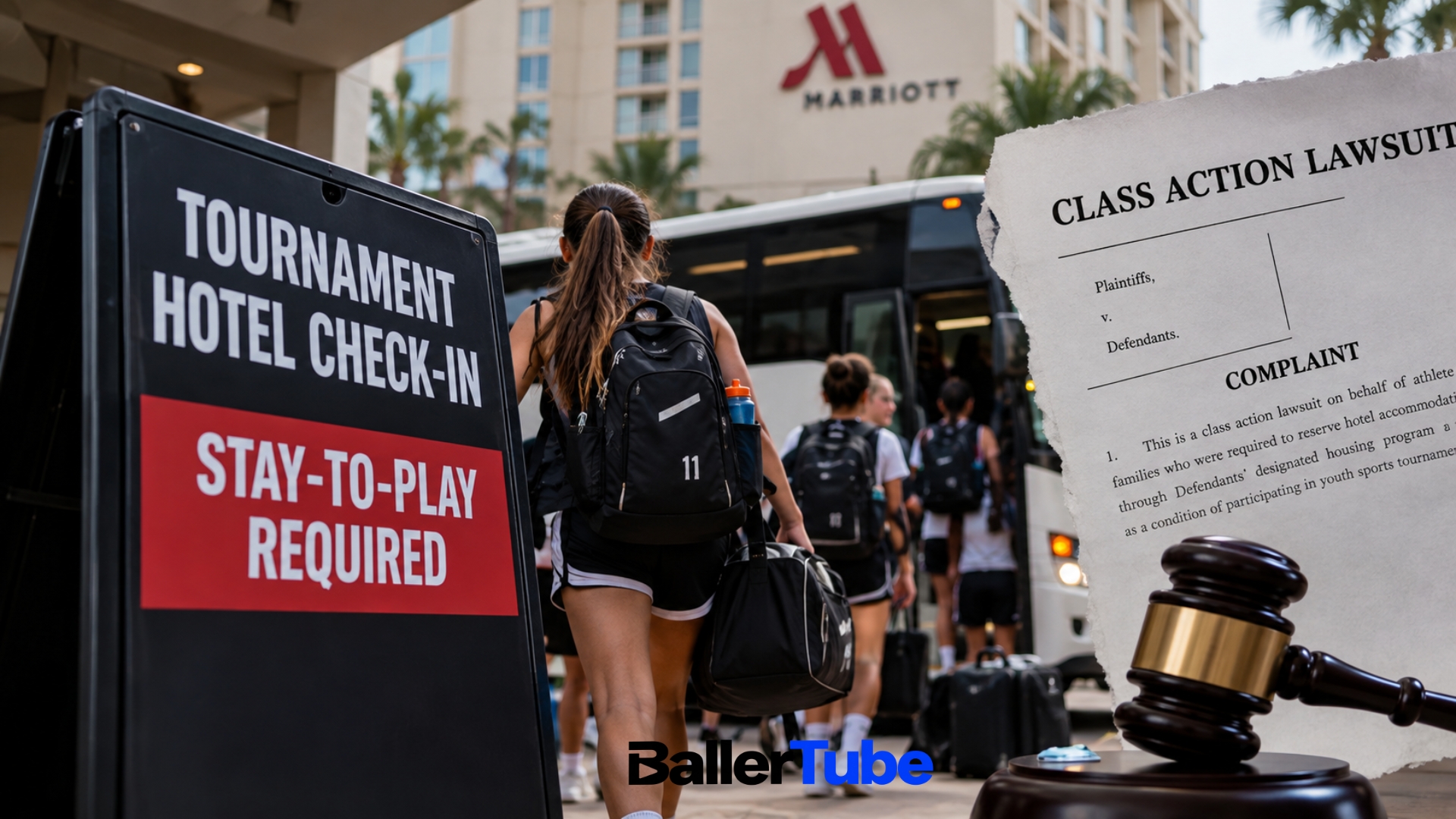
For years, stay-to-play has been treated as a normal part of travel sports. A team enters an out-of-town tournament, the organizer provides a list of approved hotels, and families are required to book through the tournament's designated housing system if their child wants to compete.
For parents already paying club dues, tournament fees, airfare, rental cars, meals and admission, the hotel requirement has often been viewed as simply another cost of playing competitive youth sports.
Now that business model is receiving considerably more scrutiny.
A series of federal lawsuits involving basketball, hockey, cheerleading and a major tournament-housing company are challenging different versions of stay-to-play. The cases don't all make identical legal claims, and allegations in pending lawsuits have not been proven. But collectively, they raise a larger question for the rapidly commercializing youth sports industry:
Should participation in a youth sporting event give the organizer the power to control where a family sleeps and how that room is purchased?
The USJN Basketball Case
Girls basketball became part of the fight in February 2025 when parent Patricia Martinez filed a proposed class action against U.S. Junior Nationals, commonly known as USJN, in federal court in Pennsylvania.
Martinez alleged that USJN's stay-to-play policy required families participating in its elite girls basketball tournaments to use selected lodging providers and its designated booking system. According to the amended complaint, families allegedly could not simply book the same hotel independently, use certain discounts or loyalty points, or choose another property.
The lawsuit attempted to characterize the arrangement as an unlawful "tying" arrangement under federal antitrust law, essentially arguing that access to one product, the basketball tournament, was conditioned on purchasing another product, lodging, through the required system.
But USJN scored an important victory in August 2026.
U.S. District Judge Mary Kay Costello dismissed the amended complaint, finding that the plaintiff had not adequately alleged several elements necessary to support the antitrust claims, including sufficient facts establishing USJN's power in the relevant tournament market. Importantly, however, the dismissal was with leave to amend, meaning the plaintiff was given an opportunity to try again with more specific allegations.
The court did not rule that stay-to-play itself is universally lawful. Instead, it found that this particular complaint had not sufficiently pleaded its claims.
That distinction matters.
Team Travel Source Faces a Much Broader Challenge
Another federal case could have implications far beyond a single tournament operator.
In May 2026, parents sued The Complete Plan Inc., which operates as Team Travel Source, in the U.S. District Court for the Western District of Kentucky. Team Travel Source is a major housing provider serving tournaments across multiple youth sports.
The lawsuit alleges that parents were told they had to reserve rooms through Team Travel Source for their children to participate, while also alleging mandatory housing fees, rates higher than families could find elsewhere and problems surrounding the company's advertised lowest-rate guarantee.
The plaintiffs are seeking class-action status. Team Travel Source disputes the allegations.
The scale of the company makes this case particularly significant. Buying Sandlot reported that Team Travel Source says it books more than 1.4 million hotel room nights annually and paid more than $17 million in rebates to tournament operators in 2025.
Those figures help explain why hotel booking has become such an important part of the economics surrounding large travel tournaments.
Stay-to-play isn't necessarily just about securing enough rooms for thousands of visiting athletes anymore. Hotel inventory can itself become a revenue-generating component of an event.
And that is exactly where the legal debate becomes more complicated.
Youth Hockey Is Now in the Fight
The newest major federal case arrived September 1, 2026.
Four youth hockey parents filed a proposed class action against Black Bear Sports Group in Delaware federal court, challenging stay-to-play policies connected with tournaments operated through brands including Defender Hockey Tournaments, Tier 1 Hockey Federation and the National Girls Hockey League.
The parents allege that families were told there were no exceptions to the housing requirement while certain exceptions or buyout options allegedly existed. They also claim mandatory fees and inflated hotel rates increased their costs.
Black Bear has strongly denied the allegations. An attorney representing the company said its policies and hotel rebates are disclosed and called the accusations meritless.
Again, that case is at an early stage. No court has determined that Black Bear violated the law.
But its arrival means stay-to-play litigation is no longer confined to one sport or one business model.
Cheerleading Already Produced an $82.5 Million Settlement
There is also an earlier case youth sports operators cannot ignore.
In litigation against Varsity Brands and related defendants, cheer families alleged a much broader collection of anticompetitive practices involving competitions, camps, apparel and lodging.
The defendants ultimately agreed to an $82.5 million settlement, without admitting wrongdoing. A federal judge granted final approval in December 2024.
The settlement also included changes to Varsity's business practices.
Among them, for five years Varsity agreed that at least 35% of its cheer competitions would not require participants to stay at Varsity-approved accommodations as a condition of competing.
That doesn't establish that every stay-to-play policy violates antitrust law. But it demonstrates that mandatory lodging can become part of significant federal competition litigation.
Why Tournament Operators Use Stay-to-Play
There is another side to the argument.
Large tournaments can bring hundreds of teams into a city simultaneously. Organizers need enough hotel inventory, and room blocks can help prevent families from discovering that every nearby hotel is sold out shortly before an event.
Guaranteed room nights can also help organizers negotiate with destinations, hotels and convention bureaus. Cities want to know whether an event will generate meaningful tourism spending before committing facilities or resources.
Housing systems can centralize reservations for thousands of travelers instead of leaving each team to independently navigate a crowded hotel market.
The legal issue therefore isn't necessarily whether tournament organizers can arrange hotel blocks.
The increasingly important question is how much control they can exercise over families and how clearly the financial relationships, fees and alternatives are disclosed.
There is a substantial difference between:
"Here are discounted hotel blocks available to participating teams."
and:
"Book through this company at this property and rate or your child cannot compete."
That distinction is becoming one of the biggest consumer issues in travel sports.
The Bigger Issue Is the Cost of Youth Sports
Stay-to-play is also colliding with a much broader debate about what competitive youth sports has become.
The industry is now estimated at roughly $40 billion, while families can face club dues, uniforms, tournament entry, admission, streaming subscriptions, recruiting services, private training and extensive travel costs.
Hotel rooms represent another opportunity to monetize that ecosystem.
That has attracted attention beyond private lawsuits. A congressional subcommittee held a June 2026 hearing examining private equity and the commercialization of youth sports. Stay-to-play requirements, mandatory add-on costs and vertically integrated sports businesses were specifically among the practices discussed.
Federal lawmakers have also introduced legislation aimed at restricting stay-to-play requirements and other practices in youth sports. Those proposals remain legislation, not current federal law, and their future is uncertain.
What Happens Next Could Matter Across Travel Sports
The federal cases are at very different stages.
Varsity settled its litigation without admitting wrongdoing. The USJN complaint was dismissed with permission to amend. The Team Travel Source case remains an active challenge to a major housing provider, while the Black Bear litigation has only recently begun.
So there has not been one sweeping federal decision declaring stay-to-play illegal.
But something has clearly changed.
Parents are challenging the practice. Lawyers are testing different consumer-protection and antitrust theories. Federal lawmakers are discussing it. And tournament operators are increasingly being asked to explain why controlling hotel reservations should be part of controlling access to youth competition.
Travel sports are expensive by nature. Elite teams travel. Facilities cost money. Events need staff, officials and infrastructure, and tournament companies are businesses entitled to generate revenue.
The emerging debate is about where that revenue should come from and how much choice families should surrender simply because their child wants to play.
For years, stay-to-play operated largely in the background of youth sports.
With multiple federal lawsuits now putting the model directly in front of judges, it may not stay there much longer.