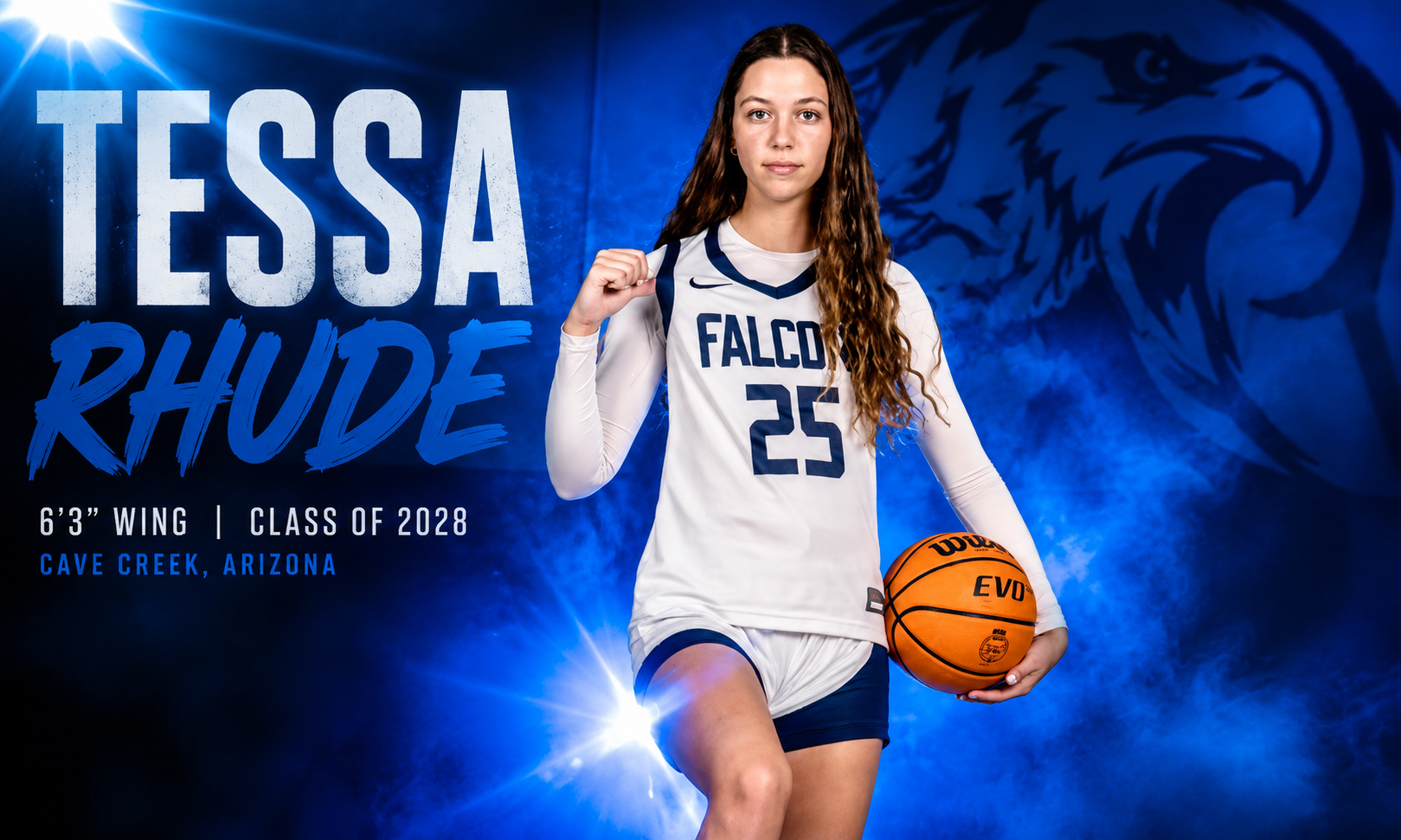
In basketball, certain players immediately stand out because of their size, athletic ability, or the way they carry themselves on the court. For young prospects, however, standing out is only the beginning. The real challenge is continuing to develop, gaining experience, and learning how to turn potential into consistent production.
For Tessa Rhude, that development process is already underway.
The 6-foot-3 wing from Cave Creek, Arizona, is a member of the 2028 class and is continuing to build her basketball résumé through both high school and club basketball. Her profile lists her as a wing, while her club experience includes Utah Lady Prospects 16U 3SSB and exposure to the Adidas 3SSB Circuit.
At her size, Rhude brings an intriguing combination of length and versatility to the wing position. A 6-foot-3 player who can operate on the perimeter naturally creates matchup questions for opposing teams. That type of physical profile gives a player opportunities to impact the game in different ways as her skills continue to develop.
But for Rhude, the journey is about more than simply being a tall guard or wing.
It is about continuing to become a complete basketball player.
Building Experience Through Competition
One of the most important parts of a young basketball player’s development is gaining experience against different levels of competition.
Club basketball provides an opportunity for players to compete outside of their normal high school environment. Players see different opponents, different styles, different coaching approaches, and different teammates. Those experiences can challenge a player to adjust quickly.
For Rhude, playing with Utah Lady Prospects and competing in the Adidas 3SSB environment provides another avenue to continue developing her game.
The exposure to high-level club basketball can be valuable because players are often competing against other athletes who have similar goals. Everyone is trying to improve, earn opportunities, and establish themselves as prospects within their respective classes.
That environment can teach a young player plenty.
There are moments when a player has to defend someone faster. There are moments when she has to handle pressure. There are games where shots aren’t falling and she has to find another way to contribute. There are also moments when confidence grows because a player realizes she belongs on the floor with talented competition.
Those experiences can become part of a player’s long-term development.
For Rhude, the opportunity to continue competing and learning at this stage of her career is an important part of her basketball story.
A Size Advantage on the Wing
At 6-foot-3, Rhude has a physical profile that immediately gets attention.
Size on the perimeter can be extremely valuable in the modern women’s game. Wings who possess length can create advantages on both ends of the floor. They can potentially see over smaller defenders, contest shots, rebound from the perimeter, and make life difficult for opponents defensively.
The key, however, is learning how to maximize that size.
Being tall is one thing.
Knowing how to use that height effectively is another.
For a young wing, development can involve becoming more comfortable handling the basketball, making decisions under pressure, improving footwork, becoming a stronger perimeter defender, and learning how to play with and without the ball.
Those are the details that can eventually separate a promising prospect from a player who becomes a consistent impact performer.
Rhude is still early in her high school career, which means there is plenty of time for her game to evolve.
That is one of the most exciting aspects of following a player in the 2028 class.
There is no finished product yet.
There is room to grow.
The Importance of Position Versatility
The wing position has become one of the most important areas on a basketball roster.
Teams want players who can do multiple things.
A wing doesn’t necessarily have to be the primary ball handler or the team’s biggest post player. Instead, the best wings often become valuable because they can fill different roles depending on what their team needs.
For a player like Rhude, continued development at the wing position could allow her to become increasingly versatile.
That could mean becoming comfortable attacking closeouts, making the extra pass, defending multiple positions, rebounding from the perimeter, and knocking down open shots when opportunities come.
The ability to make the right decision can sometimes be more important than making the spectacular play.
As players move through high school and eventually toward the next level, coaches look for athletes who understand the game and can contribute within a team structure.
Rhude’s continued development will be something to watch as she gains more experience.
Learning From Every Game
Basketball development isn’t always obvious.
Sometimes growth comes through statistics or highlight plays.
Other times, it comes through smaller improvements that may not show up in a box score.
A player might become better at communicating defensively. She might learn how to move without the basketball. She might become more comfortable making a decision with a defender closing out. She might improve her ability to stay composed after making a mistake.
Those details matter.
For young players, every game can provide another lesson.
The goal isn’t necessarily to have everything figured out at 14, 15, or 16 years old. The goal is to continue building.
Rhude’s position within the 2028 class gives her time to do exactly that.
She can continue developing physically, expanding her offensive game, becoming more consistent defensively, and learning what type of player she wants to become.
The process is often just as important as the destination.
Playing With Confidence
Confidence is another major part of player development.
For a young wing, confidence can change the way she plays.
A confident player is more willing to attack the basket, make the extra pass, defend aggressively, and take open shots without hesitation. Confidence doesn’t mean forcing the game. It means trusting the work that has been put in during practice.
As Rhude continues to compete at the club and high school levels, gaining that confidence will be important.
The more situations she experiences, the more comfortable she can become.
She will encounter different defenders.
She will face different offensive schemes.
She will play against teams that challenge her physically.
She will have games where things go exactly as planned and games where they don’t.
All of those experiences can contribute to growth.
The Arizona Basketball Connection
Cave Creek, Arizona, is where Rhude’s basketball journey is developing.
Arizona has a strong basketball community, and playing in that environment gives young athletes opportunities to compete, develop relationships, and continue building their basketball identities.
For Rhude, being part of the Arizona basketball scene while also gaining experience through club basketball creates a balance between representing her local program and testing herself in broader competition.
That combination can be valuable for a young prospect.
High school basketball provides the daily team environment and the importance of building chemistry with teammates. Club basketball can provide another level of competition and different challenges.
Learning how to adjust between those environments is part of becoming a more mature player.
Looking Ahead
There is still a long way to go in Rhude’s basketball journey.
That is what makes the 2028 class so interesting.
Players at this stage are still developing their identities. Some will grow several inches. Some will completely reshape their games. Others will discover strengths they didn’t know they had.
For Rhude, the next few years can be about continuing to put pieces together.
Her 6-foot-3 frame gives her a foundation.
Her experience at the club level gives her additional competition.
Her wing position gives her an opportunity to develop into a versatile player.
The next step is continuing to add skills and consistency to that foundation.
Development doesn’t happen overnight.
It happens through practices, games, workouts, mistakes, conversations with coaches, competition against talented players, and the willingness to keep improving.
For young athletes, that mindset can be one of the most important parts of the journey.
More Than a Recruiting Profile
It can be easy to look at a recruiting profile and focus only on a player’s height, class, club team, or exposure circuit.
But every prospect is more than those numbers and labels.
Behind the profile is a young athlete putting in the work and trying to figure out how far basketball can take her.
For Rhude, the story is still being written.
She is a 2028 prospect with a 6-foot-3 frame, wing versatility, and experience competing through Utah Lady Prospects and the Adidas 3SSB Circuit.
Those are pieces of the foundation.
What comes next will be determined by continued development, opportunities, preparation, and how she responds to every new challenge.
The road from a young prospect to a college basketball player is rarely a straight line. There are ups and downs along the way. The players who continue learning through both are often the ones who give themselves the best opportunity to reach their goals.
Rhude has time on her side.
And time, combined with consistent development, can be powerful.
As she continues her high school and club basketball journey, the focus should remain on growth—adding skills, becoming more versatile, competing against better players, and learning how to impact games in different ways.
At 6-foot-3, she already has a physical foundation that can make her an intriguing wing prospect.
Now comes the fun part.
Building the player.
Building the confidence.
Building the résumé.
And ultimately, building the basketball career that is still ahead of her.